
⚡ Quick Answer: Most car accident settlements in California take between 3 months and 18 months. Simple cases with minor injuries and a cooperative insurance company can settle in 30–90 days. Serious injury cases, disputed liability, or lawsuits can take 1–3 years. The single biggest factor is whether you’ve reached Maximum Medical Improvement (MMI).
If you were recently injured in a car accident in California, you are probably wondering: when will I actually receive my settlement money? It is one of the most common questions accident victims ask — and the honest answer is that it depends on several factors specific to your case.
The good news is that the majority of car accident claims in California settle without going to trial. According to data from the California Courts, over 95% of personal injury cases settle before a verdict. The challenge is that “settling” can mean anywhere from a few weeks to several years, depending on your injuries, the insurance company involved, and whether liability is disputed.
This guide walks you through the complete California car accident settlement timeline — from the day of the crash to the day you receive your check — so you know exactly what to expect at each stage.
📑 Table of Contents
- The Short Answer: How Long Does It Usually Take?
- Stage-by-Stage Settlement Timeline in California
- Key Factors That Affect Your Settlement Timeline
- California Car Accident Settlement Timeline by Injury Type
- What Is Maximum Medical Improvement (MMI) and Why It Matters
- How Long Do Insurance Companies Have to Settle in California?
- When Does a Car Accident Case Go to Trial in California?
- How to Speed Up Your Car Accident Settlement
- What Happens After You Accept a Settlement?
- Frequently Asked Questions (FAQ)
1. The Short Answer: How Long Does It Usually Take?
Here is a straightforward breakdown of typical California car accident settlement timelines based on case complexity:
| Case Type | Typical Timeline | Common Scenarios |
| Minor / Soft Tissue Injuries | 1 – 3 months | Whiplash, bruising, minor cuts — cooperative insurer |
| Moderate Injuries | 3 – 9 months | Broken bones, soft tissue damage, short hospitalization |
| Serious Injuries | 9 – 18 months | Spinal injuries, surgery required, long recovery |
| Catastrophic Injuries / Lawsuit Filed | 1 – 3+ years | Traumatic brain injury, paralysis, disputed liability |
| Wrongful Death | 1 – 3+ years | Complex damages, multiple parties, emotional disputes |
📌 Important: These are estimates. Your specific case timeline will depend on factors covered in Section 3. Do not accept any settlement offer until you have reached Maximum Medical Improvement (MMI) — explained in Section 5.
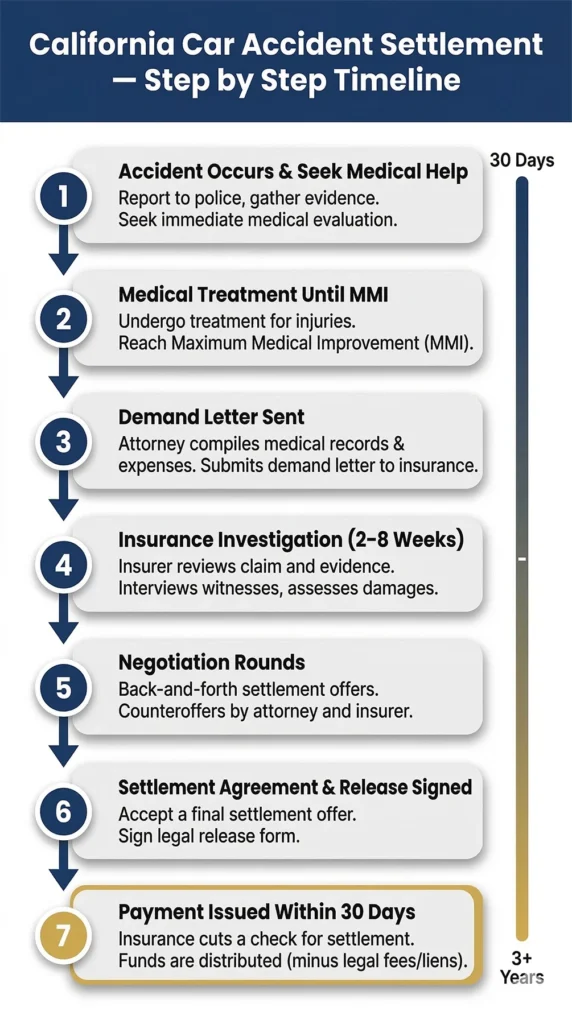
2. Stage-by-Stage Settlement Timeline in California
Understanding each stage of the claims process helps you know exactly where your case stands and what comes next. Here is the full timeline from accident to payment:
Stage 1: Immediately After the Accident (Day 1–7)
The clock starts on the day of your accident. In the first week, you should:
- Seek medical attention immediately — even if you feel fine. Injuries like whiplash and internal bleeding often show symptoms days later.
- File a police report at the scene or within 24 hours.
- Report the accident to your own insurance company — California law requires you to notify your insurer promptly.
- Gather evidence: photos of vehicles, road conditions, injuries, and contact info of witnesses.
- Do NOT give a recorded statement to the other driver’s insurance company without legal advice.
⚠️ California Law: If someone was injured or killed, or property damage exceeds $1,000, you must file a Report of Traffic Accident (SR-1) with the California DMV within 10 days.
Stage 2: Medical Treatment (Weeks 1 – Months 6+)
This is the most important — and often the longest — stage. You should continue all medical treatment until your doctor says you have reached Maximum Medical Improvement (MMI). This means your condition has stabilized and further recovery is unlikely.
Why does this matter for your settlement? Because once you accept a settlement, you cannot go back and ask for more money — even if your injuries worsen later. Settling before MMI is one of the most common and costly mistakes accident victims make.
Keep records of every medical visit, prescription, therapy session, and out-of-pocket expense. This documentation directly increases your settlement amount.
Stage 3: Demand Letter (1–3 Months After MMI)
Once you (or your attorney) have all medical records and bills, a formal demand letter is sent to the at-fault driver’s insurance company. The demand letter outlines:
- The facts of the accident and who was at fault
- Your injuries and medical treatment history
- All economic damages (medical bills, lost wages, property damage)
- Non-economic damages (pain and suffering, emotional distress)
- The total settlement amount being demanded
In California, insurance companies are required by law (California Insurance Code §790.03) to acknowledge receipt of the demand within 15 days and either accept, deny, or make a counteroffer within 40 days.
Stage 4: Insurance Company Investigation (2–8 Weeks)
After receiving the demand letter, the insurance adjuster will investigate the claim. This includes reviewing the police report, your medical records, photos of vehicle damage, and any witness statements. They may also conduct surveillance in high-value claims.
The adjuster will then return with one of three responses: acceptance of your demand, a counteroffer (most common), or a denial. A denial is rare in clear-liability cases and almost always leads to a lawsuit.
Stage 5: Negotiation (2–12 Weeks)
Negotiation is a back-and-forth process between you (or your attorney) and the insurance adjuster. Most cases require 2–5 rounds of negotiation. Insurance companies are trained to delay and minimize payouts — this is where having an attorney makes a measurable difference.
Studies consistently show that accident victims represented by attorneys receive settlements 3–4 times higher than those who negotiate alone, even after attorney fees.
Stage 6: Settlement Agreement & Release (1–2 Weeks)
Once both parties agree on an amount, you will be asked to sign a Release of All Claims document. This is a legally binding agreement that ends your right to pursue further compensation for this accident. Read it carefully before signing.
⚠️ Warning: Never sign a release under pressure. Once signed, you cannot pursue additional compensation even if your medical bills increase or your condition worsens.
Stage 7: Settlement Payment (2–6 Weeks After Signing)
After signing the release, California insurance companies typically issue payment within 30 days. The check is usually sent to your attorney (if you have one), who deducts their fee and any medical liens, then sends you the remaining balance.
| Stage | Who Is Responsible | Typical Duration |
| Accident & Medical Treatment | You + Your Doctors | Days to several months |
| Demand Letter Preparation | You or your attorney | 2–8 weeks after MMI |
| Insurance Investigation | Insurance adjuster | 2–8 weeks |
| Negotiation | Attorney + adjuster | 2–12 weeks |
| Signing & Release | You (and attorney) | 1–2 weeks |
| Payment Issued | Insurance company | Within 30 days of signing |
3. Key Factors That Affect Your Settlement Timeline
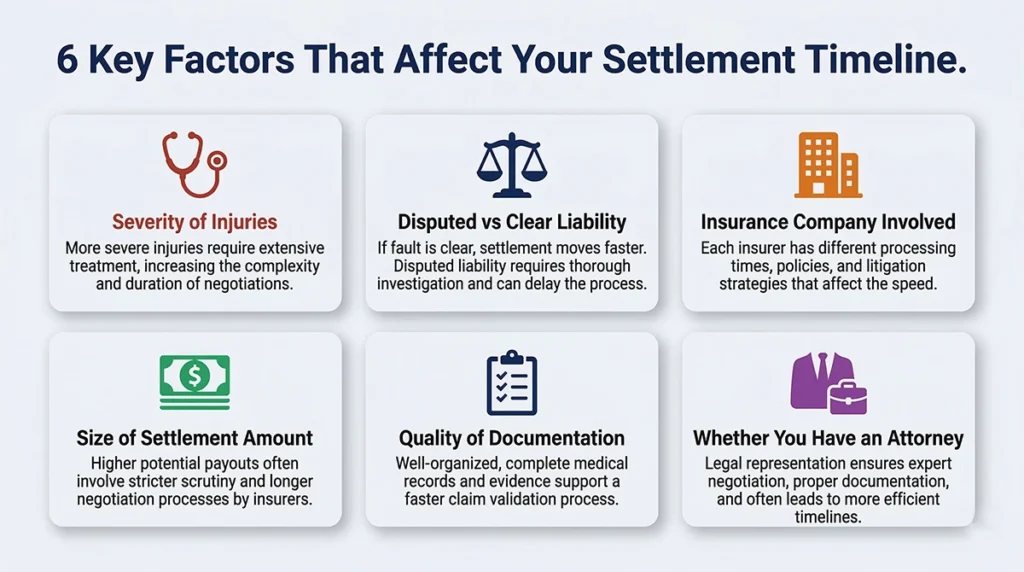
No two car accident cases are the same. These are the most significant factors that can shorten or lengthen your California settlement timeline:
🩺 Severity of Your Injuries
This is the single biggest factor. Minor soft tissue injuries may heal in 4–8 weeks, allowing for a quick settlement. Serious injuries requiring surgery, physical therapy, or long-term care can mean 12–24 months of treatment before MMI is reached — and you should not settle before then.
⚖️ Whether Liability Is Clear or Disputed
When fault is obvious — such as a rear-end collision or a driver running a red light — insurance companies settle faster. When liability is disputed (both parties blame each other, unclear witness accounts, or multiple vehicles involved), expect significant delays as each insurer investigates independently.
California follows a pure comparative negligence rule, meaning you can recover damages even if you were partially at fault. However, your compensation is reduced by your percentage of fault. If the insurer claims you were 30% at fault, expect lengthy negotiations over that percentage.
🏢 Which Insurance Company Is Involved
Not all insurance companies settle at the same speed. Some California insurers are known for fast, fair settlements. Others are notorious for delays, lowball offers, and bad faith tactics. Insurers involved in high-value claims are especially likely to stall.
💰 The Size of the Settlement Amount
The higher the claimed damages, the longer the insurance company will take to investigate and negotiate. A $5,000 soft tissue claim may settle in 30 days. A $500,000 spinal injury claim will involve multiple rounds of investigation and negotiation.
📋 How Organized Your Documentation Is
Cases with complete, well-organized documentation — medical records, bills, photos, witness statements, lost wage proof — settle faster than cases where documentation must be repeatedly requested. Keep a dedicated folder (physical and digital) from day one.
👨⚖️ Whether You Have an Attorney
Unrepresented claimants are routinely offered lower settlements and face longer delays, because insurance companies know most people will eventually accept a lowball offer out of financial desperation. Attorneys know the full value of a claim and are not in financial distress — which gives them negotiating power.
4. California Car Accident Settlement Timeline by Injury Type
| Injury Type | Est. Timeline | Average Settlement Range | Key Timing Factor |
| Whiplash / Soft Tissue | 1–4 months | $2,500 – $35,000 | Speed of medical recovery |
| Broken Bones / Fractures | 3–8 months | $15,000 – $150,000 | Surgical outcome + PT duration |
| Back & Neck Injuries | 6–18 months | $30,000 – $500,000+ | Whether surgery is needed |
| Traumatic Brain Injury (TBI) | 1–3+ years | $100,000 – $2,000,000+ | Long-term care assessment |
| Spinal Cord / Paralysis | 1–4 years | $500,000 – $5,000,000+ | Lifetime care cost calculation |
| Wrongful Death | 1–3+ years | $500,000 – $3,000,000+ | Multiple dependents / liability disputes |
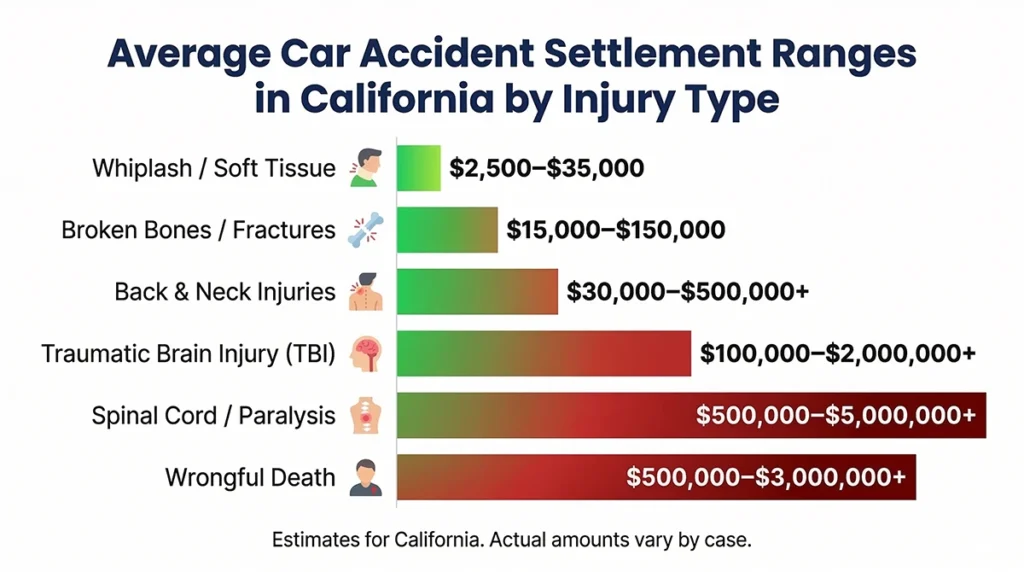
📌 Note: Settlement ranges above are estimates for California cases and include both economic and non-economic damages. Actual amounts vary significantly based on liability, insurance limits, and individual circumstances.
5. What Is Maximum Medical Improvement (MMI) and Why It Matters
Maximum Medical Improvement (MMI) is the point at which your doctor determines your injuries have healed as much as they are going to — or have stabilized to where no further improvement is expected with continued treatment.
MMI is one of the most important milestones in your California car accident settlement timeline. Here is why:
- Until you reach MMI, no one — not you, your attorney, or the insurance company — knows the full extent of your medical costs and future care needs.
- If you settle before MMI, you may discover your injuries are more serious or longer-lasting than expected — but it will be too late to seek additional compensation.
- The settlement should account for ALL future medical costs, not just what you have already spent.
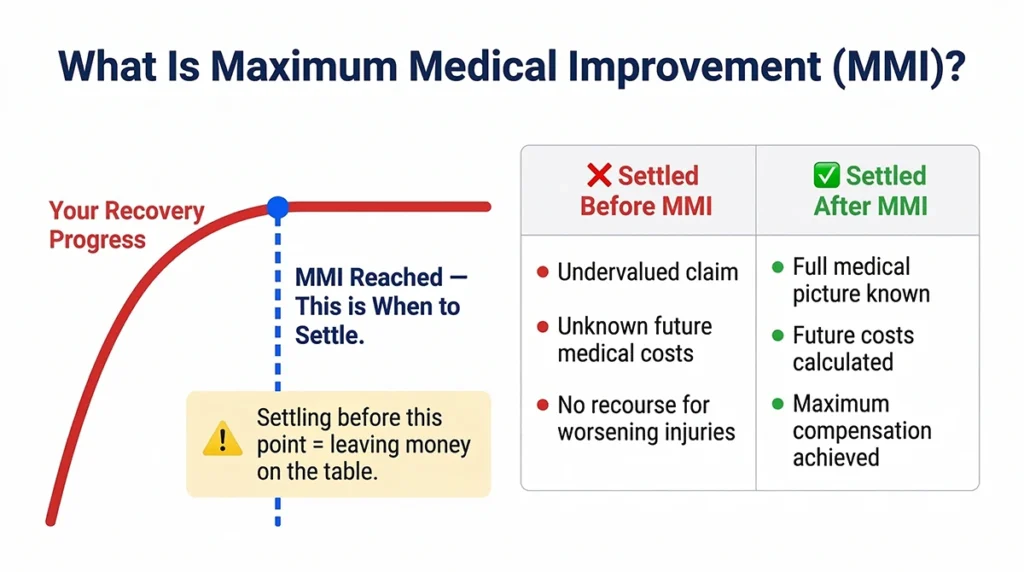
💡 Pro Tip: Never let financial pressure from mounting medical bills push you into settling before MMI. Many California personal injury attorneys work on contingency (no upfront fees) and can help cover medical expenses during treatment via medical liens.
6. How Long Do Insurance Companies Have to Settle in California?
California has strict laws — known as the Fair Claims Settlement Practices Act — that require insurance companies to handle claims within specific timeframes:
| Required Action | California Legal Deadline |
| Acknowledge receipt of claim | Within 15 days |
| Accept or deny claim (or explain why more time is needed) | Within 40 days of proof of claim |
| Issue payment after agreement is reached | Within 30 days of signed release |
| Maximum time to investigate (with written explanation) | Must notify claimant every 30 days |
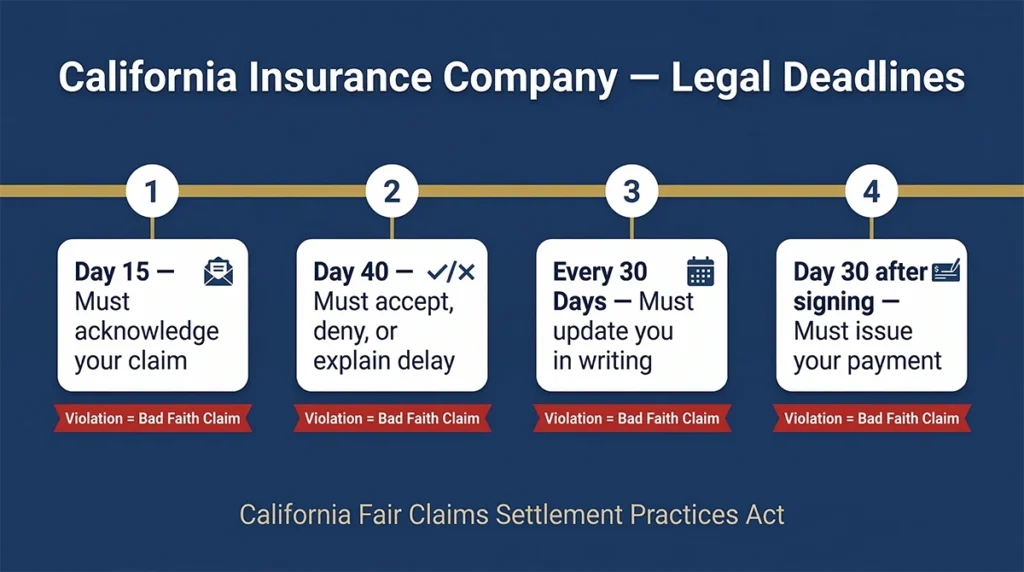
If an insurance company violates these deadlines, they may be guilty of insurance bad faith in California — which can entitle you to additional damages beyond the original claim. An experienced attorney can help you identify and pursue bad faith claims.
7. When Does a Car Accident Case Go to Trial in California?
Less than 5% of California car accident cases actually go to trial. A lawsuit is filed when:
- The insurance company denies the claim outright
- The insurer’s settlement offer is far below the actual value of your damages
- Liability is heavily disputed and cannot be resolved through negotiation
- The statute of limitations is approaching and you have not reached a settlement
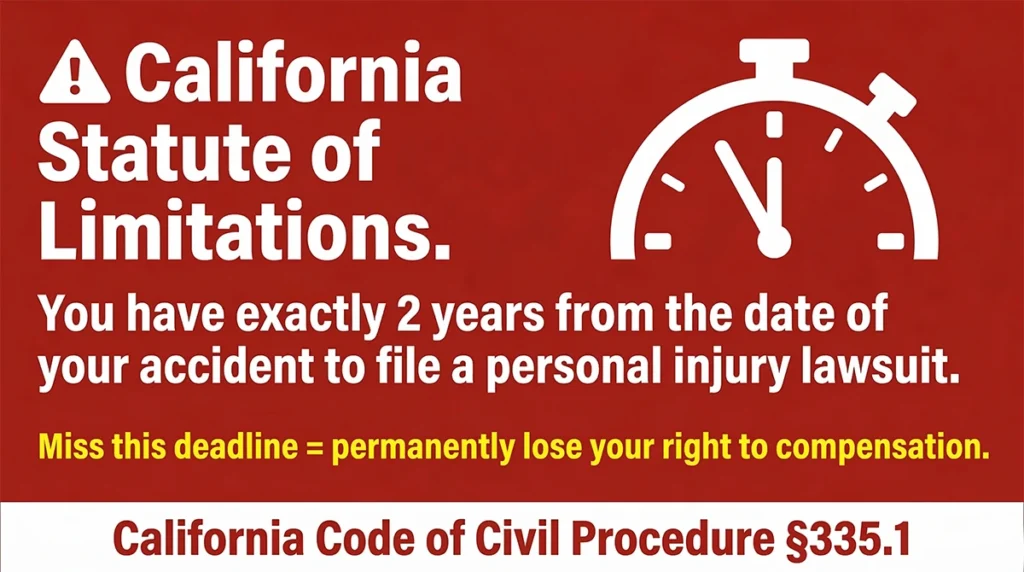
⚠️ California Statute of Limitations: You have 2 years from the date of the accident to file a personal injury lawsuit in California (Code of Civil Procedure §335.1). Miss this deadline and you permanently lose the right to sue — regardless of how strong your case is.
If a lawsuit is filed, the timeline extends significantly. Here is what the litigation timeline looks like in California:
- Filing a complaint and service of process: 1–3 months
- Discovery phase (depositions, document requests, expert witnesses): 6–18 months
- Mediation (required in most California courts): 1–3 months
- Trial: 1–4 weeks of actual courtroom time
- Total litigation timeline: 18 months – 4+ years
The majority of cases filed as lawsuits still settle before trial — often during the discovery or mediation phase — because both sides gain a clearer picture of the case’s value.
8. How to Speed Up Your Car Accident Settlement in California
While some delays are outside your control, there are concrete steps you can take to move your case forward as efficiently as possible:
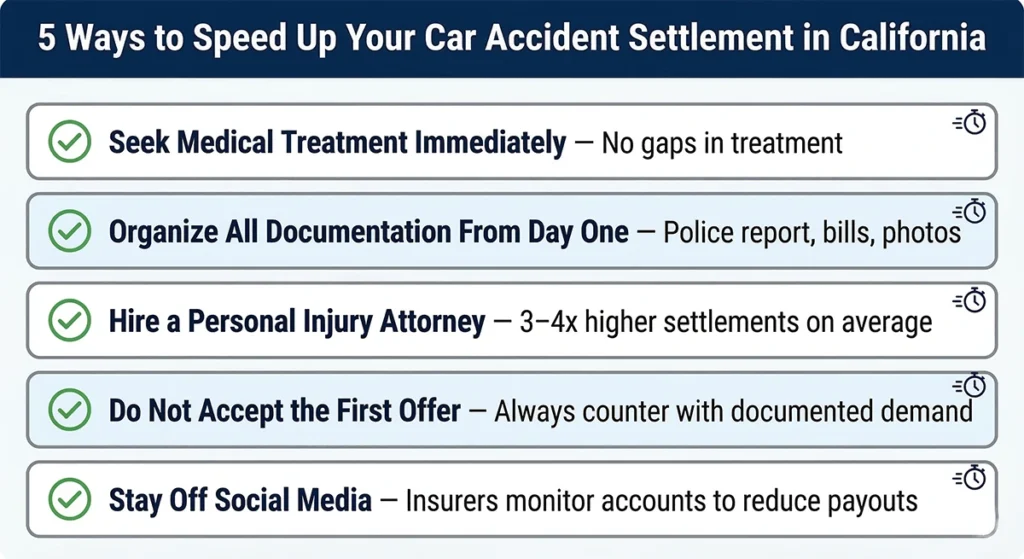
✅ Seek Medical Treatment Immediately — and Keep Going
Gaps in medical treatment are the #1 tool insurance companies use to reduce your settlement. If you skip appointments or stop treatment before MMI, the insurer will argue your injuries were not serious. Attend every appointment and follow your doctor’s orders completely.
✅ Organize All Documentation From Day One
Create a dedicated folder for: police report, all medical bills and records, photos of injuries and vehicle damage, receipts for all out-of-pocket expenses, and pay stubs proving lost wages. The faster you can provide complete documentation, the faster the insurer can evaluate your claim.
✅ Hire a Personal Injury Attorney
Attorneys who specialize in California car accident cases have established relationships with insurance adjusters, know the true value of claims, and can apply legal pressure that unrepresented claimants cannot. Most work on a contingency fee (typically 33%) — meaning you pay nothing unless you win.
✅ Do Not Accept the First Offer
The insurance company’s first offer is almost always a lowball figure — sometimes 10–20% of what your case is actually worth. Politely decline and counter with a well-documented demand. The back-and-forth is normal and expected.
✅ Avoid Social Media During Your Case
Insurance companies actively monitor claimants’ social media. A single photo of you at a party or hiking — even if taken before the accident — can be used to argue that your injuries are exaggerated. Keep your profiles private and avoid posting anything related to your health or activities.
9. What Happens After You Accept a Settlement?
Once both parties agree on a settlement amount, here is what happens next:
- You receive and review the Release of All Claims document — read this carefully, as it permanently ends your right to pursue further compensation.
- You sign the release and return it to the insurance company.
- The insurance company processes the payment — California law requires this within 30 days of receiving the signed release.
- If you have an attorney, the check is sent to their escrow account. They deduct their contingency fee (typically 33%) and pay any outstanding medical liens.
- You receive the remaining balance — your net settlement amount.
- Your attorney provides a final settlement statement showing all deductions.
💡 Tax Note: In most cases, California car accident settlements for personal injury are NOT taxable income under IRS rules. However, any portion of the settlement attributed to lost wages or punitive damages may be taxable. Consult a tax professional for your specific situation.
10. Frequently Asked Questions (FAQ)
The following questions are answered for Google’s People Also Ask feature and FAQ schema markup.
Q: How long does it take to receive a settlement check in California after signing?
A: After you sign the Release of All Claims, California insurance companies are required to issue payment within 30 days. In practice, most payments arrive within 2–4 weeks. Your attorney’s office will then process any deductions (fees, medical liens) and send you the remaining balance, typically within 7–14 days of receiving the check.
Q: Can a car accident settlement take more than 2 years in California?
A: Yes, it can — particularly for catastrophic injuries, disputed liability cases, or when a lawsuit is filed and goes through full litigation. However, be aware that California’s statute of limitations is 2 years from the date of the accident. If you are approaching this deadline without a settlement, an attorney should file a lawsuit to preserve your right to compensation, even if negotiations are still ongoing.
Q: What is a fair settlement for a car accident in California?
A: A fair settlement covers all economic damages (medical bills, lost wages, property damage, future medical costs) plus non-economic damages (pain and suffering, emotional distress). Pain and suffering is typically calculated using the ‘multiplier method’ — multiplying your total medical bills by 1.5x to 5x depending on injury severity. A minor whiplash case might settle for $10,000–$30,000, while a serious back injury case could be worth $100,000–$500,000+.
Q: Should I accept the insurance company’s first settlement offer?
A: Almost never. The first offer from an insurance company is typically a low figure designed to close the case quickly and cheaply. Studies consistently show that claimants who negotiate — especially those with legal representation — receive significantly higher settlements. Always counter with a well-documented demand based on your actual damages.
Q: Does hiring a lawyer slow down my car accident settlement in California?
A: No — in most cases, hiring a personal injury attorney actually speeds up the settlement process. Attorneys know how to organize documentation efficiently, communicate effectively with insurance adjusters, and apply legal pressure that accelerates timelines. While the negotiation may take slightly longer as the attorney builds the strongest possible case, the result is typically a significantly higher settlement.
Q: Can I still file a car accident claim if the accident was partly my fault in California?
A: Yes. California follows a pure comparative negligence rule, meaning you can recover compensation even if you were partially at fault. Your damages are simply reduced by your percentage of fault. For example, if you were found 20% at fault and your damages were $100,000, you would recover $80,000. There is no minimum fault threshold — even 99% at fault still allows for 1% recovery.
Q: What if the insurance company is taking too long to settle my claim?
A: If an insurance company is unreasonably delaying your claim without written explanation, they may be violating California’s Fair Claims Settlement Practices Act. Document all communications and contact an attorney. You may be entitled to file a bad faith insurance claim, which can result in additional damages above your original settlement amount.
Q: How does California’s 2-year statute of limitations affect my settlement timeline?
A: You have exactly 2 years from the date of your accident to file a personal injury lawsuit in California (Code of Civil Procedure §335.1). This deadline does not mean your case must be settled in 2 years — it means you must either have settled or have an active lawsuit filed before the 2-year mark. Missing this deadline permanently bars you from compensation, regardless of case strength.
The Bottom Line
How long a car accident settlement takes in California depends heavily on the severity of your injuries, whether liability is disputed, and how organized and aggressive you are in pursuing your claim. Most cases settle within 3–18 months, but serious injuries or lawsuits can extend this to 3+ years.
The most important rule: do not settle before you reach Maximum Medical Improvement. Accepting a fast settlement feels tempting when medical bills are piling up — but it almost always means leaving thousands of dollars on the table.
If the insurance company is offering less than your case is worth, stalling without explanation, or disputing clear liability — consulting a California personal injury attorney costs you nothing upfront and can dramatically change your outcome.
⚖️ Legal Disclaimer: The information on this page is for general informational purposes only and does not constitute legal advice. YourLegalAnswers.com is not a law firm and does not provide legal representation. Every car accident case is different — consult a licensed California personal injury attorney for advice specific to your situation.