⚡ Quick Answer: Original Medicare (Parts A and B) does NOT cover dental implants in 2026. Medicare considers dental implants a routine dental procedure, which is explicitly excluded from Original Medicare coverage. However, Medicare Advantage (Part C) plans — offered by private insurers — increasingly include dental benefits that may cover implants partially or fully. There are also 7 alternative pathways to get dental implants covered or significantly reduced in cost.
Dental implants are one of the most effective — and most expensive — dental procedures available. A single dental implant costs between $3,000 and $6,000 without insurance. For seniors on Medicare who are missing teeth, the cost of dental implants can feel completely out of reach.
The question “does Medicare cover dental implants” is one of the most searched Medicare questions in the United States — and the answer surprises many people. Original Medicare, the federal program most people picture when they hear “Medicare,” provides almost no dental coverage at all. But that is not the full story in 2026.
Medicare Advantage plans have rapidly expanded their dental benefits over the past several years. Some plans now offer meaningful implant coverage. New federal legislation has pushed for expanded Medicare dental benefits. And there are several practical alternatives that can dramatically reduce the out-of-pocket cost of dental implants for Medicare beneficiaries. This guide covers all of it.
📑 What This Guide Covers
- What Original Medicare Covers for Dental — The Hard Truth
- The 1 Narrow Exception: When Medicare Does Cover Dental Implants
- Medicare Advantage (Part C) and Dental Implants in 2026
- Medicare Supplement (Medigap) and Dental Coverage
- The 7 Ways to Get Dental Implants Covered or Reduced in Cost
- How Much Do Dental Implants Cost Without Medicare Coverage?
- Dental Implant Alternatives That Medicare May Cover
- How to Choose a Medicare Advantage Plan with Dental Coverage
- Frequently Asked Questions
1. What Original Medicare Covers for Dental — The Hard Truth
Original Medicare consists of two parts: Medicare Part A (hospital insurance) and Medicare Part B (medical insurance). Neither part covers routine dental care — and dental implants are firmly in the “routine dental” category that Medicare has excluded since the program’s creation in 1965.
| Medicare Part | What It Covers | Dental Implants Covered? |
| Part A (Hospital) | Inpatient hospital stays, skilled nursing, hospice, some home health care | ❌ No — not covered |
| Part B (Medical) | Doctor visits, outpatient care, preventive services, durable medical equipment | ❌ No — not covered |
| Part D (Drug) | Prescription medications | ❌ No — drugs only |
| Medicare Advantage (Part C) | Everything in Parts A and B, PLUS optional extras like dental, vision, hearing | ⚠️ Sometimes — depends on plan |
| Medigap (Supplement) | Pays Medicare cost-sharing gaps for Parts A and B covered services | ❌ No — only fills gaps for covered services |
The Social Security Act, which governs Medicare coverage, specifically excludes dental care. Under 42 U.S.C. §1395y(a)(12), Medicare does not cover dental procedures, equipment, or supplies used in connection with the care, treatment, filling, removal, or replacement of teeth — or structures directly supporting the teeth. This statutory exclusion is broad and has been interpreted to include dental implants since they replace teeth.
This exclusion was part of the original Medicare legislation in 1965 and has never been changed by Congress, despite ongoing advocacy from dental health organizations and patient groups who argue that oral health is inseparable from overall health — particularly for seniors.
2. The 1 Narrow Exception: When Medicare Does Cover Dental Implants
While Original Medicare excludes routine dental care including implants, there is one important narrow exception where Medicare Part A may cover some dental services — and in rare cases, this exception applies to dental implants:
Hospital Admission for Dental-Related Complications
Medicare Part A covers an inpatient hospital stay when a patient requires hospitalization for a dental procedure — not the dental procedure itself, but the hospital facility charges associated with it. This exception is narrow, but it can arise when a dental implant procedure results in a serious complication requiring hospitalization, or when a patient’s overall health condition makes the procedure high enough risk that it must be performed in a hospital setting.
For example, if you have a serious bleeding disorder, are on anticoagulant therapy, or have a condition that requires IV sedation in a hospital — and your dentist or oral surgeon determines that the implant procedure must be performed in a hospital operating room — Medicare Part A may cover the hospital facility fee. The dental implant itself, the oral surgeon’s fee, and the implant components remain excluded.
Dental Services Integral to a Covered Medical Procedure
Medicare may also cover dental work that is an integral part of a covered medical procedure. The most commonly cited example is dental clearance required before radiation therapy for jaw or neck cancer, or dental extractions required before certain cardiac surgeries or organ transplants. In these cases, the dental work is a medically required step in a covered treatment, not a standalone dental service.
For dental implants specifically, this exception would apply only in very unusual circumstances — such as implants required as part of reconstructive surgery following oral cancer removal covered under Medicare. These situations are uncommon and require careful documentation and prior authorization.
⚠️ Important Clarification:
Even in cases where Medicare Part A covers the hospital costs associated with dental procedures, Medicare does not cover the actual dental implant, the oral surgeon’s professional fee, the implant components, the crown, or any other dental materials. The hospital facility cost is the only potential Medicare-covered element, and only when the patient required inpatient admission.
3. Medicare Advantage (Part C) and Dental Implants in 2026
Medicare Advantage plans — also called Medicare Part C — are the most realistic pathway for Medicare beneficiaries to get dental implant coverage in 2026. These plans are offered by private insurance companies approved by the federal government and must cover everything that Original Medicare covers, but they can also offer additional benefits beyond Original Medicare — including dental.
How Medicare Advantage Dental Coverage Works
Medicare Advantage plans are not required to offer dental benefits, but the majority of plans now include some form of dental coverage because it has become a competitive differentiator in the market. In 2026, approximately 74% of Medicare Advantage enrollees are in plans that offer some dental benefits according to CMS data. However, the extent of that dental coverage varies enormously:
| Coverage Level | What It Typically Includes | Likely Implant Coverage |
| Basic Dental | Exams, cleanings, X-rays — preventive care only | ❌ No implant coverage |
| Mid-Level Dental | Preventive + basic restorative (fillings, extractions, simple crowns) | ❌ Usually no implant coverage |
| Enhanced / Comprehensive Dental | Preventive + restorative + major services including implants, dentures, bridges | ✅ May cover 50%–80% of implant cost |
| Special Needs Plans (SNPs) | Varies — often richer benefits for dual-eligible or chronic condition patients | ⚠️ Varies by specific plan |
What to Expect From Medicare Advantage Dental Implant Coverage
When a Medicare Advantage plan does cover dental implants, coverage typically works like this in 2026:
- Annual maximum dental benefit: $1,000–$3,000 per year (some premium plans offer $5,000+)
- Waiting period: Many plans require 12–24 months of enrollment before major dental benefits like implants are available
- Coinsurance: You typically pay 20%–50% of the allowed amount after meeting your dental deductible
- Network restrictions: Coverage may be limited to in-network dentists and oral surgeons
- Pre-authorization: Implant procedures almost always require prior approval from the plan
- Frequency limitations: Coverage may be limited to one implant per site per lifetime or per specified period
Because Medicare Advantage plans change their benefits annually, it is critical to review plan details every year during the Annual Enrollment Period (October 15 – December 7). A plan that covered implants last year may change its dental benefits for the coming year — or a new plan entering your area may offer significantly better dental coverage than your current plan.
💡 Key Enrollment Tip:
If you are considering dental implants and are enrolled in Original Medicare, the Annual Enrollment Period (AEP) from October 15 to December 7 is your opportunity to switch to a Medicare Advantage plan with comprehensive dental benefits. If you already need implants, look specifically for plans with no waiting period for major dental work — these exist but are less common. New enrollees during Special Enrollment Periods may also have access to plans with immediate coverage.
4. Medicare Supplement (Medigap) and Dental Coverage
Medicare Supplement plans — commonly called Medigap — are private insurance policies designed to fill the cost-sharing gaps in Original Medicare. Medigap Plans A through N pay Medicare deductibles, copayments, and coinsurance for services that Original Medicare covers.
Since Original Medicare does not cover dental implants, Medigap plans also do not cover dental implants. Medigap only pays for costs related to Medicare-covered services — and because dental is excluded from Medicare, Medigap has nothing to supplement.
📌 Medigap + Standalone Dental Insurance:
If you have a Medigap plan and want dental coverage, you need to purchase a separate standalone dental insurance policy. Many insurance companies sell standalone dental plans specifically designed for Medicare beneficiaries. These plans typically cost $30–$60 per month and may cover implants at 50% after a waiting period of 12–24 months. Major insurers like Delta Dental, Cigna, Humana, and AARP/UnitedHealthcare all offer standalone dental plans for seniors.
5. The 7 Ways to Get Dental Implants Covered or Reduced in Cost
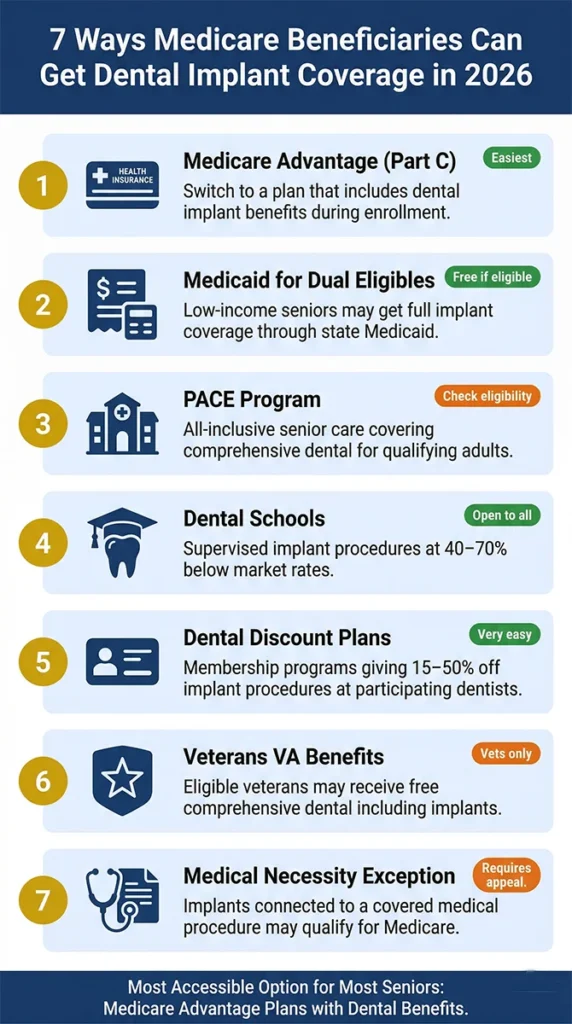
Even though Original Medicare does not cover dental implants, there are 7 realistic pathways that Medicare beneficiaries can use to access dental implant coverage or significantly reduce the cost of dental implants in 2026:
Way 1 — Switch to a Medicare Advantage Plan with Comprehensive Dental
This is the most direct solution. During the Annual Enrollment Period (October 15 – December 7), compare Medicare Advantage plans in your area that include comprehensive dental benefits covering major services like implants. Use the Medicare Plan Finder at medicare.gov/plan-compare to filter plans by dental benefits. Look specifically for plans with annual dental maximums above $2,000 and coverage for major restorative services.
Way 2 — Purchase a Standalone Dental Insurance Plan
If you prefer to keep Original Medicare or a Medigap plan, purchasing a separate standalone dental insurance policy is the most straightforward way to add implant coverage. Plans that cover implants are available from most major dental insurers. Key things to look for: annual maximum benefit of at least $2,000, major restorative services covered at 50%+, and the waiting period for major procedures. Expect to pay $40–$80 per month for a plan with meaningful implant coverage.
Way 3 — Dental Schools and Teaching Clinics
Accredited dental schools across the United States offer implant procedures performed by dental students or residents under close supervision of experienced faculty dentists. Costs at dental school clinics are typically 40%–70% lower than private practice rates. The procedure takes longer due to the educational environment, but the quality of care is generally excellent — dental school programs maintain rigorous quality standards. Find accredited dental schools at ada.org.
Way 4 — Federally Qualified Health Centers (FQHCs)
Federally Qualified Health Centers are government-funded community health centers that provide dental services on a sliding fee scale based on your income. If your income is at or near the federal poverty level, you may qualify for significantly reduced-cost dental care including complex restorative work at an FQHC. Find your nearest FQHC at findahealthcenter.hrsa.gov.
Way 5 — Dental Savings Plans (Not Insurance)
Dental savings plans — also called dental discount plans — are not insurance but membership programs where you pay an annual fee ($80–$200) and receive discounted rates at participating dentists. Discounts of 10%–60% on dental implants are common with these plans. Unlike insurance, there are no waiting periods, no annual maximums, no claim forms, and coverage begins immediately upon enrollment. Plans like Careington, Aetna Dental Access, and Spirit Dental are popular options for Medicare beneficiaries.
Way 6 — State-Funded Dental Programs and Medicaid
If you qualify for both Medicare and Medicaid — called dual eligibility — your state’s Medicaid program may cover dental implants. Medicaid dental benefits vary significantly by state: some states cover extensive dental care including implants, others limit dental benefits to emergency extractions only. If you are a low-income Medicare beneficiary, check your state Medicaid program’s dental benefit schedule at medicaid.gov to see what is covered in your state.
Way 7 — Medical Tourism and Dental Clinics Abroad
A growing number of American seniors travel to countries like Mexico, Costa Rica, Colombia, Hungary, and Thailand for dental implant procedures at a fraction of US costs. Implants at accredited international dental clinics commonly cost $700–$1,500 per implant — compared to $3,000–$6,000 in the United States. Medical tourism requires research into clinic accreditation, dentist credentials, and what happens if complications arise after returning home. Organizations like the Joint Commission International (JCI) accredit international healthcare facilities to US standards.
| Option | Potential Savings | Key Consideration |
| Medicare Advantage with Dental | 50%–80% of allowed cost | Annual maximum limits; waiting periods; network restrictions |
| Standalone Dental Insurance | 50% after waiting period | 12–24 month waiting period for major services in most plans |
| Dental School Clinics | 40%–70% off private rates | Longer appointment times; excellent supervision quality |
| FQHCs (Income-Based) | Sliding scale — up to 100% | Income qualification required; limited availability by location |
| Dental Savings Plans | 10%–60% off | No waiting period; not insurance — no annual maximum benefit |
| Medicaid (Dual Eligible) | Up to 100% in some states | State dental benefit vary enormously — check your state |
| International Dental Care | 60%–80% off US prices | Research clinic accreditation carefully; travel cost adds back |
6. How Much Do Dental Implants Cost Without Medicare Coverage?
Understanding the full cost breakdown of dental implants helps you evaluate which coverage option or savings pathway makes the most financial sense for your situation:
| Implant Component | Low Cost | Average Cost | High Cost |
| Implant post (titanium fixture) | $1,000 | $1,500 | $3,000 |
| Abutment (connector piece) | $300 | $500 | $700 |
| Dental crown (the visible tooth) | $1,000 | $1,500 | $2,500 |
| Bone graft (if needed) | $200 | $600 | $3,200 |
| Sinus lift (if upper jaw) | $1,500 | $2,500 | $4,000 |
| Tooth extraction (if needed) | $75 | $200 | $650 |
| X-rays and CT scan | $150 | $300 | $600 |
| TOTAL — Single Implant (Full Case) | $2,525 | $4,600 | $14,650 |
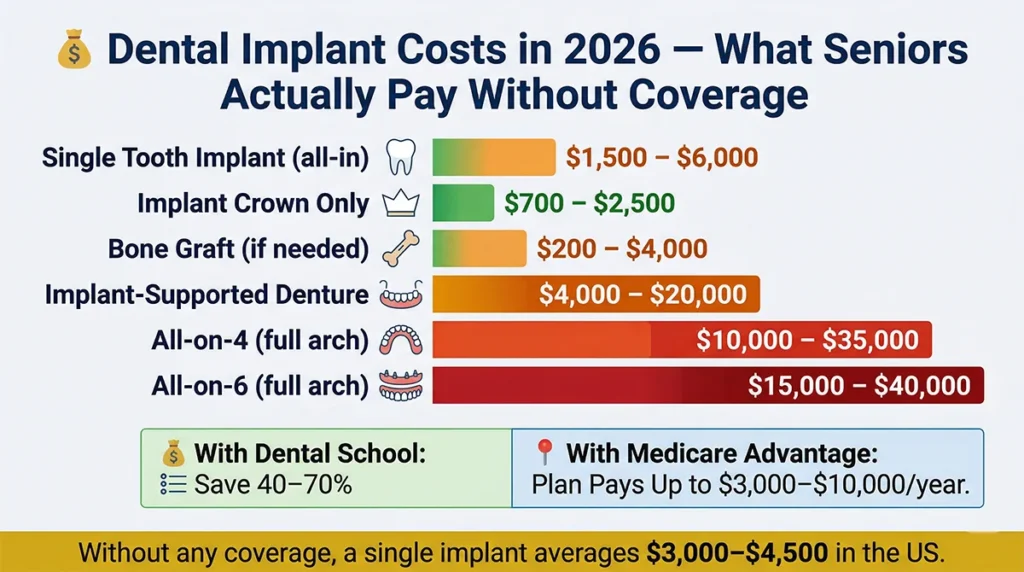
For patients needing multiple implants — or full-mouth implant-supported dentures — total costs can reach $30,000–$90,000. All-on-4 full arch implant procedures (four implants supporting a full set of teeth) typically cost $20,000–$30,000 per arch without insurance coverage.
Geographic location significantly affects implant costs. Dental implants in major metropolitan areas like New York City, San Francisco, and Los Angeles typically cost 30%–50% more than the national average. Rural areas and smaller cities generally have lower implant costs. Getting multiple quotes from dentists in your area is always advisable.
7. Dental Implant Alternatives That Medicare May Cover
If dental implants are cost-prohibitive even with the savings options described above, there are alternative tooth replacement options. Some of these alternatives may have Medicare or Medicaid coverage pathways that implants do not:
| Alternative | Average Cost | Medicare Coverage? | Pros and Cons |
| Complete Dentures (Full) | $1,500 – $3,000 | Sometimes via Medicare Advantage | Affordable; less stable; bone loss continues |
| Partial Dentures | $700 – $2,000 | Sometimes via Medicare Advantage | Removable; less expensive; requires remaining teeth |
| Dental Bridge | $2,500 – $6,000 | Sometimes via Medicare Advantage | Permanent; requires grinding adjacent healthy teeth |
| All-on-4 Implants | $20,000 – $30,000/arch | Rarely — some MA plans partially | Best function; most expensive; permanent solution |
| Mini Implants | $500 – $1,500 each | Rarely via Medicare Advantage | Less invasive; less durable than standard implants |
Dentures and bridges remain the most affordable tooth replacement options and are the most commonly covered dental services in Medicare Advantage plans. If your primary concern is cost and you need multiple teeth replaced, a consultation with both a general dentist and an oral surgeon comparing implants versus dentures for your specific situation is the best starting point.
8. How to Choose a Medicare Advantage Plan with Dental Coverage
If you have decided that switching to a Medicare Advantage plan with dental benefits is the right strategy for you, follow these steps to find the best plan for your dental implant needs:
Step 1 — Use Medicare.gov Plan Finder
Go to medicare.gov/plan-compare and enter your ZIP code. Filter results to show plans with dental benefits. For each plan, look at the Summary of Benefits document — specifically the dental section — to see what is covered, at what percentage, and what the annual maximum is.
Step 2 — Confirm Implant-Specific Coverage
Many Medicare Advantage plans advertise dental benefits but cover only preventive care (cleanings and exams). Look specifically for plans that cover ‘major restorative services’ or ‘implants’ by name in their benefit summary. If the plan description does not specifically mention implants or major restorative work, call the plan’s member services and ask directly: ‘Does your dental benefit cover dental implants?’
Step 3 — Check the Annual Maximum and Waiting Period
Confirm the annual dental maximum — the most the plan will pay toward dental care in a calendar year. For implants that can cost $4,000–$6,000 per tooth, a plan with a $1,000 annual maximum offers limited benefit. Look for plans with at least $2,000–$3,000 annual dental maximums. Also ask about waiting periods — if you need implants soon, a plan with a 24-month waiting period for major services will not help you this year.
Step 4 — Verify Your Dentist Is In-Network
Medicare Advantage plans have provider networks. If you already have a dentist or oral surgeon you trust, confirm they participate in the plan’s dental network before enrolling. Switching to an out-of-network provider typically means significantly higher out-of-pocket costs — sometimes no coverage at all for out-of-network dental care.
Step 5 — Compare the Total Premium Cost vs Dental Savings
Some Medicare Advantage plans with rich dental benefits carry higher monthly premiums. Calculate whether the additional premium cost is justified by the dental savings you expect. If your implant procedure costs $5,000 and the plan covers 50% (saving you $2,500) but costs $80 more per month in premium, it takes 31 months of premiums to break even — only worthwhile if you plan to stay on the plan long-term.
9. Frequently Asked Questions
Q: Will Medicare ever cover dental implants in the future?
A: There has been ongoing Congressional discussion about expanding Medicare dental benefits. The Dental, Vision, and Hearing Benefit Expansion Act has been introduced in Congress multiple times, and the Inflation Reduction Act of 2022 included limited dental coverage for Medicare beneficiaries. As of 2026, Original Medicare still does not cover routine dental care including implants, but legislative momentum for expanded benefits continues. Monitor changes at medicare.gov for any benefit updates.
Q: Does Medicare Part A cover implants if done in a hospital?
A: Medicare Part A covers the hospital facility costs when a dental procedure requires inpatient hospital admission — but it does not cover the dental implant itself, the oral surgeon’s fee, or any dental materials. This exception is very narrow and applies mainly when a patient’s medical condition requires the procedure to be performed in a hospital setting. The vast majority of dental implant procedures are performed in dental offices and receive no Medicare coverage whatsoever.
Q: How do I find Medicare Advantage plans that cover implants in my area?
A: Use the Medicare Plan Finder at medicare.gov/plan-compare and enter your ZIP code. After filtering for Medicare Advantage plans, review each plan’s Summary of Benefits document for the dental section. Look for plans that specifically list ‘implants’ or ‘major restorative services’ as covered benefits. You can also call 1-800-MEDICARE (1-800-633-4227) and ask a counselor to help you find plans with comprehensive dental coverage in your area.
Q: Can I get dental implants covered through Medicaid?
A: If you qualify for both Medicare and Medicaid (dual eligibility), your state’s Medicaid program may cover dental implants. Medicaid dental benefits are determined state by state — some states cover extensive dental care, others provide only emergency dental services. To find out what your state Medicaid program covers for dental, contact your state Medicaid office directly or visit medicaid.gov. Low-income Medicare beneficiaries should always check their Medicaid dental benefits before paying out of pocket.
Q: How long do dental implants last?
A: Dental implants are designed to be a permanent tooth replacement. The titanium implant post fuses with the jawbone (osseointegration) and can last a lifetime with proper care. The crown attached to the implant typically lasts 15–25 years before it may need replacement due to normal wear. Success rates for dental implants in healthy patients are above 95% over 10 years. Factors that shorten implant lifespan include smoking, uncontrolled diabetes, poor oral hygiene, and insufficient bone density at the implant site.
Q: Are dental implants worth the cost for seniors on Medicare?
A: From a health and quality-of-life perspective, dental implants provide significant benefits for seniors: they preserve jawbone density (preventing the facial collapse that occurs with dentures over time), allow normal eating and speaking, do not require removal or adhesives, and do not affect adjacent healthy teeth the way bridges do. For seniors who can manage the cost — through Medicare Advantage coverage, dental savings plans, or dental school discounts — implants are widely considered the gold standard of tooth replacement by dental professionals.
The Bottom Line
Original Medicare does not cover dental implants in 2026 — and this limitation affects millions of American seniors who need tooth replacement. But this does not mean dental implants are inaccessible or unaffordable for Medicare beneficiaries.
The most direct pathway to implant coverage is enrolling in a Medicare Advantage plan with comprehensive dental benefits during the Annual Enrollment Period. The most affordable pathway for those without implant insurance is dental school clinics, dental savings plans, or — for income-qualifying beneficiaries — Medicaid or Federally Qualified Health Centers.
If you are currently enrolled in Original Medicare and considering dental implants, start by using the Medicare Plan Finder at medicare.gov/plan-compare to review Advantage plan options in your ZIP code. The difference between a plan with comprehensive dental and one without could mean thousands of dollars in savings on your dental implant procedure.
⚖️ Disclaimer: This article provides general legal information about Medicare coverage for educational purposes only. Medicare benefits, plan availability, and costs change annually. Always verify current coverage details at medicare.gov or by calling 1-800-MEDICARE. Consult a licensed Medicare insurance agent or your State Health Insurance Assistance Program (SHIP) counselor for personalized guidance.