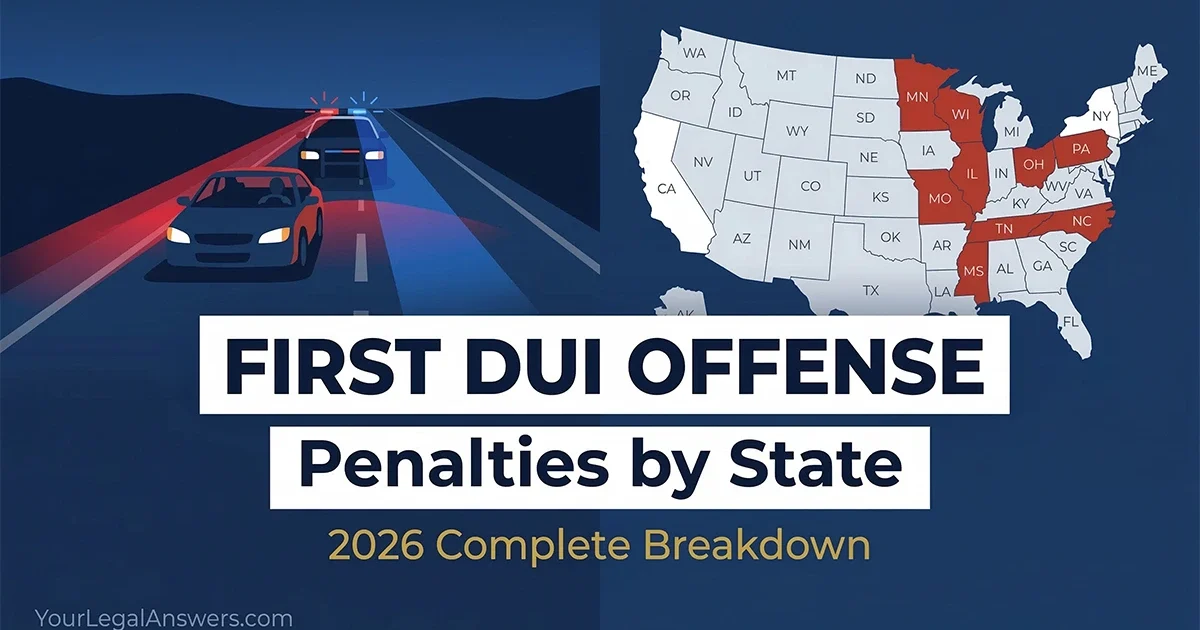
⚡ Quick Answer: A first DUI offense is a misdemeanor in most US states. Typical penalties include fines of $500–$2,000, jail time of 24 hours to 6 months (often suspended), license suspension of 90 days to 1 year, mandatory DUI school, and probation of 1–3 years. In most states, first offenders with no aggravating factors avoid significant jail time — but costs including fines, attorney fees, insurance increases, and IID requirements average $10,000–$25,000 total.
Getting pulled over and charged with a DUI for the first time is one of the most frightening experiences a person can have. The consequences — legal, financial, and personal — can follow you for years. But the severity of those consequences depends enormously on which state you were arrested in.
DUI laws are set at the state level, and the variation between states is dramatic. A first-time DUI in California carries different penalties than the same offense in Texas, Florida, or New York. Some states are notoriously tough on first offenders. Others offer diversion programs that can result in the charge being dismissed entirely.
This guide gives you a complete 2026 breakdown of first DUI offense penalties in all 50 states — covering fines, jail time, license suspension, ignition interlock device (IID) requirements, probation terms, and DUI school — so you know exactly what you are facing and what options may be available to you.
📑 Table of Contents
- What Is a First DUI Offense?
- The Standard BAC Limit in Every State
- First DUI Penalties — State-by-State Breakdown (All 50 States)
- The Real Total Cost of a First DUI — Beyond the Fine
- What Is an Ignition Interlock Device (IID)?
- License Suspension for First DUI — What to Expect
- First DUI and Your Criminal Record
- First DUI Diversion Programs — Can You Get It Dismissed?
- Aggravating Factors That Make a First DUI Worse
- Do You Need a DUI Attorney for a First Offense?
- Frequently Asked Questions (FAQ)
1. What Is a First DUI Offense?
A DUI — Driving Under the Influence — charge is typically classified as a first offense when you have no prior DUI convictions on your record, typically within a lookback period of 5–10 years depending on your state. In most states, a first DUI with no aggravating factors is charged as a misdemeanor.
Every US state defines DUI (also called DWI, OWI, or OUI depending on the state) as operating a motor vehicle with a Blood Alcohol Concentration (BAC) at or above the legal limit — which is 0.08% for non-commercial adult drivers in all 50 states. However, you can be charged with DUI even below 0.08% if an officer determines your driving was impaired.
|
DUI Term Used |
States That Use This Term |
|
DUI — Driving Under the Influence |
California, Florida, Georgia, Illinois, Colorado, Arizona, and most others |
|
DWI — Driving While Intoxicated |
Texas, New York, New Jersey, North Carolina, Missouri, Minnesota |
|
OWI — Operating While Intoxicated |
Michigan, Indiana, Iowa, Wisconsin |
|
OUI — Operating Under the Influence |
Massachusetts, Maine, Rhode Island |
|
DUII — Driving Under the Influence of Intoxicants |
Oregon |
📌 Same Law, Different Name:
DUI, DWI, OWI, and OUI all refer to the same offense — driving while impaired by alcohol or drugs. The name varies by state but the consequences are essentially the same. Throughout this article, we use 'DUI' to refer to all of these.
2. The Standard BAC Limit in Every State
All 50 US states use 0.08% BAC as the standard legal limit for adult non-commercial drivers. However, there are important variations:
|
Driver Category |
BAC Limit (All 50 States) |
|
Standard adult driver (21+) |
0.08% — automatic per se DUI at or above this level |
|
Commercial vehicle driver (CDL) |
0.04% — half the standard limit |
|
Driver under 21 (Zero Tolerance) |
0.00%–0.02% depending on state — any detectable alcohol can result in charges |
|
Utah (standard adult driver) |
0.05% — Utah is the ONLY state with a limit below 0.08% for adult drivers |
⚠️ Utah Exception:
Utah lowered its legal limit to 0.05% BAC in 2019 — the strictest in the nation for adult drivers. If you are driving in Utah, even 1–2 drinks can put you over the legal limit depending on your weight, gender, and how quickly you consumed them.
3. First DUI Penalties — State-by-State Breakdown
The table below covers the standard first-offense DUI penalties for each state. These apply to adult drivers with no prior DUI convictions and no aggravating factors (no injury, no child in vehicle, no extreme BAC). Actual penalties in individual cases may vary.
|
State |
Fines |
Jail Time |
License Suspension |
IID Required? |
Severity |
|
Alabama |
$600 – $2,100 |
Up to 1 year (minimum none) |
90 days |
Required |
🟢 Lower |
|
Alaska |
$1,500 minimum |
72 hours – 1 year |
90 days |
Required |
🟢 Lower |
|
Arizona |
$1,250 minimum |
24 hours – 10 days |
90 days |
Required (1 year) |
🟢 Lower |
|
Arkansas |
$150 – $1,000 |
24 hours – 1 year |
6 months |
Possible |
🟢 Lower |
|
California |
$390 – $1,000 + fees |
96 hours – 6 months |
6 months |
Possible (5 months) |
🟢 Lower |
|
Colorado |
$600 – $1,000 |
5 days – 1 year |
9 months |
Required (8 months) |
🟢 Lower |
|
Connecticut |
$500 – $1,000 |
Up to 6 months |
45 days + restricted |
Required (1 year) |
🟢 Lower |
|
Delaware |
$500 – $1,500 |
Up to 12 months |
12 months |
Possible |
🟢 Lower |
|
Florida |
$500 – $1,000 |
Up to 6 months |
180 days – 1 year |
Possible |
🟢 Lower |
|
Georgia |
$300 – $1,000 |
24 hours – 12 months |
12 months |
Required |
🟢 Lower |
|
Hawaii |
$150 – $1,000 |
48 hours – 5 days |
1 year |
Required (1 year) |
🟢 Lower |
|
Idaho |
$1,000 minimum |
Up to 6 months |
90 days – 180 days |
Required |
🟢 Lower |
|
Illinois |
$500 – $2,500 |
Up to 1 year |
1 year |
Required (1 year) |
🟢 Lower |
|
Indiana |
$500 – $5,000 |
Up to 60 days |
180 days |
Possible |
🟢 Lower |
|
Iowa |
$1,250 minimum |
48 hours – 1 year |
180 days |
Required (1 year) |
🟢 Lower |
|
Kansas |
$750 – $1,000 |
48 hours – 6 months |
30 days + restricted |
Required (1 year) |
🟢 Lower |
|
Kentucky |
$200 – $500 |
48 hours – 30 days |
30 – 120 days |
Possible |
🟢 Lower |
|
Louisiana |
$300 – $1,000 |
10 days – 6 months |
90 days |
Required (6 months) |
🟢 Lower |
|
Maine |
$500 minimum |
Up to 364 days |
150 days |
Possible |
🟢 Lower |
|
Maryland |
Up to $1,000 |
Up to 1 year |
6 months |
Required (1 year) |
🟢 Lower |
|
Massachusetts |
$500 – $5,000 |
Up to 2.5 years |
1 year |
Required (2 years) |
🟢 Lower |
|
Michigan |
$100 – $500 |
Up to 93 days |
30 days + restricted |
Possible |
🟢 Lower |
|
Minnesota |
$1,000 minimum |
Up to 90 days |
90 days |
Possible |
🟢 Lower |
|
Mississippi |
$250 – $1,000 |
Up to 48 hours |
90 days |
Possible |
🟢 Lower |
|
Missouri |
$500 – $1,000 |
Up to 6 months |
30 days + restricted |
Required (6 months) |
🟢 Lower |
|
Montana |
$600 – $1,000 |
24 hours – 6 months |
6 months |
Possible |
🟢 Lower |
|
Nebraska |
$500 minimum |
7 – 60 days |
6 months |
Required (6 months) |
🟢 Lower |
|
Nevada |
$400 – $1,000 |
2 days – 6 months |
185 days |
Required (185 days) |
🟢 Lower |
|
New Hampshire |
Up to $1,200 |
Possible |
6 months |
Required |
🟢 Lower |
|
New Jersey |
$250 – $400 |
12 – 48 hours |
3 months |
Required (3 months) |
🟢 Lower |
|
New Mexico |
$500 – $5,000 |
24 hours – 364 days |
1 year |
Required (1 year) |
🟢 Lower |
|
New York |
$500 – $1,000 |
Up to 1 year |
6 months |
Required (6 months) |
🟢 Lower |
|
North Carolina |
$200 minimum |
24 hours – 60 days |
1 year |
Required (1 year) |
🟢 Lower |
|
North Dakota |
$250 – $1,500 |
None required |
91 days |
Possible |
🟢 Lower |
|
Ohio |
$375 – $1,075 |
3 days – 6 months |
1 – 3 years |
Possible |
🟢 Lower |
|
Oklahoma |
$100 – $1,000 |
10 days – 1 year |
180 days |
Required (18 months) |
🟢 Lower |
|
Oregon |
$1,000 – $6,250 |
48 hours – 1 year |
1 year |
Required (1 year) |
🟢 Lower |
|
Pennsylvania |
$300 minimum |
No minimum (BAC < 0.10) |
12 months |
Required (1 year) |
🟢 Lower |
|
Rhode Island |
$100 – $300 |
10 days – 1 year |
3 – 6 months |
Possible |
🟢 Lower |
|
South Carolina |
$400 minimum |
48 hours – 30 days |
6 months |
Required (6 months) |
🟢 Lower |
|
South Dakota |
Up to $1,000 |
Up to 1 year |
30 days |
Possible |
🟢 Lower |
|
Tennessee |
$350 – $1,500 |
48 hours – 11 months 29 days |
1 year |
Required (1 year) |
🟢 Lower |
|
Texas |
$2,000 minimum |
72 hours – 180 days |
90 days – 1 year |
Possible |
🟢 Lower |
|
Utah |
$700 – $1,000 |
48 hours – 180 days |
120 days |
Required (18 months) |
🟢 Lower |
|
Vermont |
Up to $750 |
Up to 2 years |
90 days |
Possible |
🟢 Lower |
|
Virginia |
$250 – $2,500 |
Mandatory 5 days if BAC 0.15+ |
12 months |
Required (6–12 months) |
🟢 Lower |
|
Washington |
$1,000 minimum |
24 hours minimum |
90 days |
Required (1 year) |
🟢 Lower |
|
West Virginia |
$100 – $500 |
1 day – 6 months |
15 – 45 days |
Required (6 months) |
🟢 Lower |
|
Wisconsin |
$150 – $300 |
No jail — civil offense, first time |
6 – 9 months |
Required (1 year) |
🟢 Lower |
|
Wyoming |
$750 minimum |
Up to 6 months |
90 days |
Possible |
🟢 Lower |
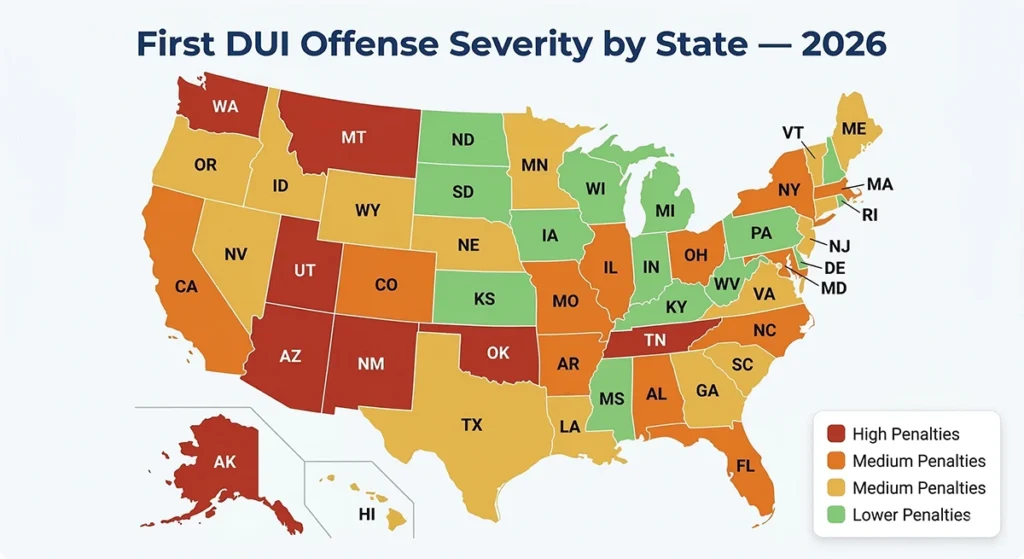
Note: All figures represent baseline first-offense penalties for BAC 0.08%–0.14% with no aggravating factors. Fines shown are statutory ranges and do not include court fees, surcharges, or assessment fees, which can double or triple the listed amount. Always verify with your state's current statute or a licensed DUI attorney.
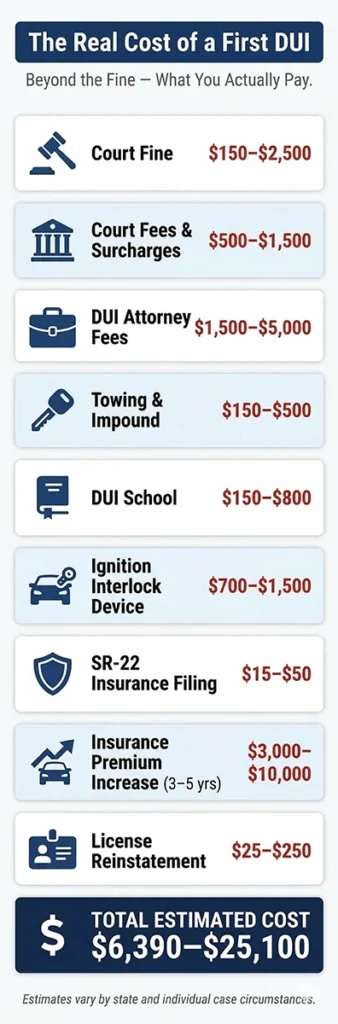
4. The Real Total Cost of a First DUI — Beyond the Fine
The statutory fine listed in the state table above is only a fraction of what a first DUI actually costs. When you add up every mandatory expense, the average first-offense DUI costs between $10,000 and $25,000 — even without a trial.
|
Expense Category |
Low Estimate |
High Estimate |
|
Court-imposed fine |
$150 |
$2,500 |
|
Court fees, surcharges, assessments |
$500 |
$1,500 |
|
DUI attorney fees |
$1,500 |
$5,000 |
|
Bail (if arrested overnight) |
$150 |
$2,500 |
|
Towing and vehicle impound |
$150 |
$500 |
|
DUI school / alcohol education program |
$150 |
$800 |
|
Ignition Interlock Device (IID) installation + monthly fees |
$700 |
$1,500 |
|
SR-22 insurance filing fee |
$15 |
$50 |
|
Auto insurance premium increase (3–5 years) |
$3,000 |
$10,000 |
|
License reinstatement fee |
$25 |
$250 |
|
Victim Restitution Fund contribution (some states) |
$50 |
$500 |
|
TOTAL ESTIMATED COST |
$6,390 |
$25,100 |
The single biggest long-term cost is your auto insurance. After a DUI conviction, most insurers classify you as a high-risk driver. You will likely be required to file an SR-22 certificate — proof of financial responsibility — for 3 years in most states. During that period, insurance premiums can increase by 50%–200% annually.
💡 Hidden Cost Most People Miss:
Many states impose a 'DUI surcharge' or 'alcohol abuse assessment fee' that is separate from the fine and not mentioned at arraignment. In California, for example, a $390 base fine becomes over $1,800 after all mandatory surcharges and penalty assessments.
5. What Is an Ignition Interlock Device (IID)?
An Ignition Interlock Device (IID) is a breathalyzer installed directly into your vehicle's ignition system. Before your car will start, you must blow into the device and register a BAC below the set threshold (typically 0.02%). Many devices also require rolling retests — you must blow into the device at random intervals while driving.
As of 2026, 34 states require IID installation for all first DUI offenses, regardless of BAC level. An additional 10 states require it for high-BAC first offenses (typically above 0.15%). Only 6 states leave IID entirely at the judge's discretion for first offenders.
|
IID Fact |
Details |
|
Installation cost |
$70 – $150 one-time |
|
Monthly monitoring fee |
$60 – $90 per month |
|
Typical first-offense duration |
6 months to 18 months depending on state |
|
Consequence of tamping |
Extended IID period, additional criminal charge, license revocation |
|
States with all-offender IID laws |
34 states including CA, TX, FL, NY, IL, AZ, CO, WA, OR, VA, NM and others |
|
Hardship exemption |
Available in some states if you do not own a vehicle — but you cannot drive any vehicle without IID during the period |
The IID records all test results, including any failed attempts. These records are regularly reviewed by your probation officer or the court. Attempting to bypass the device — for example, by having someone else blow into it — is a separate criminal offense in most states and will result in immediate license revocation.
6. License Suspension for a First DUI — What to Expect
A DUI arrest typically triggers two separate suspension processes — and most people do not know about both:
6.1 Administrative Suspension (DMV Action)
Immediately after your arrest, the arresting officer will typically confiscate your physical driver's license and issue a temporary driving permit. Your state's DMV will then initiate an administrative license suspension — separate from any court action.
You typically have only 5–10 days from the date of arrest to request a DMV hearing to challenge this administrative suspension. If you miss this deadline, the suspension automatically goes into effect — even if you are never convicted of the DUI charge in court.
⚠️ Critical Deadline:
The DMV hearing request deadline is one of the most time-sensitive aspects of any DUI case. In California, you have 10 days from arrest. In Texas, 15 days. In Florida, 10 days. Missing this deadline means automatic license suspension regardless of your court outcome. Contact a DUI attorney immediately after arrest.
6.2 Court-Ordered Suspension (Criminal Conviction)
If you are convicted of DUI in criminal court, the court will also impose its own license suspension, which may run concurrently with or consecutively to the administrative suspension. In most states, you can apply for a restricted license during the suspension period that allows driving to work, school, and medical appointments — but only with an IID installed.
|
State |
Admin Suspension |
Court Suspension |
Restricted License Available? |
|
California |
4 months |
6 months |
Yes — with IID after 30 days |
|
Texas |
90 days |
90 days – 1 year |
Yes — occupational license |
|
Florida |
6 months |
6 months – 1 year |
Yes — hardship license |
|
New York |
90 days |
6 months |
Yes — conditional license |
|
Georgia |
1 year |
12 months |
Yes — limited permit with IID |
|
Ohio |
90 days |
1 – 3 years |
Yes — limited driving privilege |
7. First DUI and Your Criminal Record
In 48 states, a first DUI conviction becomes part of your permanent criminal record. This has far-reaching consequences beyond the immediate legal penalties:
- Employment: Many employers conduct background checks. A DUI conviction can disqualify you from jobs requiring a commercial driver's license (CDL), security clearance, healthcare licenses, or positions working with children.
- Professional Licenses: Nurses, teachers, lawyers, doctors, and others with professional licenses may face disciplinary hearings or license suspension.
- Immigration: Non-US citizens convicted of DUI may face immigration consequences including visa denial, deportation, or bars to naturalization.
- Housing: Some landlords conduct background checks and may deny rental applications.
- Military Service: A DUI conviction can disqualify you from enlistment or result in discharge proceedings.
- Child Custody: A DUI conviction can be used as evidence in family court proceedings affecting custody arrangements.
Lookback Period — How Long Does a DUI Count as a Prior?
Every state has a 'lookback period' — the window of time within which a prior DUI conviction counts as a prior offense for sentencing purposes. Understanding your state's lookback period matters enormously for sentencing.
|
5-Year Lookback States |
7–10 Year Lookback States |
Lifetime Lookback States |
|
Florida (10 yrs), Maryland (5 yrs), Texas (5 yrs), Minnesota (10 yrs), Colorado (5 yrs) |
California (10 yrs), New York (10 yrs), Illinois (10 yrs), Georgia (10 yrs), Pennsylvania (10 yrs) |
Michigan, Arizona, Virginia, Washington, Wisconsin, Montana — prior DUI always counts regardless of age |
8. First DUI Diversion Programs — Can You Get It Dismissed?
Many states offer first-time DUI offenders the chance to have their charge dismissed or reduced through a diversion or deferred judgment program. These programs allow you to avoid a permanent conviction by completing a set of requirements over a period of time.
Common diversion program requirements include:
- Pleading guilty or no contest (conviction held in abeyance during the program)
- Completing a DUI education or treatment program
- Serving probation of 12–24 months with no new offenses
- Installing an IID for the probation period
- Paying all fines and fees
- Completing community service hours (typically 40–100 hours)
If you successfully complete the program, the charge is dismissed — and in many states, you can have the arrest record expunged. If you fail the program (new arrest, missed appointments, failed drug tests), the conviction is entered on your record and you are sentenced as normal.
|
State |
Program Name / Availability |
Outcome If Completed |
|
California |
Section 1000 PC — available for first offenders with no injury |
Charge dismissed |
|
Texas |
Deferred Adjudication — judge's discretion, not available in all counties |
No conviction entered |
|
Florida |
No formal statewide program — some counties offer diversion at prosecutor's discretion |
Varies by county |
|
Colorado |
Deferred Judgment available for first offenders |
Charge dismissed on completion |
|
Illinois |
Court Supervision — available if no prior DUI within 5 years |
No conviction on record |
|
New York |
DWAI reduction negotiation — can reduce DWI to DWAI (non-criminal infraction) |
Non-criminal outcome |
💡 Key Insight:
Diversion program availability is NOT automatic — it requires a specific request from your attorney, prosecutorial agreement, and often judge approval. In many states, prosecutors will not offer diversion unless you have competent legal representation advocating for it. This is one of the strongest arguments for hiring a DUI attorney even for a first offense.
9. Aggravating Factors That Make a First DUI Worse
Certain circumstances can transform a standard first-offense DUI misdemeanor into a significantly more serious charge — sometimes a felony — with mandatory minimum jail sentences that cannot be suspended. Know these aggravating factors:
|
Aggravating Factor |
How It Affects Your Charge |
States Most Affected |
|
High BAC (0.15%+) |
Enhanced penalties, mandatory IID, higher fines, mandatory jail in many states |
All 50 states have aggravated DUI provisions |
|
Child Passenger (under 16) |
Elevated to felony DUI in most states; can add child endangerment charge |
CA, TX, FL, NY, GA — all very strict |
|
Accident with injury |
Felony DUI with prison time of 1–5 years; civil lawsuit liability |
All states |
|
Accident with fatality |
Vehicular manslaughter or DUI murder; 4–25 years in prison |
All states — zero tolerance |
|
Driving on a suspended license |
Additional criminal charge; mandatory jail even for first DUI offense |
All states |
|
Excessive speed (20+ mph over limit) |
Reckless driving add-on; enhanced penalties in some states |
CA, FL, VA, CO |
|
Refusing chemical test (breathalyzer/blood) |
Automatic license suspension under implied consent law; enhanced penalties |
All 50 states have implied consent laws |
10. Do You Need a DUI Attorney for a First Offense?
This is one of the most common questions first-time DUI offenders ask. The honest answer: in most cases, yes — especially if any of the following apply to your situation.
Strong Cases for Hiring a DUI Attorney:
- Any aggravating factor is present (high BAC, accident, child passenger)
- You have a commercial driver's license (CDL) — a DUI conviction ends most CDL careers
- You are not a US citizen — immigration consequences can be severe
- Your state offers diversion programs — attorneys know how to get these approved
- You want to challenge the traffic stop's legality, the sobriety test administration, or the breathalyzer calibration
- You hold a professional license (nurse, teacher, CPA, attorney, pilot)
- You need a restricted license immediately for work or family obligations
- The prosecution's evidence has weaknesses you are not equipped to identify yourself
What a DUI Attorney Can Realistically Do for You:
- Challenge the legality of the traffic stop — if the stop was unlawful, the entire case can be dismissed
- Question breathalyzer calibration and maintenance records — faulty equipment is a valid defense
- Negotiate a charge reduction from DUI to reckless driving (wet reckless) — fewer consequences
- Secure a diversion program offer that self-representation almost never achieves
- Handle the DMV hearing separately to challenge administrative license suspension
- Minimize mandatory jail time through plea negotiation and sentencing advocacy
DUI attorneys typically charge $1,500–$5,000 for a first-offense misdemeanor case. While this is a significant expense, consider that the long-term consequences of a conviction — particularly the insurance premium increases and employment impact — almost always exceed the attorney fee.
💡 Free Consultation:
Nearly all DUI attorneys offer a free initial consultation. Use it. Even if you ultimately decide to represent yourself, the free consultation will give you a realistic picture of your case's strengths, weaknesses, and the likely outcomes in your specific jurisdiction.
11. Frequently Asked Questions (FAQ)
Q: Will I go to jail for a first DUI offense?
A: In most states, jail time for a first DUI offense is either optional, suspended, or replaced with community service. However, approximately 20 states impose a mandatory minimum jail sentence — typically 24–72 hours — even for first offenders with no aggravating factors. States like Arizona, Alaska, Iowa, and New Mexico are particularly strict. If your BAC was above 0.15%, if there was an accident, or if a child was in the vehicle, mandatory jail time becomes far more likely even for a first offense.
Q: How long does a first DUI stay on your driving record?
A: A first DUI conviction typically stays on your driving record for 5–10 years in most states, though some states keep it permanently. The DMV record is separate from your criminal record. Your criminal conviction may remain on your record permanently unless you qualify for expungement (see below). Your insurance company typically surcharges your premium for 3–5 years after a DUI conviction.
Q: Can a first DUI be expunged from your record?
A: In many states, yes — a first DUI conviction can be expunged after successfully completing probation and a waiting period. States with relatively accessible first-offense DUI expungement include California, Colorado, Illinois, and Washington. However, some states — including Arizona, Florida, and Texas — do not allow DUI expungement regardless of the circumstances. Eligibility requirements vary significantly by state.
Q: What is a 'wet reckless' and how does it help?
A: A 'wet reckless' is a plea bargain where a DUI charge is reduced to reckless driving with a notation that alcohol was involved. The benefits over a DUI conviction include lower fines, no mandatory license suspension in many states, shorter probation terms, and significantly lower insurance premium impact. Whether a wet reckless is available depends entirely on your state, the prosecutor, and the specific facts of your case — an experienced DUI attorney dramatically increases the likelihood of obtaining this reduction.
Q: Does a first DUI affect your car insurance?
A: Yes, significantly. After a DUI conviction, most insurers classify you as a high-risk driver. You will typically be required to file an SR-22 certificate for 3 years. Annual insurance premiums commonly increase by 50%–200%. Some standard insurers will non-renew your policy entirely, forcing you into the high-risk insurance market where premiums are even higher. The total insurance cost increase over 3–5 years commonly ranges from $3,000 to $10,000.
Q: Can you get a first DUI dismissed?
A: Yes, a first DUI can potentially be dismissed under several circumstances: if the traffic stop was unlawful (no reasonable suspicion), if the breathalyzer was not properly calibrated or maintained, if the field sobriety tests were administered incorrectly, if chain of custody for blood samples was broken, or if you complete a diversion program. Dismissals require strong legal arguments and are far more likely with an experienced DUI attorney than with self-representation.
Q: Is a first DUI a felony or a misdemeanor?
A: In 48 states, a first DUI with no aggravating factors is charged as a misdemeanor. It becomes a felony if certain aggravating factors are present: a prior felony DUI, an accident causing serious injury or death, a child passenger in the vehicle, or a BAC above certain thresholds (0.15%+ in some states). States that more readily charge first-offense DUI as a felony include Arizona (aggravated DUI) and some jurisdictions in Illinois and New Mexico.
Q: What happens at your first DUI court appearance?
A: Your first court appearance is called the arraignment. At the arraignment, the formal charges are read, you enter a plea (guilty, not guilty, or no contest), and bail conditions are set if you were not already released. The arraignment is typically very brief — 5–15 minutes. You do not need to do anything other than appear, respond to the judge's questions, and enter a plea. Most DUI attorneys recommend pleading not guilty at arraignment regardless of guilt, as this preserves your negotiating options.
The Bottom Line
A first DUI offense is serious — but it is manageable if you act quickly and make informed decisions. The penalties vary enormously by state, ranging from a civil fine with no jail time in Wisconsin to mandatory jail and a year-long IID requirement in states like Arizona, New Mexico, and Tennessee.
The most important steps to take immediately after a first DUI arrest are: request a DMV hearing within the required deadline (5–10 days in most states), consult with a DUI attorney before your arraignment, and document everything about the traffic stop and arrest while it is fresh in your memory.
The total cost of a first DUI — fines, attorney fees, insurance increases, and lost income — typically ranges from $10,000 to $25,000. That makes investing in quality legal representation one of the most financially sound decisions you can make following an arrest.
⚖️ Legal Disclaimer: The information on this page is for general informational purposes only. Laws change frequently and vary significantly by jurisdiction. Penalty ranges shown are statutory guidelines and actual sentences may differ. Always consult a licensed criminal defense attorney in your state for advice specific to your situation. YourLegalAnswers.com is not a law firm.