⚡ Quick Answer: Getting a green card through marriage in 2026 takes 12–24 months if your spouse is a US citizen, or 3–5 years if your spouse is a lawful permanent resident (green card holder). The timeline depends on your current immigration status, whether you are in the US or abroad, and USCIS processing backlogs. US citizen spouses have no visa quota — their foreign spouses qualify as immediate relatives with no annual cap limitation.
When you marry a US citizen or green card holder, the path to lawful permanent residence — your green card — is one of the most clearly defined pathways in the US immigration system. It is also one of the most document-intensive, expensive, and emotionally taxing processes that couples navigate together.
In 2026, the marriage green card process is affected by ongoing USCIS backlogs, staffing changes, and shifting processing priorities that make real-time timeline information more important than ever. The difference between an organized, well-prepared application and a rushed, incomplete one can be the difference between a 14-month process and a 30-month process.
This complete guide breaks down every stage of the marriage green card process for 2026 — whether you are already in the US or abroad, whether your spouse is a US citizen or a green card holder — including every form you need, every step of the process, the most common causes of delay, and what to do if your green card application is denied.
📑 What This Guide Covers
- The 2 Types of Marriage Green Cards — Which One Are You?
- The 5 Critical Stages of the Marriage Green Card Process
- Complete Timeline: Green Card Through Marriage if Spouse Is US Citizen
- Complete Timeline: Green Card Through Marriage if Spouse Is Green Card Holder
- Every Form You Need for a Marriage Green Card in 2026
- The 7 Most Common Causes of Marriage Green Card Delays
- The Conditional Green Card — What Happens After 2 Years
- Frequently Asked Questions
1. The 2 Types of Marriage Green Cards — Which One Are You?
Before understanding how long a green card through marriage takes in 2026, you must identify which of the two fundamental scenarios applies to you — because the timeline difference is enormous:
| Factor | Scenario A: Spouse Is US Citizen | Scenario B: Spouse Is Green Card Holder (LPR) |
| Visa category | Immediate Relative (IR-1/CR-1) — NO annual cap | Family Preference Category F2A — annual cap applies |
| Waiting for a visa number | Never — immediate relatives have unlimited visas | Yes — must wait for priority date to become current |
| Total timeline in US (AOS) | 12–24 months | 3–5+ years |
| Total timeline abroad (CP) | 12–20 months | 3–6+ years |
| Can work during process? | Yes — work authorization (EAD) available during AOS | Not until green card approved — years away |
| Travel during process? | With Advance Parole (AP) during AOS in US | Must depart for interview abroad when priority date current |
| Green card type initially issued | Conditional (2 years) if married less than 2 years at time of approval | Conditional (2 years) if married less than 2 years at time of approval |
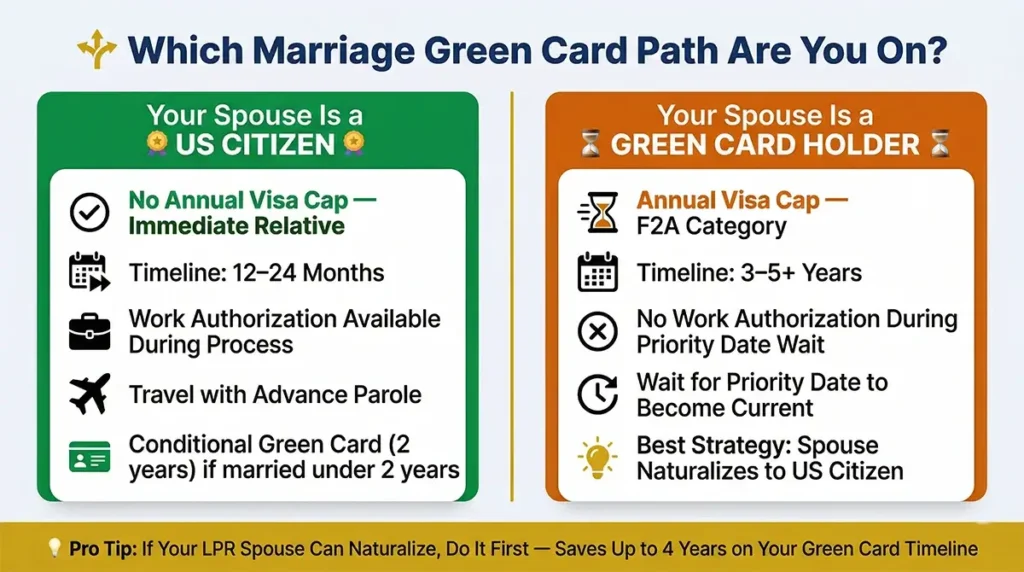
📌 The Most Important Distinction:
If your spouse is a US citizen, you are an ‘immediate relative’ — there is no annual visa cap and no waiting for a priority date. This is the fastest marriage green card pathway. If your spouse is a green card holder (LPR), you must wait for a visa number to become available under the F2A preference category, which currently has waits of 2–4+ years depending on your country of birth.
2. The 5 Critical Stages of the Marriage Green Card Process
Regardless of whether your spouse is a US citizen or green card holder, and whether you are in the US or abroad, every marriage green card application goes through the same 5 critical stages. Understanding what happens at each stage and how long each takes is essential to planning your timeline in 2026:
Stage 1 — File Form I-130 (Petition for Alien Relative)
The first step in getting a green card through marriage is for your US spouse to file Form I-130 (Petition for Alien Relative) with USCIS. This form establishes the bona fide marriage relationship between the petitioner (US citizen or LPR spouse) and the beneficiary (foreign spouse seeking the green card).
The I-130 must be accompanied by extensive documentation proving the marriage is genuine — not entered solely for immigration benefits. Key supporting documents include your marriage certificate, joint financial records, lease agreements or property documents, photos together, and affidavits from people who know you as a couple.
USCIS I-130 processing time in 2026 ranges from 5 to 18 months depending on the filing location, whether you filed at a USCIS service center or abroad at a US embassy, and current USCIS workload. Premium processing is not available for I-130 petitions.
💡 File Concurrently to Save 6–12 Months:
If the foreign spouse is already in the US in valid status, the US citizen petitioner can file the I-130 and the I-485 (Adjustment of Status) simultaneously — known as concurrent filing. This is one of the most significant timeline-shortening strategies available in the marriage green card process for US citizen spouses, potentially saving 6–12 months of total processing time.
Stage 2 — USCIS Processing and Approval of I-130
After filing the I-130, USCIS will send a receipt notice (Form I-797) confirming they received the petition. You can track your case status online at my.uscis.gov using the receipt number. During processing, USCIS may issue a Request for Evidence (RFE) asking for additional documentation to support the marriage — responding promptly and thoroughly to any RFE is critical.
Once the I-130 is approved, what happens next depends on your pathway. If the beneficiary is in the US and concurrent filing was done, the case moves directly to the I-485 stage. If the beneficiary is abroad, the approved I-130 is transferred to the National Visa Center (NVC) for the next stage of the marriage green card process.
Stage 3 — National Visa Center (NVC) Processing (Consular Processing Only)
For couples where the foreign spouse is outside the US, after I-130 approval the case transfers to the National Visa Center for document collection and fee payment. The NVC assigns a case number, collects civil documents (birth certificate, police clearance, military records), and prepares the case for the immigrant visa interview at the US embassy or consulate abroad.
NVC processing for marriage green card cases in 2026 typically takes 3–6 months. The NVC will notify you when they have reviewed all documents and are ready to schedule the immigrant visa interview at the relevant US embassy. This interview is the final step before the visa stamp is placed in the passport.
Stage 4 — Immigrant Visa Interview or Green Card Interview
Whether the foreign spouse is adjusting status inside the US (I-485 interview at a USCIS field office) or going through consular processing abroad (immigrant visa interview at a US embassy), this is the critical in-person stage of the marriage green card process. Both spouses are typically required to attend.
The marriage green card interview focuses on the genuineness of the marriage. Officers will ask about how you met, your wedding, your daily life together, shared finances, children, living arrangements, and future plans. Officers are specifically trained to identify marriages of convenience entered solely for immigration benefits — known as sham marriages.
Most bona fide couples with good documentation pass the marriage green card interview without difficulty. However, inconsistent answers, missing documents, or suspicious patterns (such as a large age gap, different languages, or very short acquaintance before marriage) can trigger additional scrutiny or a Stokes interview — a separate interview of each spouse without the other present.
Stage 5 — Green Card Issuance and Arrival
For adjustment of status cases inside the US, if the USCIS interview is successful, the green card is mailed to the applicant’s address typically within 2–3 weeks of interview approval. For consular processing abroad, after the immigrant visa interview the foreign spouse receives a visa stamp in their passport and upon entry into the US the green card is issued — the physical card arrives by mail within 2–3 weeks of entry.
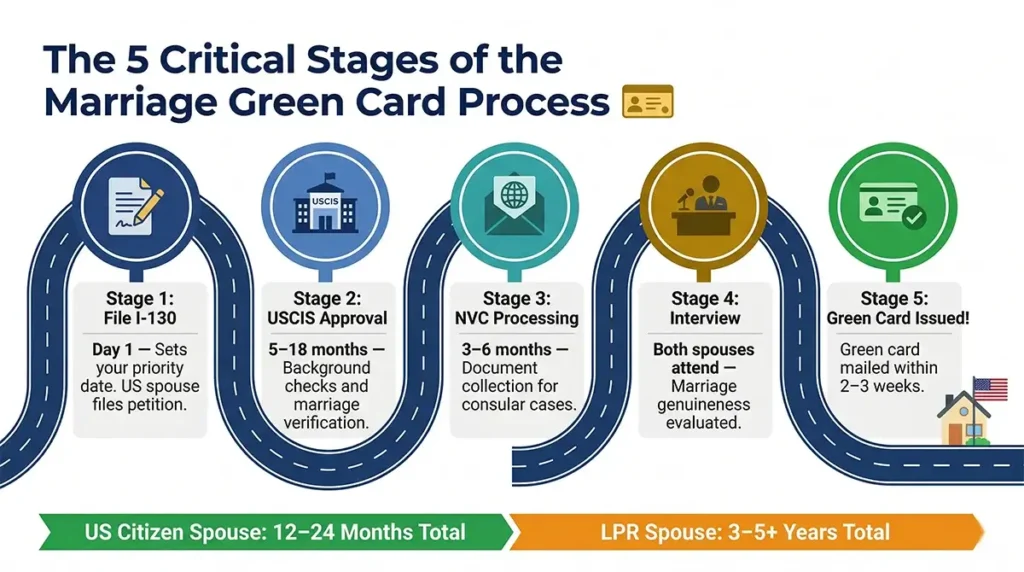
| # | Stage | Who Does It | 2026 Timeline |
| 1 | File I-130 petition | US spouse files with USCIS | 5–18 months processing |
| 2 | USCIS I-130 approval | USCIS reviews and approves | Included in Stage 1 processing time |
| 3 | NVC processing (consular only) | NVC collects documents | 3–6 months (abroad pathway only) |
| 4 | Visa/green card interview | Both spouses attend in person | Scheduled 1–4 months after NVC/I-485 approval |
| 5 | Green card issued and mailed | USCIS or CBP at port of entry | 2–3 weeks after interview/entry |
3. Complete Timeline: Green Card Through Marriage — US Citizen Spouse
This is the most commonly sought pathway — a foreign national married to a US citizen applying for a marriage green card in 2026. There are two sub-pathways based on where the foreign spouse is located:
Path A — Adjustment of Status (Foreign Spouse Inside the US)
Adjustment of Status (AOS) allows a foreign spouse who is already in the US in a valid immigration status (on a visa, student status, work visa, etc.) to apply for the green card without leaving the country.
| Milestone | Timeline | Notes |
| File I-130 + I-485 + I-765 + I-131 (concurrent) | Day 1 | Concurrent filing available for immediate relatives (US citizen spouse) |
| Receipt notices received | 2–4 weeks | I-797 receipt for each form filed |
| Biometrics appointment (fingerprints, photo) | 2–4 months | Required for background check |
| Work authorization (EAD) and Advance Parole | 3–7 months | Allows work and travel during AOS — critical for many couples |
| I-130 approved (if filed separately) | 5–12 months | For concurrent filers, I-130 and I-485 typically processed together |
| USCIS green card interview scheduled | 8–18 months from filing | At local USCIS field office — both spouses must attend |
| Green card approved and mailed | 12–24 months total | If no RFE, no issues at interview, and no USCIS backlog delays |
Path B — Consular Processing (Foreign Spouse Outside the US)
Consular processing is used when the foreign spouse is living outside the US at the time of the marriage green card application. The immigrant visa interview is conducted at the US embassy or consulate in the foreign spouse’s home country.
| Milestone | Timeline | Notes |
| File I-130 with USCIS or US embassy abroad | Day 1 | US citizen spouse files from US; can also file directly at US embassy in some countries |
| I-130 USCIS processing and approval | 5–12 months | Case then transferred to NVC automatically |
| NVC processing — fees, civil documents | 3–6 months | Collect birth certificate, police clearance, medical exam preparation |
| Embassy interview scheduled and completed | 1–4 months after NVC | Both spouses often attend; interview at foreign spouse’s home country embassy |
| Visa stamp issued and travel to US | Within weeks of interview | Foreign spouse must enter US within visa validity period (typically 6 months) |
| Green card mailed after US entry | 12–20 months total | Green card arrives 2–3 weeks after entry through port of entry |
4. Complete Timeline: Green Card Through Marriage — Green Card Holder Spouse
If your US spouse is a lawful permanent resident (LPR) rather than a US citizen, the marriage green card process is fundamentally different — and significantly longer. Your marriage green card falls under the F2A preference category, which has an annual visa cap and requires waiting for your priority date to become current in the monthly Visa Bulletin published by the US State Department.
| Milestone | 2026 Timeline | Key Detail |
| File I-130 petition | Day 1 — sets priority date | Priority date = date I-130 is received by USCIS — this is your place in line |
| I-130 approved by USCIS | 5–18 months | Approval does not mean a visa is available — just that the relationship is recognized |
| Wait for priority date to become current | 2–4+ years (varies) | Check monthly Visa Bulletin at travel.state.gov — F2A category dates |
| NVC processing or I-485 filing when current | 3–8 months | Can file I-485 in US or proceed through consular processing abroad when date is current |
| Biometrics, EAD/AP (if AOS) | 2–5 months after I-485 | Work authorization not available during long priority date wait period |
| Green card interview and approval | 3–5+ years total | Highly variable — depends on country of birth and current F2A backlog |
⚠️ Key Strategy for LPR Spouses:
If your spouse is currently a green card holder but is eligible to naturalize as a US citizen, the single most effective timeline strategy is for your spouse to apply for US citizenship as soon as they are eligible. Upon naturalization, your marriage green card category automatically upgrades from F2A to Immediate Relative — eliminating the priority date wait entirely and potentially saving 2–4 years.
5. Every Form You Need for a Marriage Green Card in 2026
One of the most confusing aspects of the marriage green card process is the volume of forms required. Here is the complete list of forms needed in 2026, organized by pathway:
| Form | Name | Who Files It and Why |
| I-130 | Petition for Alien Relative | US citizen or LPR spouse files to establish the marriage relationship — the first and most important form |
| I-130A | Supplemental Info for Spouse Beneficiary | Foreign spouse completes and submits with I-130 — biographical and immigration history information |
| I-485 | Application to Register Permanent Residence | Foreign spouse files if in the US — the core Adjustment of Status application form |
| I-765 | Application for Employment Authorization | Foreign spouse files with I-485 for work authorization (EAD) while AOS is pending |
| I-131 | Application for Travel Document (Advance Parole) | Foreign spouse files with I-485 to obtain permission to travel outside US during AOS without abandoning the application |
| I-864 | Affidavit of Support | US citizen or LPR spouse files to guarantee they will financially support the foreign spouse — required at 125% of poverty level |
| I-693 | Report of Medical Examination and Vaccination | Foreign spouse completes with USCIS-designated civil surgeon — required for AOS; embassy doctor for consular processing |
| DS-260 | Immigrant Visa Application | Foreign spouse completes online through NVC portal — required for consular processing pathway only |
| I-751 | Petition to Remove Conditions on Residence | Filed jointly by both spouses within 90 days before the 2-year conditional green card expires — to get the 10-year permanent green card |
The total government filing fees for a marriage green card application in 2026 depend on the pathway. For adjustment of status inside the US, total USCIS filing fees for the I-130, I-485, I-765, and I-131 are approximately $1,440–$2,000 (fees adjusted periodically by USCIS). For consular processing abroad, fees are lower — approximately $535–$800 in government fees — but travel and embassy medical exam costs add to the total.
6. The 7 Most Common Causes of Marriage Green Card Delays in 2026
Understanding what causes delays in the marriage green card process allows you to either avoid preventable delays or realistically plan for unavoidable ones:
| # | Delay Cause | How to Avoid or Minimize It |
| 1 | Incomplete or incorrect application forms | Double-check every field — typos, wrong dates, and inconsistent information trigger RFEs that add 3–9 months |
| 2 | Request for Evidence (RFE) response delays | Respond to every RFE within the stated deadline with comprehensive evidence — a weak or late RFE response is grounds for denial |
| 3 | Missing or inadequate bona fide marriage evidence | Submit extensive joint financial records, lease agreements, photos, joint accounts, insurance policies — officers want volume of evidence |
| 4 | Criminal history or immigration violations | Any criminal history — including arrests without conviction — requires disclosure and explanation; consult an immigration attorney before filing |
| 5 | Prior immigration violations or overstays | Prior overstays, unauthorized entries, or prior deportations can trigger 3–10 year bars and require waivers that add 1–2+ years |
| 6 | USCIS or embassy scheduling backlogs | Unavoidable — track your case online and submit InfoPass appointment requests if your case is outside normal processing times |
| 7 | Sponsor income below 125% poverty line (I-864) | If sponsor income is insufficient, use assets (savings, property) to supplement or add a co-sponsor who meets the income requirement |
7. The Conditional Green Card — What Happens After 2 Years
If you and your spouse have been married for less than 2 years at the time your marriage green card is approved, USCIS issues a conditional green card — valid for only 2 years — rather than the standard 10-year permanent green card. This is extremely common and applies to the majority of marriage green card approvals.
Why Does USCIS Issue a Conditional Green Card?
The conditional green card was created by Congress specifically to deter marriage fraud. The 2-year conditional period gives USCIS an opportunity to verify that the marriage is still ongoing and was entered in good faith — not solely for immigration purposes. At the end of the 2-year conditional period, you must apply to have the conditions removed.
Filing Form I-751 to Remove Conditions
To convert your conditional green card to a permanent 10-year green card, both spouses must jointly file Form I-751 (Petition to Remove Conditions on Residence) with USCIS during the 90-day window before the conditional card expires. The I-751 requires evidence that the marriage is still bona fide — continued joint tax returns, bank statements, lease or mortgage documents, photos, and a letter from each spouse explaining your ongoing marital relationship.
USCIS processing of the I-751 in 2026 typically takes 12–24 months. During this time, USCIS issues automatic extension notices that allow the conditional resident to continue living and working in the US legally. When the I-751 is approved, you receive a 10-year permanent green card.
What If You Divorce Before Removing Conditions?
If your marriage ends in divorce before your conditional green card expires or before your I-751 is approved, you may still be eligible to have the conditions removed as an individual. USCIS allows divorced or separated conditional residents to file a waiver of the joint filing requirement, demonstrating that the marriage was entered in good faith — not for immigration purposes. This waiver process is more complex and typically requires immigration attorney assistance.
📌 I-751 Filing Window — Do Not Miss It:
The I-751 joint petition to remove conditions must be filed within the 90-day window immediately before your conditional green card expires — not before this window, and not after. Filing too early or letting the conditional card expire without filing the I-751 can result in loss of your green card status. Set a calendar reminder 91 days before your conditional card’s expiration date.
8. Frequently Asked Questions
Q: Can I work in the US while my marriage green card is being processed?
A: If you are inside the US and filed the I-485 Adjustment of Status, you can apply for an Employment Authorization Document (EAD) on Form I-765, filed concurrently with the I-485. The EAD typically takes 3–7 months to receive and allows you to work for any employer in the US while your green card is pending. If you are going through consular processing abroad, you generally cannot work in the US until you receive the immigrant visa and physically enter the US.
Q: Can I travel outside the US while waiting for my marriage green card?
A: If you are in the US and have filed the I-485 Adjustment of Status, you must obtain Advance Parole (Form I-131) before traveling internationally. Leaving the US without Advance Parole while your I-485 is pending is considered abandonment of your application, and you will not be allowed to re-enter. Advance Parole is typically applied for concurrently with the I-485 and takes 3–7 months to receive.
Q: What is the difference between a conditional and permanent green card?
A: A conditional green card is valid for 2 years and is issued when the foreign spouse has been married less than 2 years at the time of approval. It looks identical to a permanent green card but has a 2-year expiration. To get the permanent 10-year green card, the couple must file Form I-751 jointly within 90 days before the conditional card expires, providing evidence the marriage remains genuine. A permanent green card is valid for 10 years and is renewed without any relationship review.
Q: What happens if USCIS denies my marriage green card?
A: If USCIS or the embassy denies your marriage green card application, you have several options depending on the reason for denial. You can file a Motion to Reopen or Motion to Reconsider within 30 days of the denial if you believe USCIS made an error. You can file an appeal with the Board of Immigration Appeals (BIA) within 30 days. If the denial was for insufficient evidence, you may be able to re-file with stronger documentation. An immigration attorney is strongly recommended for any denied marriage green card case.
Q: Does a prior divorce affect my marriage green card application?
A: Prior divorces by either spouse do not automatically disqualify a marriage green card application. However, you must disclose all prior marriages and provide divorce decrees for each. USCIS uses this information to verify the current marriage is legally valid and that any prior marriages were legally terminated. Multiple prior marriages may increase officer scrutiny but do not constitute legal grounds for denial if the current marriage is genuine and all prior marriages were properly dissolved.
Q: Can I speed up my marriage green card application in 2026?
A: The most effective speed strategies for a marriage green card through a US citizen spouse are: concurrent filing of I-130 and I-485 (saves 6–12 months), submitting a complete and thorough application to avoid RFEs, and proactively gathering all civil documents before filing. For a green card holder spouse, the most effective strategy is for the LPR spouse to naturalize as a US citizen as soon as eligible, eliminating the F2A priority date wait entirely. There is no premium processing available for marriage green card applications as of 2026.
The Bottom Line
Getting a green card through marriage in 2026 takes 12–24 months for the spouse of a US citizen and 3–5+ years for the spouse of a green card holder. The single most important factor in your timeline is the immigration status of your US spouse — and if your spouse is a green card holder, their naturalizing as a US citizen is the most powerful timeline strategy available to you.
For US citizen spouses, the marriage green card process is manageable with thorough preparation. Filing concurrently, submitting comprehensive bona fide marriage evidence, responding promptly to any RFE, and working with an immigration attorney for complex situations (criminal history, prior overstays, prior deportations) are the strategies that produce the fastest and most reliable outcomes.
The marriage green card process is one of the most significant legal processes a couple can go through together. Given the stakes — permanent US residence, the right to work, travel, and eventually citizenship — professional immigration attorney guidance is investment, not expense. Most immigration attorneys offer free initial consultations. Start there.
⚖️ Legal Disclaimer: This article provides general immigration information for educational purposes only. Immigration laws, processing times, fees, and USCIS procedures change frequently. Always verify current information at uscis.gov and consult a licensed immigration attorney for advice specific to your case.

Claire Donovan covers landlord-tenant rights, family law, and senior healthcare law for YourLegalAnswers.com. Her writing focuses on giving renters, families, and aging Americans the legal knowledge they need to protect themselves without paying for a consultation.