⚡ Quick Answer: In California, no divorce can be finalized in less than 6 months from the date the divorce papers are served on your spouse — this is the mandatory waiting period under California Family Code §2339. Simple uncontested divorces typically take 6–8 months total. Contested divorces involving property, children, or support disputes typically take 1–3 years. High-conflict cases can take 3–5+ years if they proceed to trial.
One of the first questions anyone facing a California divorce asks is: how long is this actually going to take? It is a completely reasonable question — divorce affects your housing, your finances, your children, and your ability to move forward with your life. Not knowing the timeline makes everything harder.
The honest answer is that how long a divorce takes in California depends almost entirely on how much you and your spouse agree on. A cooperative, well-prepared couple can complete a California divorce in as little as 6–7 months. A contested divorce involving property division disputes, custody battles, business valuations, or retirement account division can take 2–4 years before a final judgment is entered.
This guide breaks down every California divorce timeline scenario — from the fastest possible uncontested divorce to the longest contested trial — explains every factor that controls how long your California divorce will take, and gives you concrete strategies to shorten the process without compromising your legal rights.
📑 What This Guide Covers
- The 6-Month Mandatory Waiting Period — California’s Unbreakable Rule
- The 5 California Divorce Timeline Scenarios
- Stage-by-Stage Breakdown of the California Divorce Process
- The 8 Factors That Make a California Divorce Take Longer
- How to Speed Up Your California Divorce
- California Divorce Timelines by County — What to Expect
- Do You Need a Divorce Attorney in California?
- Frequently Asked Questions
1. The 6-Month Mandatory Waiting Period — California’s Unbreakable Rule
Before discussing any timeline scenarios, one fact about California divorce law must be understood clearly: there is a mandatory 6-month waiting period that applies to every single divorce in California without exception.
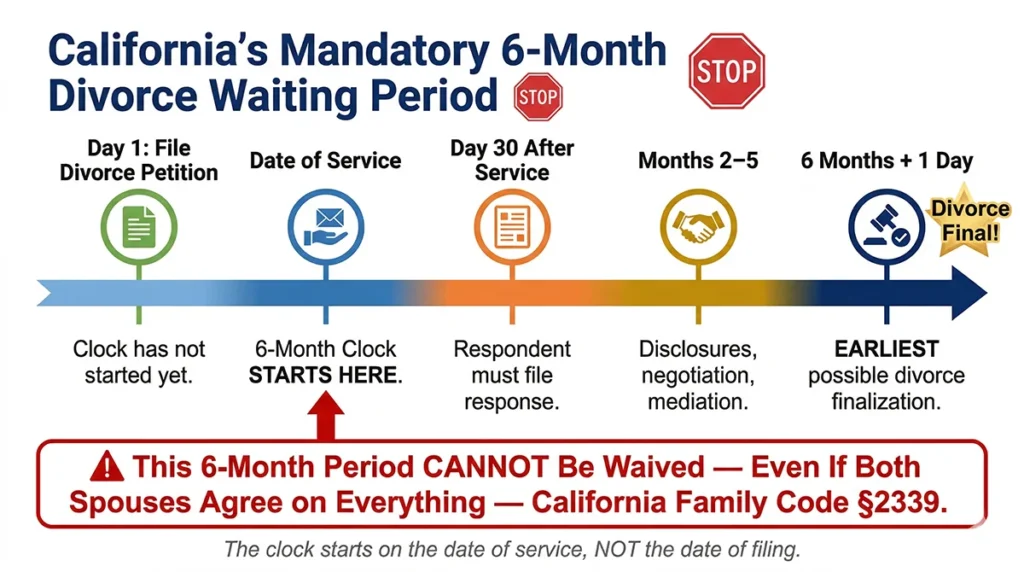
Under California Family Code §2339, no divorce judgment can be entered until at least 6 months have passed from the date the divorce petition was served on the respondent spouse — or from the date the respondent spouse filed a response, if earlier. This waiting period is called the interlocutory period, and it cannot be waived, shortened, or avoided by any agreement between the spouses.
📌 The 6-Month Rule in Plain English:
Even if you and your spouse agree on everything — property, children, support — and you complete all your paperwork on day one, California law will not let a judge finalize your divorce until 6 months have passed from the date your spouse was served. The earliest any California divorce can be completely finalized is 6 months and 1 day after service of the divorce petition.
This 6-month period was designed by the California Legislature to give couples time to reconsider their decision and to allow both spouses time to understand the legal and financial consequences of the divorce before it becomes final. During this waiting period, the parties can reach agreements, complete financial disclosures, and resolve any disputes — but the court cannot enter a final divorce judgment.
One common misconception is that the 6 months starts when you file the divorce petition. It does not. The 6-month clock starts on the date your spouse is served with the divorce papers — which can be days or weeks after the initial filing. If service is delayed or if the respondent spouse is difficult to locate, the effective waiting period can be longer than 6 months from the filing date.
2. The 5 California Divorce Timeline Scenarios
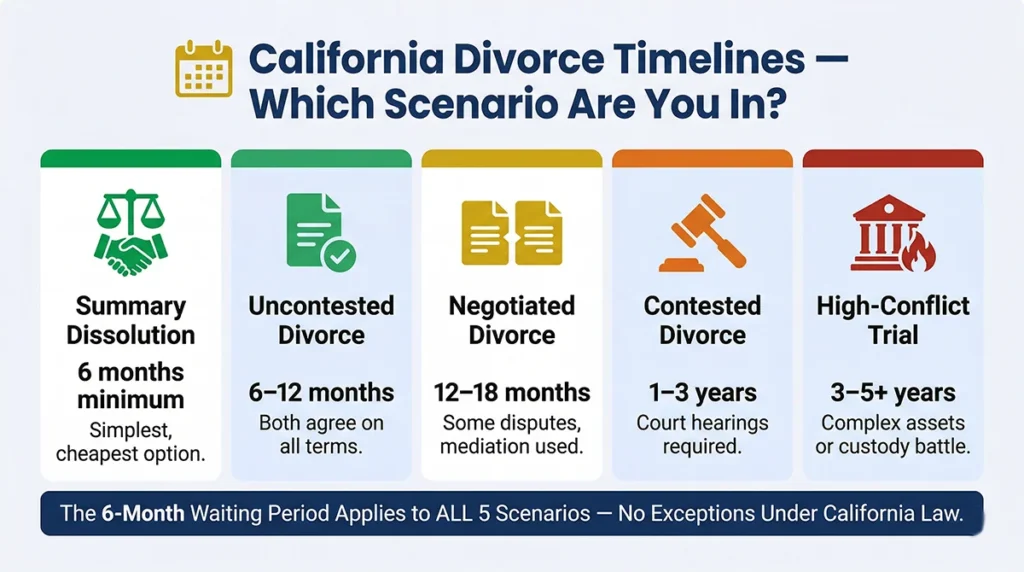
California divorces fall into 5 broad timeline categories based on complexity and the level of agreement between spouses. Understanding which scenario matches your situation is the starting point for planning your California divorce timeline:
| Divorce Type | Timeline | Typical Cost | Best For |
| Summary Dissolution | 6 months minimum | Under $500 total | Short marriages (<5 yrs), no children, limited assets/debt, both agree on everything |
| Uncontested Divorce (Default) | 6–8 months | $500 – $2,500 | Respondent does not respond — petitioner proceeds by default judgment |
| Uncontested Divorce (Agreed) | 6–12 months | $1,500 – $5,000 | Both spouses agree on all terms — property, children, support — and submit a marital settlement agreement |
| Contested Divorce | 1–3 years | $15,000 – $75,000+ | Disputes over property division, custody, spousal support, or business valuation require judicial resolution |
| High-Conflict / Trial Divorce | 3–5+ years | $50,000 – $200,000+ | Complex assets, business interests, custody disputes, domestic violence, or one spouse determined to fight everything |
Summary Dissolution — The Fastest California Divorce Option
Summary dissolution is a simplified divorce procedure available in California for couples who meet all of the following strict requirements under California Family Code §2400:
- Married for less than 5 years
- No children born or adopted during the marriage (and no pending pregnancy)
- No real estate ownership (renting only)
- Total debts incurred during marriage are under $6,000 (excluding car loans)
- Total marital property is under $47,000 in value
- Neither spouse owns separate property worth over $47,000
- Both spouses agree to waive spousal support
- Both spouses have signed a property settlement agreement
If you qualify for summary dissolution, it is significantly cheaper and faster than a standard divorce. Both spouses file a joint petition at the courthouse, and after the 6-month waiting period, either spouse can file to have the divorce finalized. No court appearance is required in most summary dissolution cases.
3. Stage-by-Stage Breakdown of the California Divorce Process
Whether your divorce is contested or uncontested, every California divorce follows the same basic procedural stages. Understanding this timeline helps you know where you are in the process and what comes next:
| # | Stage | What Happens | Typical Duration |
| 1 | Filing the Petition (FL-100) | Petitioner files divorce petition with the Superior Court in their county. Court fee: $435–$450. | Day 1 |
| 2 | Serving the Respondent | Respondent spouse is formally served with divorce papers by a process server or sheriff. This starts the 6-month clock. | Within 60 days of filing |
| 3 | Respondent’s Response (FL-120) | Respondent has 30 days to file a Response. If no response, petitioner can proceed by default. | 30 days after service |
| 4 | Preliminary Financial Disclosures | Both spouses must exchange Declarations of Disclosure (FL-140, FL-142, FL-150) within 60 days of the petition/response. | Within 60 days of petition/response |
| 5 | Discovery (Contested Only) | Formal exchange of financial information through interrogatories, depositions, and document requests. Can take 6–18 months. | 6–18 months (contested) |
| 6 | Mediation or Settlement Conference | California courts require most divorcing couples to attempt mediation for custody disputes. Many financial disputes also settle here. | 1–6 months |
| 7 | Marital Settlement Agreement (MSA) | If spouses agree on all terms, they sign an MSA covering property, custody, support. This is submitted to the court. | When agreement reached |
| 8 | Trial (Contested Only) | If no settlement, a judge decides contested issues at trial. Family law trials in California take 1–5 days of court time but may be scheduled months apart. | 1–3+ years (contested) |
| 9 | Final Judgment of Dissolution | After 6-month waiting period expires AND all issues resolved, judge signs the Judgment of Dissolution. Divorce is final. | 6 months minimum from service |
The most important document in the California divorce process is the Judgment of Dissolution — the court order signed by the judge that officially ends your marriage. Until this document is signed and filed by the court, you are still legally married in California, regardless of how long you have been separated or how complete your settlement agreement is.
4. The 8 Factors That Make a California Divorce Take Longer
Understanding what extends a California divorce timeline allows you to either prepare for a longer process or take deliberate steps to avoid the delays. These are the 8 most significant factors that extend how long a divorce takes in California:
Factor 1 — Child Custody and Visitation Disputes
Nothing extends a California divorce timeline more reliably than child custody disputes. When parents cannot agree on legal custody, physical custody, or visitation schedules, the court becomes involved — requiring mediation through the Family Court Services department, custody evaluations by licensed evaluators (which take 3–6 months alone), multiple hearings, and sometimes a full trial on custody issues only.
California courts must determine custody based on the best interests of the child — a standard that considers dozens of factors. This analysis takes time, and custody evaluations can add 6–12 months to a contested California divorce timeline.
Factor 2 — Complex Property and Asset Division
California is a community property state — all assets and debts acquired during the marriage are generally split 50/50. When assets are complex — a family business, stock options, pension plans, real estate investments, cryptocurrency, or offshore accounts — determining what is community versus separate property requires forensic accountants, business valuation experts, and real estate appraisers.
Each expert takes time to hire, prepare, and submit reports. Opposing experts are common in high-asset divorces, meaning each side has their own appraiser or business valuator who disagrees — requiring a judge to decide. This process adds 6–18 months to a California divorce timeline.
Factor 3 — Spousal Support (Alimony) Disputes
When one spouse earns significantly more than the other, spousal support — called alimony or spousal maintenance in other states — is a heavily contested issue in California divorce proceedings. Disputes over the amount, duration, and terms of spousal support require financial expert testimony, analysis of both spouses’ earning capacity, and the court’s application of the 14 factors listed in California Family Code §4320. This adds months to the divorce timeline.
Factor 4 — One Spouse Is Uncooperative or Difficult to Serve
If the respondent spouse refuses to be served, moves without leaving a forwarding address, or is overseas, serving them with divorce papers becomes a legal obstacle. California courts allow substitute service and, ultimately, service by publication in a newspaper — but each workaround requires court permission and additional time. Publication service alone typically adds 4–8 weeks to a California divorce timeline.
Factor 5 — Failure to Complete Financial Disclosures
California law requires both spouses to exchange full financial disclosures — including all income, assets, debts, and expenses — within 60 days of the petition and response. When one spouse fails to provide complete disclosures, the other can file a motion to compel compliance. This court process adds weeks or months and creates adversarial tension that makes negotiated settlements harder to achieve.
Factor 6 — Court Backlogs by County
California’s family courts are chronically underfunded and backlogged. Hearing dates in busy counties like Los Angeles, San Diego, and the San Francisco Bay Area can be scheduled 3–6 months out for routine motions and 12–18 months out for trial dates. Even if you and your spouse resolve everything quickly, the court’s calendar controls how soon the final judgment can be entered.
Factor 7 — Domestic Violence or Restraining Orders
When domestic violence is involved, a California divorce involves additional legal proceedings — Domestic Violence Restraining Order (DVRO) hearings, emergency protective orders, and potentially criminal proceedings running parallel to the family law case. Each additional legal proceeding slows the divorce timeline and adds complexity to property and custody determinations.
Factor 8 — Appeals or Post-Judgment Motions
After a trial judge issues a divorce judgment in California, either spouse can appeal to the Court of Appeal, which adds 1–3 years to the final resolution. Even without an appeal, post-judgment motions to modify custody, support, or property terms are common and can keep parties in litigation for years after the initial divorce judgment is entered.
5. How to Speed Up Your California Divorce
While you cannot eliminate the 6-month waiting period, there are concrete steps that meaningfully shorten how long a California divorce takes beyond the mandatory minimum:
| Strategy | How It Shortens Your California Divorce Timeline |
| Serve your spouse immediately after filing | The 6-month clock starts on the date of service — every day you delay filing extends your minimum timeline by a day |
| Submit complete financial disclosures on time | Late or incomplete disclosures trigger motions to compel — adding months and thousands in attorney fees |
| Use a mediator for all disputes | Private mediation is faster and cheaper than court litigation — a skilled mediator can resolve custody and property in 2–4 sessions versus 12+ months of litigation |
| Hire a family law attorney who files promptly | Attorneys who know the local court’s filing procedures and judicial preferences can avoid unnecessary delays that inexperienced attorneys cause |
| Agree on a temporary orders arrangement | Temporary orders for custody, support, and property use reduce conflict and urgency during the waiting period, making a final settlement more likely |
| Use a divorce financial analyst (CDFA) | A Certified Divorce Financial Analyst helps both parties understand the financial implications of settlement options — reducing disagreements that would otherwise require a judge |
| Consider Collaborative Divorce | Collaborative divorce in California involves both attorneys committing to settlement — no court litigation. Typically resolves in 6–18 months compared to 2–4 years for contested cases |
💡 Fastest Strategy:
The single most effective way to shorten a California divorce is to reach a complete written settlement agreement — covering all property, debt, custody, and support — before the 6-month waiting period expires. When both spouses submit a complete Marital Settlement Agreement at or near the 6-month mark, the divorce can be finalized almost immediately after the waiting period ends.
6. California Divorce Timelines by County — What to Expect
In addition to the complexity of your divorce, the county where you file significantly affects how long your California divorce takes. Family court backlogs vary dramatically across California counties:
| County | Uncontested Timeline | Contested Timeline | Backlog Level |
| Los Angeles County | 7–10 months | 2–4+ years | Very High |
| San Diego County | 6–9 months | 18 months – 3 years | High |
| Alameda County (Oakland) | 7–10 months | 2–3+ years | Very High |
| Santa Clara County (San Jose) | 7–9 months | 2–3 years | High |
| Orange County | 6–8 months | 18 months – 2.5 years | Medium-High |
| Sacramento County | 6–8 months | 18 months – 2 years | Medium |
| Riverside County | 6–8 months | 1.5 – 2.5 years | Medium |
| San Bernardino County | 6–8 months | 1.5 – 2.5 years | Medium |
| Fresno County | 6–7 months | 1–2 years | Lower |
Los Angeles County consistently has the worst family court backlogs in California. Trial dates in LA Superior Court’s family law division can be set 18–24 months after a case is filed, and courtrooms are oversubscribed. If you are in Los Angeles and facing a contested divorce, early and aggressive mediation is not just advisable — it is almost economically necessary given how long a Los Angeles divorce takes compared to smaller counties.
7. Do You Need a Divorce Attorney in California?
Whether you need a divorce attorney in California depends on the complexity of your case. Here is an honest breakdown:
When You Can Handle Your California Divorce Without an Attorney:
- You qualify for summary dissolution — short marriage, no children, minimal assets
- Your divorce is fully uncontested and you and your spouse agree on all terms in writing
- Your financial situation is straightforward — no business, no significant retirement accounts, no real estate
- You have no children, or you have a co-parenting arrangement you are both satisfied with
- California Courts Self-Help Center (courts.ca.gov/selfhelp) provides all necessary forms for self-represented divorcing spouses
When You Should Hire a California Divorce Attorney:
- Children are involved and custody or visitation is disputed
- One spouse significantly out-earns the other — spousal support calculation is complex and high-stakes
- You or your spouse own a business, stock options, professional practice, or partnership interest
- You have significant retirement accounts (401k, pension, CalPERS) — dividing these requires a QDRO
- You own real estate — community versus separate property characterization requires legal analysis
- Domestic violence is a factor — protective orders and safe process are essential
- Your spouse has hired an attorney — self-representation against an experienced family law attorney puts you at a severe disadvantage
California family law attorneys typically charge $250–$650 per hour. For complex contested divorces, total attorney fees of $25,000–$100,000+ per spouse are not unusual. However, many California divorce attorneys offer free initial consultations, payment plans, and some offer flat-fee packages for uncontested divorces starting at $1,500–$3,000.
If cost is a concern, consider Collaborative Divorce — a process where both spouses and their attorneys commit to reaching a settlement without litigation. Collaborative divorce in California typically costs significantly less than contested litigation and takes less time.
8. Frequently Asked Questions
Q: Can you get a divorce in less than 6 months in California?
A: No. California Family Code §2339 imposes a mandatory 6-month waiting period that cannot be waived by any agreement, order, or judge. The earliest any California divorce can be finalized is 6 months and 1 day after the date the respondent spouse was served with the divorce petition. Even if both spouses agree on everything and submit all paperwork on day one, the court cannot enter a final judgment until this period has passed.
Q: What is the difference between contested and uncontested divorce in California?
A: An uncontested California divorce is one where both spouses agree on all issues — property division, debt allocation, child custody, visitation, child support, and spousal support — and submit a written Marital Settlement Agreement to the court. A contested divorce is one where the spouses cannot reach agreement on one or more issues and require a judge to decide. Uncontested divorces typically take 6–12 months in California. Contested divorces typically take 1–3+ years.
Q: How long does a divorce take in California with children?
A: A California divorce involving children takes longer because child custody and visitation must be determined — either by agreement or by the court. If parents agree on custody, a California divorce with children can still be completed in 6–12 months. If custody is disputed, add 6–18 months for mediation, custody evaluations, and court hearings. California courts require parents to attempt mediation through Family Court Services before a judge will make custody orders.
Q: Does it matter who files for divorce first in California?
A: In terms of the divorce outcome — property division, custody, support — filing first makes no legal difference in California. California is a no-fault divorce state, meaning neither spouse is required to prove wrongdoing, and filing first gives no legal advantage in how assets are divided or custody is determined. However, filing first does mean you control when the 6-month clock starts, and the petitioner typically presents their case first in court proceedings.
Q: What is the date of separation and why does it matter in a California divorce?
A: The date of separation is the date one spouse communicated their decision to end the marriage and acted consistently with that decision. It matters enormously in a California divorce because community property accumulation stops on the date of separation. Income earned, debt incurred, and assets acquired after the date of separation are separate property — not subject to 50/50 division. Disputes over the date of separation are common in California divorces and can affect the division of significant assets.
Q: Can you date while going through a divorce in California?
A: Legally, you can date after physical separation in California — but it is not advisable during an ongoing divorce, particularly if children are involved or spousal support is at issue. California is a no-fault divorce state, so dating does not affect property division. However, a new partner’s presence can inflame custody disputes, affect temporary support orders, and create credibility issues if you are claiming financial need. Most California family law attorneys advise clients to wait until the divorce is finalized before dating.
The Bottom Line
How long a divorce takes in California comes down to one overriding factor: how much you and your spouse agree on. The mandatory 6-month waiting period is unavoidable, but everything beyond that is within your control — if you are both willing to communicate, negotiate, and compromise.
A cooperative, well-prepared uncontested California divorce can be complete in 6–8 months. A contested divorce where both spouses dig in and fight every issue can take 3–5 years and consume hundreds of thousands of dollars in attorney fees. For most couples, the financial and emotional cost of extended litigation far exceeds the value of whatever they were fighting over.
If you are facing a California divorce, the most important steps you can take right now are: consult a California family law attorney to understand your rights before making any agreements, serve your spouse promptly to start the 6-month clock, exchange complete financial disclosures on time, and make a genuine effort to resolve disputes through mediation before court litigation. Your future self — and your bank account — will thank you for it.
⚖️ Legal Disclaimer: This article provides general legal information about California divorce timelines for educational purposes only. Timelines shown are estimates based on typical cases and court conditions that change over time. Your specific case may vary significantly. Always consult a licensed California family law attorney for advice specific to your situation.