⚡ Quick Answer: To apply for Social Security Disability (SSDI or SSI) in 2026, you can apply online at ssa.gov, by phone at 1-800-772-1213, or in person at your local SSA office. The process has 7 key steps: check eligibility, gather medical records, complete the application, submit supporting documents, wait for the initial decision (3–6 months), and appeal if denied. Over 60% of initial SSDI applications are denied — the quality of your medical evidence is the single biggest factor in approval.
Applying for Social Security Disability benefits is one of the most important financial decisions a disabled American can make — and one of the most confusing processes the US government has ever designed. The Social Security Administration (SSA) processes millions of disability applications every year, and the denial rate for first-time applicants consistently exceeds 60%.
The difference between an approved Social Security Disability application and a denied one almost always comes down to preparation — specifically, the quality and completeness of your medical evidence, the accuracy of your work history documentation, and whether you understand the SSA’s definition of disability before you file.
This complete 2026 guide walks you through every step of the Social Security Disability application process — from checking your basic eligibility before you apply, to understanding exactly what happens after you submit, to the appeal options available when the SSA denies your claim. Whether you are applying for SSDI, SSI, or both, this guide covers everything you need to know.
📑 What This Guide Covers
- SSDI vs SSI — Which Program Should You Apply For?
- SSDI Eligibility Requirements for 2026
- The 7 Proven Steps to Apply for Social Security Disability
- The 7 Biggest Mistakes That Get SSDI Applications Denied
- What Happens After You Apply — The Review Process
- The SSDI Appeal Process — 4 Levels Explained
- Do You Need a Disability Attorney to Apply for SSDI?
- Frequently Asked Questions
1. SSDI vs SSI — Which Social Security Disability Program Should You Apply For?
Before you apply for Social Security Disability, you must understand which program or programs you are applying for. The SSA administers two separate disability benefit programs that are frequently confused:
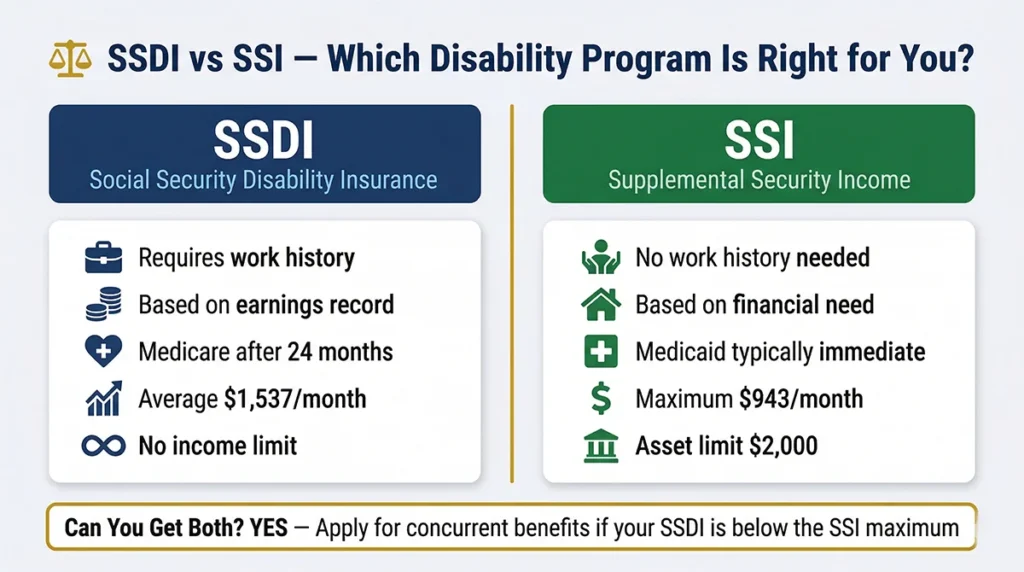
| Feature | SSDI — Social Security Disability Insurance | SSI — Supplemental Security Income |
| Based on | Your work history and Social Security tax contributions | Financial need — income and assets, not work history |
| Work history required? | Yes — must have sufficient work credits (usually 5 of last 10 years) | No — available to disabled people with limited income/resources |
| Age requirement | Must have worked; under full retirement age | Available to disabled adults and children of any age |
| 2026 Monthly Benefit | Average $1,537/month (based on earnings record) | Maximum $943/month (federal benefit rate) |
| Medicare / Medicaid | Medicare after 24-month waiting period | Medicaid typically automatic upon SSI approval |
| Income / asset limits | No income or asset limit for benefits themselves | Income limit applies; asset limit $2,000 (individual) / $3,000 (couple) |
| Can you apply for both? | Yes — if you meet eligibility for both SSDI and SSI, you can receive both simultaneously (called concurrent benefits) | Yes — concurrent benefits possible if SSDI payment is below SSI maximum |
💡 Apply for Both if Eligible:
If you are applying for Social Security Disability and you qualify for SSDI based on your work history but your SSDI benefit would be below the SSI maximum, apply for both programs simultaneously. The SSA will process both applications and pay you the higher of the two — or a combination if you qualify for concurrent benefits.
2. SSDI Eligibility Requirements for 2026
Before investing time in the Social Security Disability application process, verify that you meet the SSA’s basic eligibility requirements. Being denied for a technical eligibility reason — rather than a medical one — wastes months of waiting time.
Medical Eligibility — The SSA’s Definition of Disability
The SSA’s definition of disability for SSDI purposes is strict — significantly stricter than many people expect. To qualify for Social Security Disability benefits, you must have a medically determinable physical or mental impairment that:
- Has lasted, or is expected to last, at least 12 continuous months, OR is expected to result in death
- Prevents you from performing any Substantial Gainful Activity (SGA) — not just your previous job
- Is documented by objective medical evidence — symptoms alone, without supporting clinical findings, are not sufficient
The SGA limit for 2026 is $1,550 per month for non-blind individuals and $2,590 for blind individuals. If you are earning more than these amounts, you are presumed not disabled regardless of your medical condition.
Work Credit Requirements for SSDI
SSDI is an insurance program funded by Social Security taxes from your paychecks. To qualify, you must have accumulated sufficient work credits through your employment history. Work credits are based on your total yearly wages or self-employment income. In 2026, you earn one work credit for each $1,730 in covered earnings, up to a maximum of 4 credits per year.
| Your Age at Disability Onset | Credits Required | Recent Work Requirement |
| Under 24 | 6 credits | Earned in 3 years before disability |
| 24–31 | Credit for half the time since age 21 | Proportional recent work requirement |
| 31–42 | 20 credits | Earned in 10 years before disability |
| 44 | 22 credits | Earned in last 10 years |
| 50 | 28 credits | Earned in last 10 years |
| 60 | 38 credits | Earned in last 10 years |
| 62 or older | 40 credits | 20 earned in last 10 years |
3. The 7 Proven Steps to Apply for Social Security Disability in 2026
This is the complete, proven process for applying for Social Security Disability in 2026. Follow every step in order. Skipping steps or submitting an incomplete application is the leading cause of unnecessary SSDI denials.
Step 1 — Verify Your Eligibility Before You Apply
Before beginning the Social Security Disability application, confirm two things: first, that your medical condition meets the SSA’s 12-month duration requirement and prevents all substantial gainful activity; and second, that you have sufficient work credits for SSDI (or that you meet the income and asset requirements for SSI).
You can check your estimated work credits and projected SSDI benefit amount for free by creating an account at ssa.gov/myaccount. This tool shows your complete Social Security earnings record and your estimated disability benefit based on your actual earnings history. Reviewing this before you apply prevents surprises and helps you understand exactly what benefits you are applying for.
Step 2 — Gather Your Complete Medical Records Before Filing
Medical evidence is the single most important component of a Social Security Disability application. The SSA’s disability examiners must be able to verify your condition, its severity, its duration, and its functional limitations entirely from the documents you provide. Incomplete medical records are the most common reason for SSDI denials.
Before you apply for Social Security Disability, collect the following medical documentation:
- Names, addresses, phone numbers, and fax numbers of all treating physicians
- Names of all hospitals, clinics, and medical facilities where you have received treatment
- Dates of all medical visits, hospitalizations, surgeries, and treatments
- Names and dosages of all current and recent medications and their side effects
- All medical test results — lab work, imaging (MRI, X-ray, CT scans), and specialist reports
- Mental health treatment records if your disability includes a mental health component
- Workers compensation or prior disability records if applicable
📌 Critical Documentation Tip:
The SSA will request records from your doctors directly, but this process is slow and often incomplete. Get copies of your own complete medical records before you apply and upload them with your application. Proactively providing thorough medical records rather than waiting for the SSA to request them can shorten your processing time by 2–3 months.
Step 3 — Gather Your Personal and Work History Information
In addition to medical records, the Social Security Disability application requires detailed personal and employment information. Gather all of the following before you begin:
- Social Security number and proof of age (birth certificate or passport)
- Proof of US citizenship or immigration status
- Complete employment history for the past 15 years — employer names, addresses, job titles, dates
- Description of job duties for each position in the past 15 years
- W-2 forms or self-employment tax returns for the past year
- Banking information for direct deposit of benefits
- Contact information for someone who can provide information about your condition if needed
- For SSI only: financial information including bank accounts, property, and other assets
Step 4 — Choose Your Application Method and Complete the Application
There are three ways to apply for Social Security Disability in 2026. Each has advantages depending on your situation:
| Application Method | How to Use It | Best For |
| Online — ssa.gov/applyfordisability | Complete application at ssa.gov — takes 60–90 minutes, can save and return to it | Most applicants — fastest processing, available 24/7, immediate confirmation |
| Phone — 1-800-772-1213 | Call SSA and complete the application by phone with an agent (Monday–Friday, 8am–7pm) | Applicants who prefer assistance or have difficulty using computers |
| In Person — Local SSA Office | Visit your nearest SSA office — find location at ssa.gov/locator | Complex situations, SSI applicants, those needing interpretive services |
The online application at ssa.gov is the SSA’s recommended method and typically results in faster processing. You will receive an application confirmation number immediately after submitting online, which you use to track your application status. For SSI applications, an in-person or phone appointment is often required because SSI involves a financial eligibility interview.
Step 5 — Complete the Function Report and Work History Report
After submitting the initial Social Security Disability application, the SSA will send you two critically important supplemental forms that most applicants underestimate:
The Adult Function Report (SSA-787) asks detailed questions about how your disability affects your daily activities — your ability to dress yourself, cook, shop, drive, concentrate, follow instructions, handle stress, and interact with others. This report directly impacts whether the SSA determines your disability is as limiting as your medical records suggest. Be thorough and specific — describe your worst days, not your best days.
The Work History Report (SSA-3369) asks for detailed descriptions of every job you held in the past 15 years — the physical demands, tools used, lifting requirements, and skills involved. This report is used to determine whether you can return to past work or transition to other types of work. Accurate, detailed descriptions of your heaviest job duties strengthen your Social Security Disability application.
⚠️ Most Common Mistake on Function Report:
Applicants routinely understate their limitations on the Adult Function Report because they do not want to appear helpless or because they describe what they can do on a good day. The SSA evaluates your ability to work full-time, every day. If completing a task causes significant pain, takes much longer than normal, or requires rest afterward — say so explicitly. Understating limitations is a leading cause of Social Security Disability application denials.
Step 6 — Submit to the Disability Determination Services (DDS)
After the SSA processes your initial application, your case is transferred to your state’s Disability Determination Services (DDS) office — the agency that actually evaluates whether you meet the medical criteria for Social Security Disability benefits. A DDS examiner — typically paired with a medical consultant — will review your complete file.
The DDS examiner may request that you attend a Consultative Examination (CE) — a medical examination paid for by the SSA with an SSA-contracted doctor. A CE is typically ordered when your own medical records are incomplete or insufficient to make a determination. Attend all scheduled CEs — missing one without a valid reason is grounds for denying your Social Security Disability application without evaluation.
Step 7 — Track Your Application and Respond Promptly to All SSA Requests
After submitting your Social Security Disability application, track its status online through your My Social Security account at ssa.gov/myaccount. The initial decision typically takes 3–6 months from the date of application, though processing times vary significantly by state and current SSA backlogs.
During the review period, respond to every SSA request within the stated deadline — typically 10 days for document requests. Failure to respond promptly is treated as non-cooperation and can result in your Social Security Disability application being denied without a medical determination. Update the SSA immediately if your condition worsens, you are hospitalized, or you start or stop medical treatment.
| # | Step | Key Action | Timeline |
| 1 | Verify eligibility | Check work credits at ssa.gov/myaccount | Before applying |
| 2 | Gather medical records | Collect all records, test results, medications | 1–2 weeks before filing |
| 3 | Gather personal/work history | Employment records, SSN, financial info (SSI) | Before applying |
| 4 | Complete the application | Online (fastest), phone, or in person | Application day |
| 5 | Complete Function + Work History Reports | Describe worst-day limitations — be specific | Within 10 days of request |
| 6 | DDS medical review | Attend CE if scheduled; submit additional records | 3–6 months post-application |
| 7 | Track and respond | Monitor ssa.gov/myaccount; respond within 10 days | Throughout process |
4. The 7 Biggest Mistakes That Get Social Security Disability Applications Denied
The SSA denies over 60% of initial Social Security Disability applications every year. Understanding the most common avoidable mistakes dramatically improves your chances of approval at the initial application stage:
| # | Mistake | How to Avoid It |
| 1 | Incomplete or missing medical records | Proactively gather and submit all records — do not wait for SSA to request them from your doctors |
| 2 | Understating limitations on Function Report | Describe your worst days and how long tasks take — never describe your best possible performance |
| 3 | Gaps in medical treatment | Maintain consistent treatment — gaps suggest your condition is not severe or is under control |
| 4 | Missing SSA deadlines or not responding | Treat every SSA communication as urgent — respond within stated deadlines or call for an extension |
| 5 | Failing to follow prescribed treatment | Follow all doctor recommendations — non-compliance with treatment is an independent grounds for denial |
| 6 | Earning above the SGA limit ($1,550/month) | If working, ensure earnings are below the SGA limit — earnings above this level mean automatic disqualification |
| 7 | Not appealing a denial | Over 60% of initial applications are denied — denial is not the end. Appeal within 60 days using the process in Section 6 |
5. What Happens After You Apply for Social Security Disability
After you submit your Social Security Disability application, the SSA follows a five-step sequential evaluation process to determine if you qualify for disability benefits. Understanding this process helps you understand how and why decisions are made.
| Step | Question Asked | How SSA Evaluates It |
| 1 | Are you working? | If earning above SGA ($1,550/month in 2026) → automatically NOT disabled. Application denied at Step 1. |
| 2 | Is your condition severe? | Must significantly limit basic work activities for at least 12 months. Minor conditions denied at Step 2. |
| 3 | Is your condition on the Blue Book list? | SSA Blue Book lists conditions that automatically qualify. If your condition meets a listing → automatically approved. |
| 4 | Can you do your past work? | If your RFC (Residual Functional Capacity) allows past work → denied. RFC assessed from medical evidence. |
| 5 | Can you do any other work? | SSA considers age, education, work experience, and RFC. If no other work exists that you can do → approved. |
The key insight from this five-step process is that you do not need to have a condition listed in the SSA Blue Book to qualify for Social Security Disability. Steps 4 and 5 allow approval based on the combination of your functional limitations and your background — age, education, and work history. This is why older applicants with limited education and physical work histories are often approved even when their condition is not on the Blue Book list.
6. The SSDI Appeal Process — 4 Levels Explained
If your Social Security Disability application is denied — which happens to over 60% of first-time applicants — do not give up. The SSDI appeal process has four levels, and success rates increase significantly at each stage. You must file your appeal within 60 days of receiving your denial notice.
Level 1 — Reconsideration
Reconsideration is a complete review of your Social Security Disability application by a different SSA examiner who was not involved in the original decision. You can submit additional medical evidence at this stage — and you should. The approval rate at reconsideration is approximately 10%–15%, which is low, but the reconsideration is a required step before you can request a hearing. File within 60 days of your initial denial.
Level 2 — Administrative Law Judge (ALJ) Hearing
The ALJ hearing is the most important stage in the Social Security Disability appeal process — and the one with the highest approval rate. Approximately 45%–55% of SSDI claimants who reach an ALJ hearing are approved. At the hearing, you present your case before an SSA administrative law judge, who may question you, your medical expert, and a vocational expert about your limitations and work capacity.
Having a disability attorney at your ALJ hearing is extremely valuable. Attorneys know how to present medical evidence, question vocational experts, and argue the medical-vocational guidelines (the ‘Grid Rules’) that often determine approval for older applicants. The approval rate with attorney representation at ALJ hearings is significantly higher than for self-represented claimants.
Level 3 — Appeals Council Review
If the ALJ denies your Social Security Disability claim, you can request review by the SSA’s Appeals Council within 60 days. The Appeals Council reviews ALJ decisions for legal errors and may approve your claim, remand it back to the ALJ for a new hearing, or deny review (which means the ALJ decision stands). Approval rates at the Appeals Council are low — under 10% — but it is a necessary step before federal court.
Level 4 — Federal District Court
If the Appeals Council denies review or upholds the ALJ denial, you can file a civil lawsuit in US District Court within 60 days. Federal court reviews are limited to whether the SSA followed proper legal procedures and whether the denial was supported by substantial evidence. Federal court reversal rates vary by district, but some districts reverse SSA denials at rates of 30%–40% when represented by experienced Social Security disability attorneys.
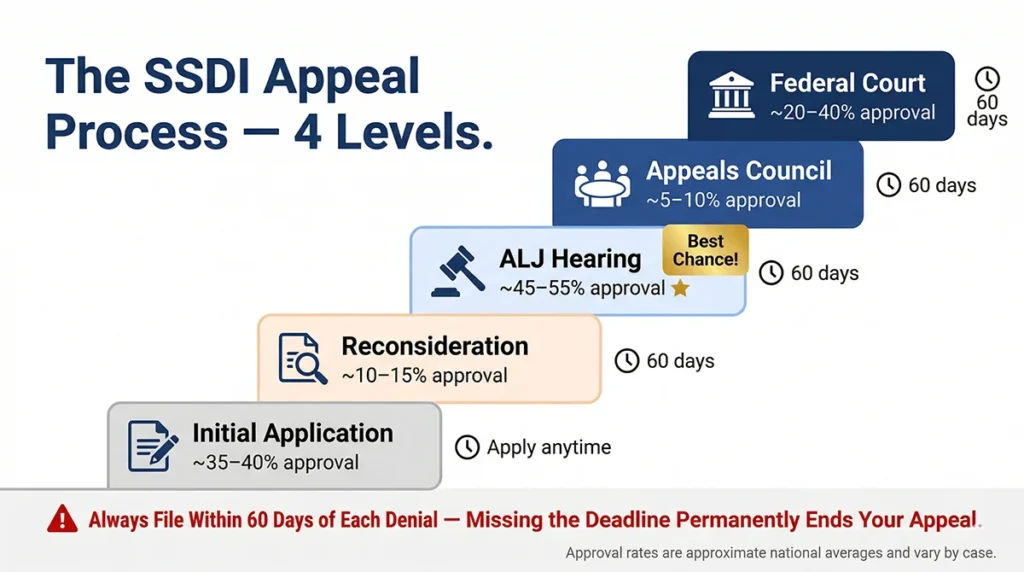
| Appeal Level | Approval Rate | Deadline to File | Attorney Recommended? |
| Initial Application | ~35%–40% | N/A — apply anytime | Helpful |
| Reconsideration | ~10%–15% | 60 days from denial | Helpful |
| ALJ Hearing | ~45%–55% | 60 days from recon. denial | Strongly Recommended |
| Appeals Council | ~5%–10% | 60 days from ALJ denial | Strongly Recommended |
| Federal District Court | ~20%–40% | 60 days from AC denial | Essential |
7. Do You Need a Disability Attorney to Apply for SSDI?
For the initial Social Security Disability application, having an attorney is helpful but not essential. For any level of appeal — particularly the ALJ hearing — an attorney dramatically improves your chances of approval.
Social Security Disability attorneys work on a contingency fee structure regulated by the SSA. Their fee is limited by law to the lesser of 25% of your back pay award or $7,200 (the 2026 SSA cap). There is no upfront cost and no fee at all if your claim is denied. The SSA withholds the attorney fee directly from your first payment — you never write a check.
Studies consistently show that SSDI claimants represented by attorneys are approved at significantly higher rates at every stage of the process. At the ALJ hearing level — where the outcome of most SSDI claims is determined — represented claimants are approved at rates approximately 25%–30% higher than unrepresented claimants.
| What a Disability Attorney Does For You | Attorney Fee Structure |
| Gathers and organizes all medical evidence before filing or appeal | Contingency fee — 0% upfront, 25% of back pay OR $7,200 cap (whichever is less) |
| Identifies additional conditions to include in your disability claim | SSA withholds fee directly — you never pay out of pocket |
| Prepares you for the ALJ hearing — questions, testimony strategy | No fee at all if your claim is ultimately denied |
| Cross-examines vocational experts at ALJ hearing | Free initial consultation at virtually all disability law firms |
| Argues Grid Rules that can mandate approval for older claimants | Attorneys only earn their fee when you WIN |
8. Frequently Asked Questions
Q: How long does it take to get approved for Social Security Disability in 2026?
A: The initial Social Security Disability application decision typically takes 3–6 months from the date of application. If denied and you proceed through the appeal stages, the total process from initial application to ALJ hearing approval averages 18–24 months, though backlogs in some states push this to 3+ years. The SSA’s Compassionate Allowances program fast-tracks approval for approximately 200 serious conditions — typically within 2–3 weeks of application.
Q: What conditions automatically qualify for Social Security Disability?
A: The SSA Blue Book lists hundreds of medical conditions that qualify for automatic approval if your condition meets the specific listing criteria — including ALS (Lou Gehrig’s disease), certain cancers, advanced heart failure, end-stage renal disease, HIV/AIDS, and many others. Approximately 200 conditions also qualify under the Compassionate Allowances program for expedited approval. Even conditions not listed in the Blue Book can qualify if your functional limitations prevent all work.
Q: Can I work while applying for Social Security Disability?
A: Yes, but with strict limitations. During a Social Security Disability application, you cannot earn more than $1,550 per month (the 2026 SGA limit) or the SSA will consider you not disabled. If you are earning below this threshold, working part-time does not automatically disqualify you, though it may be used as evidence that you can perform some level of work. Be completely transparent about any income in your application.
Q: What is the difference between SSDI and SSI when applying?
A: SSDI (Social Security Disability Insurance) is based on your work history and Social Security tax contributions. SSI (Supplemental Security Income) is based on financial need and has no work history requirement. When applying, if you qualify medically for disability, you should apply for SSDI first. If your SSDI benefit would be below $943/month, you may also qualify for SSI to supplement it — called concurrent benefits. Apply for both simultaneously if your SSDI benefit is expected to be low.
Q: How much Social Security Disability will I receive per month in 2026?
A: Your SSDI benefit is calculated based on your lifetime earnings record — specifically your Average Indexed Monthly Earnings (AIME). The average SSDI payment in 2026 is approximately $1,537 per month, with a maximum of approximately $3,822 per month for those with high lifetime earnings. SSI pays a flat federal rate of $943 per month for individuals in 2026. You can get a personalized benefit estimate by reviewing your Social Security statement at ssa.gov/myaccount.
Q: What should I do if my Social Security Disability application is denied?
A: Appeal immediately — within 60 days of your denial notice. Do not re-apply from scratch, which resets your application date and means you lose potential back pay. File for Reconsideration first (even though approval rates are low), then request an ALJ hearing, which has the highest approval rates in the process. Consult a Social Security disability attorney before your ALJ hearing — represented claimants are approved at significantly higher rates than unrepresented ones.
The Bottom Line
Applying for Social Security Disability in 2026 is a process that rewards preparation and penalizes shortcuts. The most important things you can do to improve your chances of approval are: gather complete medical records before you apply, describe your worst-day limitations honestly on the Function Report, maintain consistent medical treatment throughout the process, and respond to every SSA request promptly.
If your initial Social Security Disability application is denied — as it is for over 60% of first-time applicants — do not give up and do not reapply from scratch. File for Reconsideration within 60 days and consult a Social Security disability attorney before your ALJ hearing. The ALJ hearing is where most SSDI claims are ultimately decided, and represented claimants succeed at significantly higher rates.
The Social Security Disability benefit you have been paying into your entire working life exists to protect you when you can no longer work. With thorough preparation and the right strategy, thousands of qualified disabled Americans are approved every month. You deserve those benefits too.
⚖️ Legal Disclaimer: This article provides general information about the Social Security Disability application process for educational purposes only. SSA rules, benefit amounts, and SGA limits are subject to annual changes. Always verify current information at ssa.gov. Consult a licensed Social Security disability attorney for advice specific to your claim.