⚡ Quick Answer: California is an at-will employment state — but this does not mean employers can fire you for any reason. Wrongful termination in California occurs when a firing violates state or federal law, a written or implied contract, or public policy. The 9 strongest signs you have a wrongful termination case include being fired after reporting illegal activity, after a discrimination complaint, after requesting leave, or receiving a suspiciously vague or shifting explanation for your termination.
Losing your job is devastating. But if you were fired in California and something about it feels wrong — the timing was too convenient, the reason given does not add up, or the termination came right after you raised a concern — your instincts may be correct. Wrongful termination in California is more common than most fired employees realize, and California employees have some of the strongest legal protections in the entire country.
The challenge is that most wrongful termination cases are not obvious. Your employer will almost never tell you the real reason for your firing. They will cite performance issues, restructuring, or budget cuts — even when the true reason is illegal retaliation, discrimination, or a violation of your contract rights. Recognizing the warning signs of wrongful termination in California is the critical first step in protecting yourself.
This guide covers the 9 most significant signs that your firing in California may constitute wrongful termination, explains exactly which California laws protect you, identifies the strict deadlines you must meet to preserve your rights, and tells you what to do if you believe you were wrongfully terminated in California.
📑 What You Will Learn
- At-Will Employment in California — What It Actually Means
- The 9 Alarming Signs You Have a Wrongful Termination Case in California
- California Laws That Protect Against Wrongful Termination
- Critical Deadlines You Cannot Miss
- How Much Is a Wrongful Termination Case Worth in California?
- What to Do Right Now If You Think You Were Wrongfully Fired
- Do You Need a Wrongful Termination Attorney in California?
- Frequently Asked Questions
1. At-Will Employment in California — What It Actually Means
California is an at-will employment state under California Labor Code §2922. This means an employer can terminate an employee at any time, for any reason, or for no reason at all — without notice. Employees can also quit at any time for any reason. This is the general rule.
However, at-will employment in California has significant, legally enforceable exceptions. An employer cannot fire you for an illegal reason — even in an at-will state. When a firing violates one of these exceptions, it constitutes wrongful termination in California, regardless of the at-will default rule.
| Exception to At-Will Employment | What It Means for Your Wrongful Termination Case |
| Illegal Discrimination | Cannot fire based on race, sex, age, disability, religion, national origin, sexual orientation, or other protected class |
| Illegal Retaliation | Cannot fire for reporting illegal activity, filing a complaint, taking protected leave, or asserting legal rights |
| Contract Violation | Written employment contracts, implied contracts from employee handbooks, and verbal promises can override at-will |
| Public Policy Violation | Cannot fire for reasons that violate fundamental California or federal public policy — e.g., serving on jury duty, voting |
| WARN Act Violation | Employers with 75+ employees must give 60-day advance notice before mass layoffs — failure = wrongful termination claim |
📌 The Most Important Point:
When an employer fires you, they will almost never admit the real reason — especially if it is illegal. The signs of wrongful termination in California are patterns and circumstances that point to an illegal motive hiding behind a stated legitimate reason. Learning to recognize these signs is what this article is about.
2. The 9 Alarming Signs You Have a Wrongful Termination Case in California
These are the 9 most significant red flags that your firing in California may be illegal. The more of these signs that apply to your situation, the stronger your potential wrongful termination case in California.
Sign 1 — You Were Fired Shortly After Reporting Illegal Activity
This is the most recognizable sign of wrongful termination in California. If you reported workplace misconduct — discrimination, safety violations, wage theft, harassment, fraud, or any other illegal activity — to a supervisor, HR, a government agency, or law enforcement, and you were fired within days, weeks, or even months of that report, California law treats this as potential retaliation.
California Labor Code §1102.5, the state whistleblower protection statute, prohibits employers from retaliating against employees who report violations of state or federal law. Under this statute, an employee who is fired in retaliation for whistleblowing can recover back pay, lost future earnings, emotional distress damages, punitive damages, and attorney fees.
Courts look at the timing of your firing relative to your complaint. In California wrongful termination cases, courts have found retaliation where employees were fired as little as 3–4 months after making a protected complaint — if no other credible reason exists for the termination.
Sign 2 — Your Firing Followed a Discrimination Complaint
If you filed a complaint with HR, reported discrimination to the California Civil Rights Department (CRD), or filed a charge with the EEOC — and your employer fired you shortly afterward — this is a textbook sign of retaliatory wrongful termination in California.
California’s Fair Employment and Housing Act (FEHA) — Government Code §12940 — explicitly prohibits retaliation against employees who oppose discrimination, file complaints, or participate in discrimination investigations. The anti-retaliation protections under FEHA are among the strongest in the country and apply to all employers with 5 or more employees in California.
Sign 3 — You Were Fired After Taking Protected Leave
California employees have extensive protected leave rights — and firing an employee for taking or requesting protected leave is a well-established category of wrongful termination in California. Protected leaves that commonly trigger wrongful termination cases include:
- California Family Rights Act (CFRA) leave — up to 12 weeks for family or medical reasons
- Pregnancy Disability Leave (PDL) — up to 4 months for pregnancy-related disability
- Workers compensation leave — leave taken due to a work-related injury
- California Paid Sick Leave — taking legally protected sick days
- Military leave under USERRA or California Military and Veterans Code
- Jury duty leave — firing for serving on jury duty is a public policy violation in California
If you were fired during or immediately after returning from any of these protected leaves — or if you were denied leave and then fired for taking it anyway — you have a strong indicator of wrongful termination in California.
Sign 4 — Your Employer’s Given Reason Does Not Hold Up
One of the most telling signs of wrongful termination in California is when the reason your employer gives for firing you is inconsistent, shifts over time, or is directly contradicted by the evidence. Employment attorneys call this ‘pretext’ — a false or exaggerated reason used to cover an illegal motive.
Common pretext indicators in California wrongful termination cases include:
- You received positive performance reviews shortly before being fired for ‘poor performance’
- Other employees who engaged in the same conduct were not fired
- Your employer gave different reasons for the firing to different people
- The ‘restructuring’ that eliminated your role only eliminated your position
- You were the only member of a protected class affected by the layoff
- No written documentation of the alleged performance issues exists
Sign 5 — You Were Fired Because of Your Protected Characteristic
Under California’s FEHA, it is illegal to fire an employee because of any of the following protected characteristics: race, color, national origin, ancestry, sex, gender identity, sexual orientation, religion, marital status, disability (physical or mental), medical condition, age (40+), military or veteran status, or pregnancy.
Signs that your firing in California may have been based on a protected characteristic include: you are the only person of your race, gender, age, or religion who was let go; discriminatory comments were made about your protected characteristic before or during your termination; your replacement is significantly younger, of a different race, or otherwise does not share your protected characteristic; or your employer has a documented history of discrimination complaints by other employees.
Sign 6 — You Were Constructively Discharged
Wrongful termination in California does not only occur when your employer formally fires you. Constructive discharge occurs when an employer deliberately makes your working conditions so intolerable — through harassment, demotion, pay cuts, schedule manipulation, or hostile work environment — that a reasonable person would feel compelled to resign.
In California, a constructive discharge is treated as a termination in wrongful termination cases. If you were not technically fired but were forced out, you may still have a valid wrongful termination claim. The key is proving that your employer deliberately created intolerable conditions with the intent to push you out.
Sign 7 — Your Written Employment Contract Was Violated
If you had a written employment contract specifying that you could only be terminated for ‘good cause’ or listing specific grounds for termination — and your employer terminated you without following those terms — this constitutes wrongful termination in California based on breach of contract.
Beyond formal written contracts, California courts have found implied employment contracts in detailed employee handbooks, verbal assurances of continued employment (‘you’ll have a job here as long as you perform’), and established company policies about progressive discipline. If your employer had a written progressive discipline policy and fired you without following it, you may have a wrongful termination case based on implied contract.
Sign 8 — You Were Fired for Refusing to Do Something Illegal
In California, firing an employee for refusing to perform an act that violates a statute, government regulation, or established public policy is wrongful termination. This is called a ‘Tameny claim’ in California, named after the landmark California Supreme Court case Tameny v. Atlantic Richfield Co.
Common examples in California wrongful termination cases based on Tameny claims include: refusing to falsify financial records, refusing to commit insurance fraud, refusing to violate workplace safety regulations, refusing to engage in illegal price fixing, and refusing to make false statements in a legal proceeding. If you were fired for saying ‘no’ to something illegal, California law protects you.
Sign 9 — You Were Fired During or After a Wage Complaint
If you complained about unpaid wages, unpaid overtime, meal and rest break violations, or tip theft — to your employer, to the California Labor Commissioner, or to the California Division of Labor Standards Enforcement (DLSE) — and were fired as a result, this is a serious red flag for wrongful termination in California.
California Labor Code §98.6 prohibits employers from retaliating against employees who file wage claims or exercise their rights under California wage and hour laws. Wage-related wrongful termination cases in California have increased significantly as wage theft enforcement has grown, and California courts have awarded substantial damages in these cases.
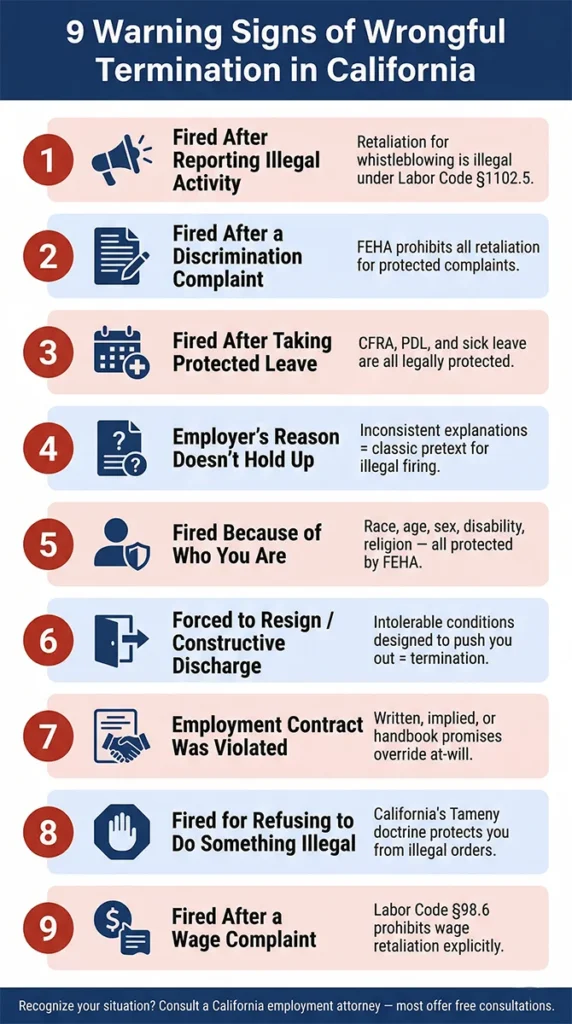
| # | Sign of Wrongful Termination in California | Relevant California Law | Claim Strength |
| 1 | Fired after reporting illegal activity | Labor Code §1102.5 | ⭐⭐⭐⭐⭐ Very Strong |
| 2 | Fired after discrimination complaint | FEHA §12940(h) | ⭐⭐⭐⭐⭐ Very Strong |
| 3 | Fired after taking protected leave | CFRA, PDL, Labor Code | ⭐⭐⭐⭐⭐ Very Strong |
| 4 | Employer’s reason is inconsistent or pretextual | FEHA / Common Law | ⭐⭐⭐⭐ Strong |
| 5 | Fired because of protected characteristic | FEHA §12940(a) | ⭐⭐⭐⭐⭐ Very Strong |
| 6 | Constructively discharged / forced to resign | FEHA / Common Law | ⭐⭐⭐⭐ Strong |
| 7 | Written or implied contract was violated | Labor Code §2922 exceptions | ⭐⭐⭐⭐ Strong |
| 8 | Fired for refusing to do something illegal | Tameny claim / Public Policy | ⭐⭐⭐⭐⭐ Very Strong |
| 9 | Fired after filing a wage complaint | Labor Code §98.6 | ⭐⭐⭐⭐⭐ Very Strong |
3. California Laws That Protect Against Wrongful Termination
California has a comprehensive network of employment protection laws that go significantly beyond federal minimums. Understanding which laws apply to your wrongful termination case in California determines what damages you can recover and which agencies you can file with.
| California Law | Applies To | Protection Provided |
| Fair Employment and Housing Act (FEHA) | Employers with 5+ employees | Prohibits termination based on all protected characteristics — broadest discrimination protection in the US |
| California Family Rights Act (CFRA) | Employers with 5+ employees | Protects employees who take leave for family or medical reasons from termination or retaliation |
| Labor Code §1102.5 | All California employers | Whistleblower protection — prohibits firing for reporting legal violations to any government agency |
| Labor Code §98.6 | All California employers | Prohibits retaliation for filing wage claims or exercising wage and hour rights |
| Pregnancy Disability Leave (PDL) | Employers with 5+ employees | Up to 4 months protected leave for pregnancy-related disability — firing during PDL is presumptively illegal |
| WARN Act (California) | Employers with 75+ employees | 60 days advance notice required before mass layoff — violation is wrongful termination claim |
| Common Law Tameny Claim | All California employers | Firing for refusing to violate public policy or law — established by California Supreme Court |
4. Critical Deadlines You Cannot Miss
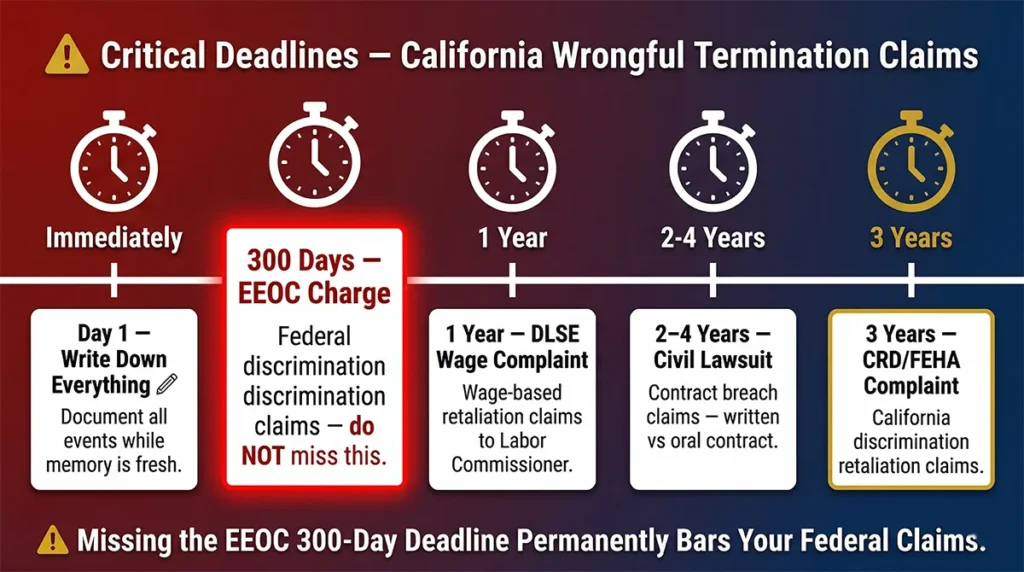
Wrongful termination cases in California have some of the strictest filing deadlines in employment law. Missing any one of these deadlines can permanently bar you from recovery — even if your wrongful termination case in California is ironclad. Mark these dates the day you are fired:
| Deadline | Timeframe | Action Required |
| File DFEH / CRD complaint (for FEHA claims) | 3 years from termination (expanded in 2020 by AB 9) | File complaint with California Civil Rights Department — required before suing under FEHA |
| File EEOC charge (for federal discrimination claims) | 300 days from termination | File charge with EEOC to preserve federal Title VII, ADA, ADEA rights |
| File DLSE complaint (wage retaliation) | 1 year from retaliation | File with California Labor Commissioner for wage-based retaliation claims |
| File civil lawsuit (breach of contract) | 2–4 years depending on contract type | Written contract = 4 years; Oral contract = 2 years (California Code of Civil Procedure) |
| File Tameny / public policy claim | 2–3 years from termination | Personal injury statute of limitations applies — consult attorney for exact deadline |
| WARN Act claim | 3 years from violation | File civil lawsuit in California Superior Court for 60 days back pay and benefits |
🔴 Most Urgent Deadline:
The EEOC charge deadline of 300 days is often the most urgent and most commonly missed deadline in California wrongful termination cases. Federal claims under Title VII (race, sex, national origin discrimination), the ADA (disability), and the ADEA (age) cannot be pursued in federal court without first filing an EEOC charge within 300 days of the termination. Do not wait.
5. How Much Is a Wrongful Termination Case Worth in California?
Wrongful termination settlements and verdicts in California vary enormously based on the type of violation, the strength of your evidence, your income level, and whether your employer’s conduct was particularly egregious. Here are the realistic compensation categories available in a wrongful termination case in California:
| Compensation Category | Typical Range | What It Covers |
| Back Pay | Wages lost from termination to settlement | Every dollar of salary, bonuses, and benefits you would have earned if not wrongfully fired |
| Front Pay | 1–3 years of future wages | Estimated future earnings loss if you cannot find equivalent employment quickly |
| Lost Benefits | Actual value of lost benefits | Health insurance, retirement contributions, stock options, and other employment benefits lost |
| Emotional Distress | $25,000 – $500,000+ | Anxiety, depression, humiliation, loss of dignity from being wrongfully fired — California juries award generously |
| Punitive Damages | Up to 9× compensatory damages | Available for malicious, oppressive, or fraudulent employer conduct — can dramatically increase total recovery |
| Attorney Fees | Paid by employer in many CA cases | Under FEHA, successful wrongful termination plaintiffs can recover attorney fees from the employer |
| Typical Settlement Range | $50,000 – $500,000+ | California wrongful termination cases resolve significantly higher than national average due to strong FEHA protections and attorney fee provisions |
6. What to Do Right Now If You Think You Were Wrongfully Fired
If you believe you have a wrongful termination case in California, the actions you take in the days and weeks after your firing can make or break your case. Here is exactly what to do:
Step 1 — Write Down Everything While It Is Fresh
Immediately after your termination, write a detailed account of everything you remember — the date and time of the firing, exact words used by your employer, who was present, what reason was given, and any events leading up to the firing in the past 6–12 months. Memory fades quickly and this contemporaneous account becomes valuable evidence in your wrongful termination case in California.
Step 2 — Preserve All Evidence Before You Lose Access
Collect and preserve all evidence you legally have access to before your employer cuts off your access to company systems. This includes copies of performance reviews, emails praising your work, communications about the events leading to your firing, your employment contract, the employee handbook, pay stubs, and any correspondence about protected activity (discrimination complaints, leave requests, wage disputes). Do not take documents you were not authorized to access — but preserve everything you legitimately had.
Step 3 — Do Not Sign Anything Without Legal Review
Many employers offer a severance package in exchange for signing a release of all claims against the company. Do not sign this under any circumstances without having an employment attorney review it first. Once you sign a release, your wrongful termination rights in California are almost certainly gone forever — even if you later discover compelling evidence of illegal conduct.
⚠️ Severance Agreement Warning:
Employers know exactly what they are doing when they offer a severance agreement immediately after a suspicious firing. The release is designed to extinguish your wrongful termination claim in California before you realize you have one. You have 21 days to consider a severance release (40+ days if part of a group layoff) and 7 days to revoke after signing. Use this time to consult an employment attorney.
Step 4 — File Your EEOC or CRD Complaint
If your wrongful termination in California involved discrimination, harassment, or retaliation under FEHA, you must file an administrative complaint with the California Civil Rights Department (CRD) — formerly DFEH — before you can sue in court. You can file online at calcivilrights.ca.gov. The CRD will issue a right-to-sue notice which allows you to file your civil lawsuit.
Step 5 — Consult a California Employment Attorney
Contact a California employment attorney who specializes in wrongful termination as soon as possible after your firing — ideally within the first 2 weeks. Most California wrongful termination attorneys offer a free initial consultation and work on contingency, meaning you pay nothing unless you win. The attorney will evaluate your case, identify all applicable claims, calculate your damages, and handle all filings and deadlines on your behalf.
7. Do You Need a Wrongful Termination Attorney in California?
For a wrongful termination case in California, yes — in almost every situation. Here is an honest assessment:
California wrongful termination cases are legally complex. They typically involve multiple overlapping legal theories (FEHA, contract claims, Tameny claims), strict administrative requirements (CRD filing, right-to-sue letters), and well-resourced employer defense teams. Self-represented wrongful termination plaintiffs in California almost universally achieve significantly worse outcomes than represented plaintiffs.
The financial case for hiring an attorney is equally clear. Under California FEHA, successful plaintiffs can recover their attorney fees from the employer — meaning in a winning case, the employer pays both the settlement and your legal fees. And because California employment attorneys take wrongful termination cases on contingency, you pay nothing upfront regardless of the strength of your case.
| With a Wrongful Termination Attorney in CA | Without Legal Representation |
| All applicable legal theories identified and pled simultaneously | Most self-represented employees miss one or more valid claims |
| All administrative deadlines handled correctly | Missed EEOC or CRD deadlines permanently bar federal claims |
| Employer’s severance offer properly evaluated | Many employees unknowingly sign away valid wrongful termination claims |
| Emotional distress and punitive damages pursued | Self-represented claimants rarely recover these significant damages |
| Pay $0 upfront — contingency fee only if you win | No upfront cost advantage — but much lower recovery expected |
8. Frequently Asked Questions
Q: How do I know if my firing was wrongful termination in California?
A: The clearest indicators are: your firing closely followed a protected activity (complaint, leave, whistleblowing); the reason given does not match your documented work history; other employees in similar situations were treated differently; or your employer violated a written policy or contract in terminating you. If you recognize any of the 9 signs covered in this article, consult a California employment attorney for a free case evaluation.
Q: How long does a wrongful termination case take in California?
A: Most California wrongful termination cases resolve within 12–24 months. Cases that settle before trial typically resolve in 6–18 months. Cases that go to trial can take 2–4 years from filing to verdict. The timeline depends on the complexity of the case, how early the employer engages in settlement discussions, and how backed up the court’s calendar is in your county.
Q: Can I be fired for any reason in California?
A: California is an at-will employment state, which means yes in general — but with very significant exceptions. You cannot be legally fired for a discriminatory reason (race, sex, age, disability, etc.), for retaliation (after a complaint, leave, or whistleblowing), for refusing to commit an illegal act, or in violation of a written or implied employment contract. These exceptions cover a very large percentage of all firings in California.
Q: What evidence do I need for a wrongful termination case in California?
A: The most valuable evidence in a California wrongful termination case includes: your performance reviews showing positive evaluations before termination; emails or written communications about the events leading to your firing; documentation of your protected activity (leave request, complaint, wage dispute) and its timing relative to your firing; witness statements from coworkers who observed relevant events; your employment contract and employee handbook; and comparator evidence showing how similarly situated employees were treated differently.
Q: Does California have stronger wrongful termination protections than other states?
A: Yes — significantly stronger. California’s FEHA covers more protected classes than federal law, applies to employers with only 5 employees (vs. 15 for federal Title VII), provides a 3-year filing deadline (vs. 300 days for EEOC), allows recovery of emotional distress damages without a cap, and provides for attorney fee recovery by successful plaintiffs. California wrongful termination settlements and verdicts consistently exceed those in other at-will states.
Q: What is the average settlement for wrongful termination in California?
A: California wrongful termination settlements range enormously depending on the type of violation, the severity of the employer’s conduct, and the employee’s lost earnings. Settlements in straightforward discrimination or retaliation cases with documented evidence typically range from $50,000 to $200,000. Cases involving severe emotional distress, punitive damages, or high-earning employees can settle for $500,000 or more. A California employment attorney can give you a realistic assessment of your specific case value after reviewing the facts.
The Bottom Line
California is an at-will employment state — but the at-will rule has powerful, legally enforceable exceptions that protect employees from wrongful termination in California every single day. If your firing followed a complaint, involved discrimination against a protected characteristic, violated a written or implied contract, or came in retaliation for exercising a legal right, your employer may have broken the law.
The 9 signs covered in this guide are the patterns that California employment attorneys look for when evaluating a wrongful termination case. The more of these signs that apply to your situation, the stronger your potential claim. But the clock starts running on your deadlines the day you are fired — the EEOC 300-day deadline in particular has ended many otherwise strong cases.
If you recognize these warning signs in your own firing, consult a California employment attorney immediately. Most offer free initial consultations. Most work on contingency — meaning you pay nothing unless you win. And in California, winning a wrongful termination case often means your employer pays your attorney fees too. You have nothing to lose by making the call.
⚖️ Legal Disclaimer: This article provides general legal information about California wrongful termination law for educational purposes only. It does not constitute legal advice and does not create an attorney-client relationship. Employment laws and deadlines change frequently. Always consult a licensed California employment attorney for advice specific to your situation.