⚡ Quick Answer: Yes — you can sue your landlord for mold in California. California law requires landlords to maintain habitable rental units free from mold under Civil Code §1941. If your landlord knew about mold, failed to fix it, and you suffered health problems or property damage as a result, you may be entitled to compensation for medical bills, rent refunds, moving costs, damaged property, and pain and suffering.
Mold in a rental home is not just an inconvenience — it is a serious health hazard and a violation of California tenant rights. Black mold and other toxic mold species found in rental apartments and houses are linked to respiratory problems, chronic headaches, skin irritation, and in severe cases, permanent lung damage.
California is one of the strongest states in the country for tenant mold rights. If you are a California renter dealing with mold in your rental unit — and your landlord has failed to address it — you have multiple legal tools available. You can sue your landlord for mold in California, withhold rent, repair and deduct, or pursue a constructive eviction claim depending on your specific situation.
This guide explains the 5 key legal grounds for suing your landlord for mold in California, exactly what evidence you need to build a strong mold case, realistic compensation amounts in California mold lawsuits, and the step-by-step process for taking action.
📑 What You Will Learn in This Guide
- California Mold Law — What Landlords Are Legally Required to Do
- The 5 Legal Grounds to Sue Your Landlord for Mold in California
- What Evidence You Need to Win a Mold Lawsuit in California
- How Much Compensation Can You Get for Landlord Mold in California?
- 5 Steps to Take Right Now If Your Rental Has Mold
- Other Legal Remedies Beyond Suing — Rent Withholding and Repair & Deduct
- Do You Need a Tenant Attorney for a California Mold Case?
- Frequently Asked Questions
1. California Mold Law — What Landlords Are Legally Required to Do
California has some of the most comprehensive mold and habitability laws in the United States. Understanding what the law requires is the foundation for any mold lawsuit against your landlord in California.
California Civil Code §1941 — The Implied Warranty of Habitability
Under California Civil Code §1941, every landlord in California has a legal duty to maintain a rental unit in a habitable condition throughout the tenancy. A habitable rental unit must be free from conditions that affect the health and safety of tenants — and mold is explicitly included in this definition.
California Civil Code §1941.1 lists specific conditions that make a rental unit legally uninhabitable, including effective waterproofing and weather protection, adequate ventilation, and freedom from dampness in the living areas. All three of these conditions directly relate to mold growth in a rental unit.
California Health and Safety Code §17920.3 — Mold Is Substandard Housing
California Health and Safety Code §17920.3 explicitly defines visible mold growth — other than mold caused by the tenant’s own behavior — as a substandard housing condition. This means a California rental unit with visible mold is legally substandard by definition — not just unsightly or inconvenient, but a violation of state housing law.
This is a powerful provision for tenants because it establishes mold as a per se habitability violation. You do not need to prove that the mold made you sick to show the rental unit violated California habitability standards — the visible mold itself is the violation.
Landlord Knowledge Requirement
To hold your landlord liable for mold in California, you generally must show that the landlord knew or should have known about the mold and failed to remediate it within a reasonable time. California courts have found landlord liability where:
- The tenant gave written or verbal notice of mold to the landlord and received no response
- The landlord previously attempted partial repairs that did not resolve the underlying moisture source
- The mold was in a visible, obvious location that the landlord would have observed during inspections or repair visits
- Prior tenants complained about mold and the landlord failed to properly disclose this history
| California Law | What It Requires from Landlords Regarding Mold |
| Civil Code §1941 | Maintain habitable unit — mold-free living areas are a core habitability requirement |
| Civil Code §1941.1 | Effective waterproofing, ventilation, and freedom from dampness — direct mold prevention requirements |
| Health & Safety Code §17920.3 | Visible mold = legally substandard housing condition — no health proof required |
| Civil Code §1942 | Tenant right to repair and deduct mold remediation costs if landlord fails to act within reasonable time |
| Civil Code §1942.4 | Landlord cannot raise rent or retaliate against a tenant who reports mold — anti-retaliation protection |
2. The 5 Legal Grounds to Sue Your Landlord for Mold in California
When you sue your landlord for mold in California, you are not limited to a single legal theory. Strong mold cases often combine multiple legal grounds to maximize your compensation. Here are the 5 most powerful legal bases for suing your landlord for mold in California:
Ground 1 — Breach of the Implied Warranty of Habitability
This is the most commonly used legal ground when suing a landlord for mold in California. Under California Civil Code §1941, every residential lease in California contains an implied warranty of habitability — a legal promise that the landlord will maintain the unit in a livable condition regardless of whether the lease says so.
When mold makes your rental unit uninhabitable and your landlord fails to remediate it after receiving notice, the landlord has breached this warranty. Damages available include rent refund for the period the unit was uninhabitable, costs of temporary housing during remediation, and property damage to your belongings.
Ground 2 — Negligence
A negligence claim against your landlord for mold in California requires showing four elements: duty (the landlord owed you a duty to maintain a safe rental), breach (the landlord failed to address known mold), causation (the mold caused your health problems or property damage), and damages (you suffered measurable losses). Negligence is the primary legal ground when you are seeking compensation for mold-related health injuries, including medical bills, lost wages, and pain and suffering.
Ground 3 — Nuisance
Under California law, a landlord who knowingly allows mold to persist in a rental unit may be liable for creating or maintaining a private nuisance. A nuisance claim for mold in California focuses on the landlord’s interference with your right to peacefully enjoy your rental — your right to live in a safe, clean home without health-threatening conditions. Nuisance damages can include compensation for emotional distress, loss of use of your home, and diminished enjoyment of your living space.
Ground 4 — Breach of the Covenant of Quiet Enjoyment
California Civil Code §1927 grants every tenant the right to quietly enjoy their rental without interference from the landlord. When severe mold in a California rental makes the unit unusable — forcing you to stay with family, sleep in an uninhabitable unit, or abandon your lease — the landlord has breached the covenant of quiet enjoyment. This legal ground supports claims for constructive eviction, where the conditions are so severe that you are effectively forced out of your home.
Ground 5 — Violation of California Health and Safety Code
Because California Health and Safety Code §17920.3 explicitly designates visible mold as substandard housing, your landlord is violating California statutory law by allowing mold to persist in your rental. This statutory violation makes it significantly easier to establish liability because you do not need to prove negligence separately — the violation of the Health and Safety Code itself creates a basis for liability and can support claims for additional punitive damages in extreme cases.
💡 Pro Strategy:
The most successful mold lawsuits in California typically combine Grounds 1, 2, and 5 — breach of habitability, negligence, and statutory violation. Ground 3 (nuisance) is added when emotional distress damages are significant. Ground 4 (quiet enjoyment breach) is added when you had to leave the unit. A tenant attorney will plead all applicable grounds simultaneously.
3. What Evidence You Need to Win a Mold Lawsuit in California
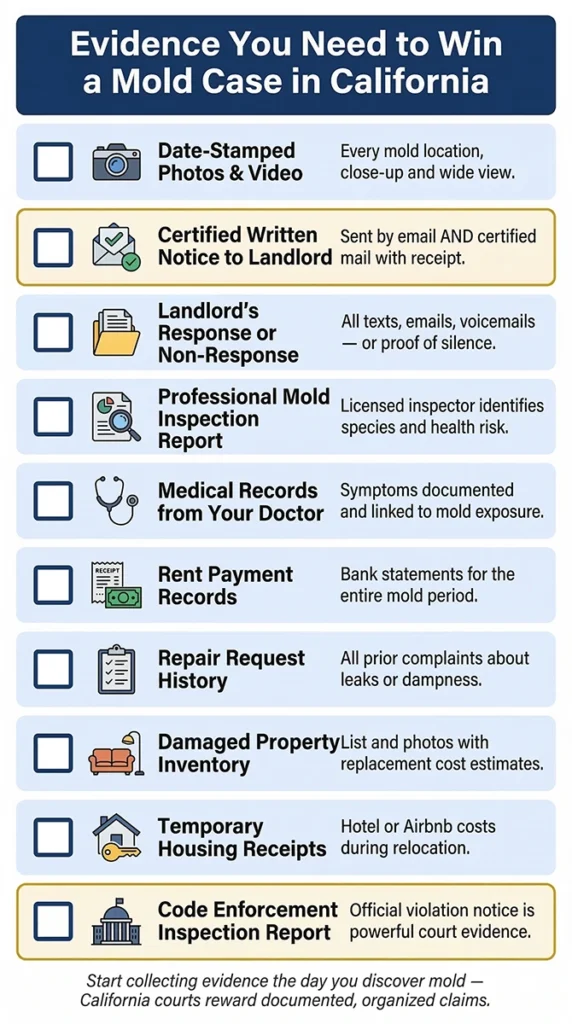
The strength of your mold case against your landlord in California depends almost entirely on your evidence. Strong documentation is the difference between winning significant compensation and getting nothing. Start gathering this evidence the moment you discover mold in your California rental:
| Evidence Type | What to Collect | Why It Matters |
| Photographs and Video | Date-stamped photos and video of all mold — every room, every surface. Show the extent and location clearly | Visual proof of mold existence and severity |
| Written Notice to Landlord | Certified letter or email notifying landlord of mold with your signature, date, and specific description of location | Establishes landlord knew about mold |
| Landlord’s Response (or Non-Response) | Save all texts, emails, voicemails from landlord. If no response, document that too | Proves landlord ignored the problem |
| Professional Mold Inspection Report | Licensed mold inspector identifies species, spore count, source of moisture, and health risk level | Expert confirmation of mold type and severity |
| Medical Records | Doctor visits, diagnoses, test results linking your health symptoms to mold exposure — especially respiratory issues | Connects mold to your health damages |
| Rent Payment Records | Proof of all rent paid during the period the mold was present — bank statements or receipts | Quantifies rent refund damages owed |
| Repair Requests History | All prior repair requests related to water leaks, dampness, or mold — showing ongoing ignored complaints | Demonstrates pattern of landlord neglect |
| Damaged Property Inventory | List and photos of furniture, clothing, electronics, and personal items damaged by mold with replacement costs | Quantifies personal property damages |
| Temporary Housing Receipts | Hotel bills, Airbnb receipts, or any housing costs during mold remediation or relocation | Documents relocation cost damages |
📌 Most Critical Piece of Evidence:
The single most important evidence in a California landlord mold lawsuit is proof that you gave written notice to the landlord and the landlord failed to act. Courts consistently look for this. Send your mold complaint by certified mail with return receipt AND by email so you have multiple documented proof points. Take a photo of the envelope at the post office.
4. How Much Compensation Can You Get for Landlord Mold in California?
Compensation in a California landlord mold lawsuit depends on the severity of the mold, the duration of exposure, your health impact, and the extent of your landlord’s negligence. Here is a realistic breakdown of the compensation categories available to California tenants suing their landlord for mold:
| Compensation Category | Typical Range | What It Covers |
| Rent Refund (Reduction in Habitability) | 25%–100% of rent paid during mold period | Court reduces rent to reflect the diminished value of the uninhabitable unit |
| Medical Expenses | $500 – $50,000+ | Doctor visits, ER bills, medications, specialist visits, ongoing treatment for mold-related illness |
| Lost Wages | Varies — actual losses | Income lost due to mold-related illness or time off to deal with mold remediation |
| Property Damage | $500 – $10,000+ | Replacement cost of furniture, clothing, electronics, personal items destroyed by mold |
| Relocation and Temporary Housing | $1,000 – $8,000 | Hotel, motel, Airbnb, or other temporary housing during mold remediation or while searching for new rental |
| Pain and Suffering | 1.5× – 3× medical bills | Physical suffering, emotional distress, anxiety, sleep disruption caused by mold exposure and landlord neglect |
| Punitive Damages | Up to 3× compensatory damages | Available in cases of extreme landlord negligence or deliberate concealment of known mold — rare but powerful |
| Attorney Fees | Typically contingency (33%) | In some California mold cases, the court can order the landlord to pay your attorney fees under Civil Code §1942.4 |
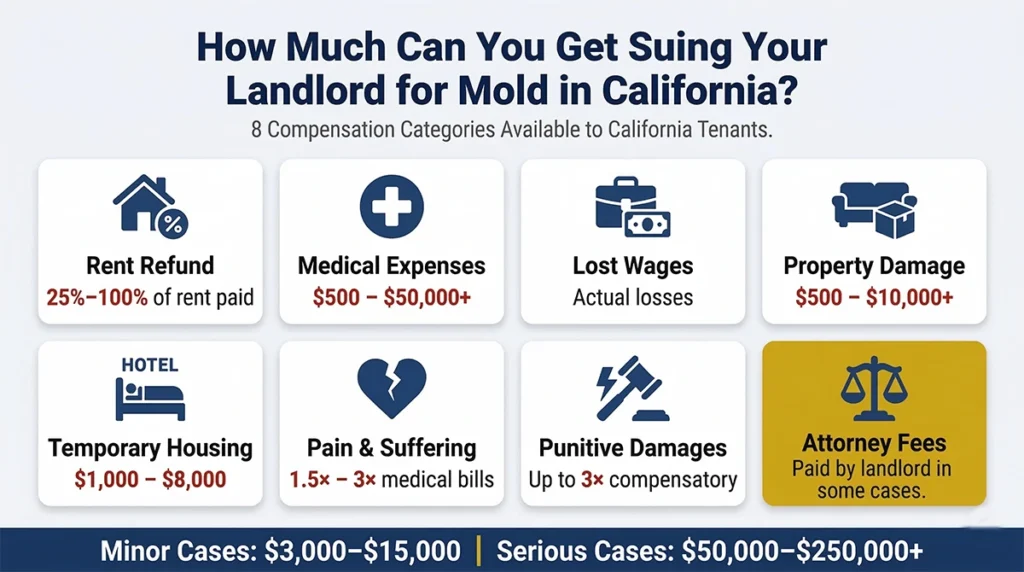
Minor mold cases in California small claims court — where mold caused property damage and required temporary relocation but no major health injury — typically settle for $3,000–$15,000. Serious cases involving toxic black mold, significant health consequences, and extended landlord neglect have resulted in California jury verdicts and settlements ranging from $50,000 to several hundred thousand dollars.
5. 5 Steps to Take Right Now If Your Rental Has Mold
If you have discovered mold in your California rental unit, the actions you take in the first few days are critically important. These 5 steps protect your health, preserve your legal rights, and build the evidence foundation for a mold lawsuit against your landlord in California if one becomes necessary:
Step 1 — Document the Mold Immediately and Thoroughly
Before cleaning, touching, or reporting the mold, take extensive date-stamped photographs and video of every area of mold you can see. Capture the mold up close and also show the surrounding context — room, wall, ceiling, floor. Note the size of the affected areas. Open closets, look under sinks, check behind furniture and appliances. The documentation you gather on day one is often the strongest visual evidence in your entire case.
Step 2 — Give Written Notice to Your Landlord Immediately
Notify your landlord of the mold in writing — both by email AND certified mail with return receipt. Your written notice should specifically describe: the location of the mold, when you first discovered it, any health symptoms you or your household members are experiencing, and a specific request that the landlord inspect and remediate the mold within a reasonable time (typically 30 days for non-emergency situations, or 48 hours for conditions posing immediate health risk).
This written notice is legally essential. Under California Civil Code §1942, landlords generally must receive notice of a defective condition before their repair obligation is triggered. Without written notice, it is much harder to prove the landlord knew about the mold.
Step 3 — Get a Professional Mold Inspection
Hire a licensed mold inspector or industrial hygienist to inspect your rental unit and provide a written report. A professional mold inspection report identifies the mold species, spore count levels, the moisture source causing the mold, and the health risk classification. This expert report is critical medical and scientific evidence that courts take very seriously in California mold lawsuits. The cost of a professional mold inspection in California typically ranges from $300–$600.
Step 4 — See a Doctor and Create a Medical Record
If you are experiencing any symptoms — coughing, wheezing, headaches, skin irritation, fatigue, or congestion — see a doctor and specifically tell your doctor you are experiencing symptoms that may be related to mold exposure in your rental. This creates a formal medical record linking your health symptoms to mold exposure, which is essential for claiming health-related damages in a mold lawsuit against your landlord in California.
Step 5 — Consult a Tenant Rights Attorney
Contact a California tenant rights attorney or a landlord-tenant attorney for a consultation. Most California tenant attorneys offer a free initial consultation and take mold cases on contingency — meaning you pay nothing upfront. An experienced California tenant attorney will evaluate the strength of your mold case, advise you on the best legal strategy (lawsuit, rent withholding, or repair and deduct), and handle all the legal filings on your behalf.
6. Other Legal Remedies Beyond Suing — Rent Withholding and Repair & Deduct
A full mold lawsuit in California court is not the only option available to tenants dealing with mold in a rental unit. California law gives tenants two powerful self-help remedies that can be faster and less expensive than a full lawsuit in some situations:
Repair and Deduct — California Civil Code §1942
Under California Civil Code §1942, if your landlord fails to remediate mold within a reasonable time after receiving written notice, you may be able to hire a licensed mold remediation contractor yourself and deduct the cost from your rent — up to one month’s rent. This remedy is powerful for moderate mold situations where the remediation cost falls within the one-month rent cap. Requirements:
- You must have given written notice to the landlord of the mold condition
- A reasonable time must have passed without landlord action — typically 30 days unless there is an emergency
- You can only use the repair and deduct remedy twice in any 12-month period
- The deduction cannot exceed one month’s rent
Rent Withholding — Constructive Eviction
If mold conditions in your California rental are so severe that the unit is truly uninhabitable, you may have grounds to withhold rent entirely under the doctrine of constructive eviction — where the conditions are so bad that your landlord has effectively forced you out of your home. This is a high bar in California courts, and rent withholding without a valid legal basis can result in eviction, so it should only be pursued with legal counsel.
Reporting to California Housing Authorities
You can report mold conditions to your local code enforcement agency, the California Department of Housing and Community Development, or the local health department. A code enforcement inspection that results in a written violation notice against your landlord is extremely valuable evidence in a subsequent mold lawsuit. It independently confirms the mold’s existence, severity, and the landlord’s failure to address it through official government records.
| Remedy | Best Used When | Key Limitation |
| Sue Landlord (Civil Court) | Health injuries, significant damages, landlord refused to act for months | Time-consuming — can take 6–18 months |
| Small Claims Court | Property damage under $12,500, no major health injury, landlord ignored mold | Maximum $12,500 award; no attorney representation |
| Repair and Deduct | Mold remediation cost fits within 1 month’s rent; landlord non-responsive | Maximum deduction = 1 month’s rent; limited to 2× per year |
| Rent Withholding | Extreme mold making unit completely uninhabitable; immediate health risk | High risk of eviction if legal grounds are not solid — requires attorney |
| Code Enforcement Report | Any mold situation — especially as a first step before suing | Takes 2–8 weeks; does not directly compensate you |
7. Do You Need a Tenant Attorney for a California Mold Case?
Whether you need a tenant attorney to sue your landlord for mold in California depends on the value of your claim and its complexity. Here is an honest breakdown:
Use Small Claims Court (No Attorney) When:
- Your damages are under $12,500 and consist mainly of property damage and a rent refund
- You have not suffered significant health injuries requiring medical treatment
- You have clear documentary evidence — photos, written notices, landlord non-response
- The mold situation has already been resolved and you are seeking past damages only
Hire a California Tenant Attorney When:
- You or family members experienced health problems from mold exposure requiring medical treatment
- Your damages exceed $12,500 — medical bills, lost wages, extended relocation costs
- The landlord has a history of ignoring mold reports and other tenants are affected
- Your landlord is retaliating against you for reporting mold — attempting to evict you or raise rent
- The mold was caused by a structural defect or ongoing water intrusion the landlord refused to address
- You want to pursue punitive damages for extreme or deliberate landlord negligence
Most California tenant attorneys who handle mold cases work on contingency — you pay no upfront fees. The attorney takes a percentage (typically 33%) of your final settlement or judgment. Under California Civil Code §1942.4, in cases where the landlord violated the habitability statute and was put on notice, the court can order the landlord to pay your attorney fees directly — meaning you potentially recover the full judgment amount.
💡 Free Resources for Tenants:
If cost is a concern, California tenants can get free legal help from local legal aid organizations, the California Courts Self-Help Center (courts.ca.gov/selfhelp), and tenant advocacy organizations in your county. For serious mold cases with health injuries, the contingency fee structure means you pay nothing unless you win.
8. Frequently Asked Questions
Q: How long does a landlord have to fix mold in California?
A: California law requires landlords to address habitability defects within a ‘reasonable time’ after receiving written notice. For serious mold that poses an immediate health risk, courts have held 24–48 hours to be a reasonable response time. For moderate mold conditions, 30 days is generally considered the standard reasonable repair period. If your landlord fails to begin remediation within 30 days of written notice, you may have grounds to sue, use repair and deduct, or report to code enforcement.
Q: Can a landlord evict you for complaining about mold in California?
A: No. California Civil Code §1942.5 prohibits landlords from retaliating against tenants who make good-faith complaints about habitability conditions including mold. Retaliatory acts include eviction, rent increases, and reduction of services. If your landlord attempts any of these actions within 180 days of your mold complaint, there is a legal presumption of retaliation — and you can sue the landlord for actual and punitive damages plus attorney fees.
Q: What kind of mold makes a landlord liable in California?
A: California Health and Safety Code §17920.3 applies to visible mold growth in general — it does not require the mold to be toxic black mold (Stachybotrys) specifically. Any visible mold growth on walls, ceilings, floors, or other surfaces that was not caused by the tenant’s own behavior qualifies as a substandard housing condition under California law. However, toxic black mold cases typically result in significantly higher damages due to the serious health risks involved.
Q: Can I break my lease early because of mold in California?
A: Yes — if mold conditions in your California rental make the unit legally uninhabitable, you may be able to terminate your lease early without penalty under the doctrine of constructive eviction. You must first provide written notice to your landlord of the mold condition and give them a reasonable time to remediate. If they fail to do so and the conditions remain uninhabitable, you can vacate the unit and seek return of your security deposit plus other damages. Always consult a tenant attorney before attempting to break a lease for mold.
Q: How do I report my landlord for mold in California?
A: You can report mold to your local city or county code enforcement agency, your local health department, or the California Department of Housing and Community Development. To find your local code enforcement contact, search ‘[your city] code enforcement housing.’ Inspectors typically respond within 1–4 weeks. A code enforcement citation issued against your landlord becomes powerful evidence in any subsequent mold lawsuit.
Q: Is landlord responsible for mold caused by tenant behavior?
A: No. Under California Health and Safety Code §17920.3, the substandard housing definition for mold specifically excludes ‘mold that is caused by the actions or inactions of the tenant.’ If mold grew because you failed to use provided ventilation fans, left wet items around, or refused to allow the landlord to make necessary repairs, the landlord is not liable. However, if the underlying moisture source — a roof leak, plumbing leak, or inadequate ventilation in the building structure — is the landlord’s responsibility, the landlord cannot blame you for mold that resulted from their structural failure.
The Bottom Line
Yes — you can sue your landlord for mold in California, and the law is strongly on your side. California has some of the most tenant-protective mold and habitability laws in the entire United States. When your landlord knows about mold in your rental unit and fails to remediate it, they are violating multiple California statutes simultaneously.
The key to a successful mold lawsuit against your landlord in California is thorough documentation — photographs, written notice, professional inspection, and medical records. Start gathering evidence on day one, notify your landlord in writing immediately, and consult a California tenant attorney before taking any major action such as withholding rent or breaking your lease.
Most California tenant attorneys take mold cases on contingency — you pay nothing unless you win. The free consultation alone will tell you whether your mold situation constitutes a viable lawsuit, what your case is worth, and what your best legal strategy is.
⚖️ Legal Disclaimer: This article provides general legal information about California landlord-tenant mold law for educational purposes only. It does not constitute legal advice and does not create an attorney-client relationship. California mold laws and remedies vary based on specific facts of each case. Always consult a licensed California tenant attorney for advice specific to your situation.