⚡ Quick Answer: If you ignore a debt collector, several things can happen — some manageable, some serious. In the short term, calls and letters continue. If the debt is valid and the collector sues you and wins a judgment, they can garnish your wages, freeze your bank account, or place a lien on your property. However, you also have powerful federal rights under the FDCPA that debt collectors frequently violate — and knowing these rights changes everything about how you respond.
Debt collection calls are stressful, anxiety-inducing, and often relentless. When your phone rings for the third time in one day from a number you do not recognize, the temptation to simply ignore it — to let it go to voicemail, to avoid opening the letters piling up — is completely understandable.
But before you decide to ignore a debt collector, you need to understand exactly what happens legally when you do — because the consequences range from minor inconvenience to wage garnishment, bank account freeze, and permanent damage to your credit. More importantly, you need to know the powerful federal rights that the Fair Debt Collection Practices Act (FDCPA) gives you — rights that most debt collectors hope you do not know about.
This guide covers everything: what happens if you ignore a debt collector at each stage, your 7 most powerful FDCPA rights, exactly what debt collectors can and cannot legally do, when ignoring a debt collector is a reasonable strategy, and when it puts you at serious financial risk.
📑 What This Guide Covers
- What Happens If You Ignore a Debt Collector — Stage by Stage
- Your 7 Powerful FDCPA Rights Every American Should Know
- What Debt Collectors Can Legally Do to You
- What Debt Collectors Are Absolutely Prohibited From Doing
- The Statute of Limitations — When Ignoring Debt Becomes Safe
- The Debt Validation Letter — Your Most Powerful First Move
- When Ignoring a Debt Collector Is and Is Not a Good Strategy
- Frequently Asked Questions
1. What Happens If You Ignore a Debt Collector — Stage by Stage
Ignoring a debt collector does not make the debt disappear. Here is exactly what happens at each stage when you choose not to respond to debt collection attempts:
Stage 1 — Increased Contact Attempts (Weeks 1–4)
When you ignore a debt collector’s initial calls and letters, the first consequence is an increase in contact frequency. Under the FDCPA, debt collectors may call up to 7 times per week per debt — a rule established by the Consumer Financial Protection Bureau (CFPB) in 2021. Many collectors push to this legal limit when they receive no response.
During this stage, collectors may also begin contacting you through additional channels — text messages, emails, and in some cases, voicemails. They may also reach out to third parties such as neighbors, family members, or your employer solely to obtain your contact information — though they are strictly prohibited from discussing your debt with these third parties.
Stage 2 — Account Escalation and Credit Reporting (Weeks 4–8)
If you continue to ignore a debt collector, the account is typically escalated internally and the debt may be reported to the major credit bureaus — Experian, Equifax, and TransUnion — if it has not been already. A collection account on your credit report can lower your credit score by 50–150 points depending on your current score and credit history.
For debts that have already been reported to the credit bureaus, continued non-response does not change the credit damage — the negative mark was placed when the account entered collections, not when you failed to respond. However, the derogatory mark remains on your credit report for 7 years from the date of first delinquency, regardless of whether you pay or not.
Stage 3 — Potential Lawsuit Filing (Months 2–6)
This is where ignoring a debt collector becomes genuinely risky for many people. If the debt is valid, the amount is significant (typically over $1,000–$2,500, though thresholds vary by collector), and the statute of limitations has not expired, the debt collector or the original creditor may file a lawsuit against you in civil court.
Here is the critical danger of ignoring a debt collection lawsuit: if you do not respond to the lawsuit within the required timeframe — typically 20–30 days after being served — the court will enter a default judgment against you automatically. A default judgment gives the debt collector legal authority to collect the debt using enforcement tools they could not use before — including wage garnishment, bank account levies, and property liens.
Stage 4 — Judgment Enforcement (After Default Judgment)
After obtaining a default judgment, a debt collector has powerful court-authorized collection tools available:
- Wage Garnishment: In most states, a judgment creditor can garnish up to 25% of your disposable weekly earnings (or the amount by which your earnings exceed 30 times the federal minimum wage, whichever is less)
- Bank Account Levy: A judgment creditor can freeze and seize funds from your bank account up to the amount owed — including direct deposited paychecks
- Property Lien: A judgment can be recorded as a lien against real property you own, preventing you from selling or refinancing until the debt is paid
- License Suspension: In some states, unpaid judgments can result in suspension of professional licenses or driver’s licenses
🔴 Critical Warning:
The single most dangerous consequence of ignoring a debt collector is receiving a lawsuit and not responding. You do not need to win the lawsuit — you just need to respond. A default judgment entered because you did not respond to a lawsuit is one of the most damaging financial events possible, giving collectors legal power to garnish wages and seize bank accounts without further court involvement.
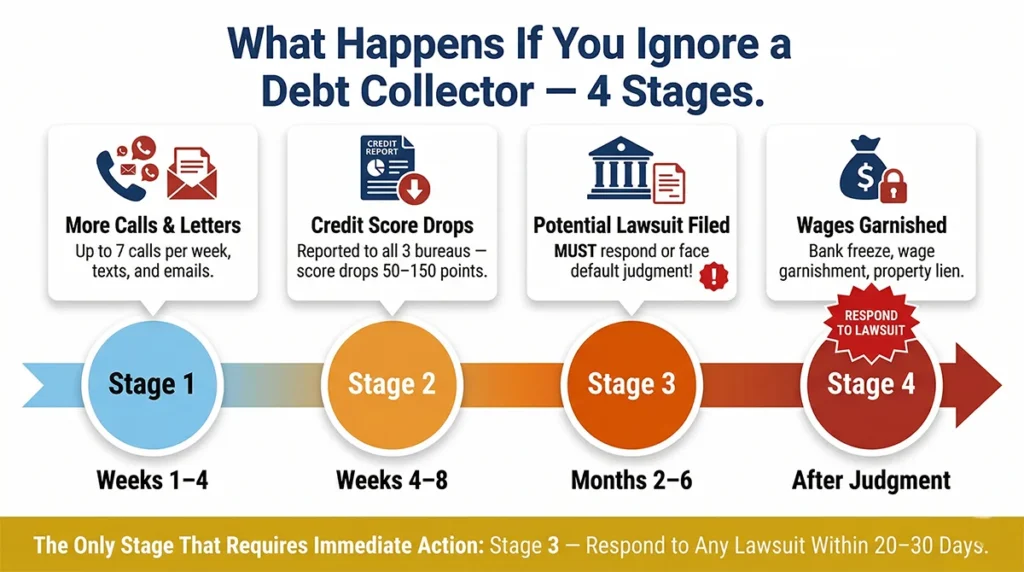
| Stage | Timeline | What Happens If You Ignore Debt Collector |
| Stage 1 | Weeks 1–4 | More calls (up to 7/week), texts, emails, and letters from debt collector |
| Stage 2 | Weeks 4–8 | Account reported or re-reported to credit bureaus — credit score drops 50–150 points |
| Stage 3 | Months 2–6 | Debt collector may file civil lawsuit — MUST respond or face default judgment |
| Stage 4 | After judgment | Wage garnishment, bank levy, property lien — court-authorized collection |
2. Your 7 Powerful FDCPA Rights Every American Should Know
The Fair Debt Collection Practices Act (FDCPA), 15 U.S.C. §1692 et seq., is one of the most consumer-protective federal laws in the United States. Enacted in 1978 and strengthened by CFPB regulations in 2021, the FDCPA gives you 7 powerful rights that apply to virtually every third-party debt collection attempt against you:
FDCPA Right 1 — The Right to Demand Debt Validation
Within 5 days of their first contact with you, debt collectors must send you a written validation notice containing the amount of the debt, the name of the creditor, and your right to dispute the debt. Within 30 days of receiving this notice, you have the right to send a debt validation letter demanding that the collector verify the debt.
Once you send a debt validation letter, the debt collector must stop all collection activity until they provide you with verification of the debt — including the name of the original creditor and a copy of the judgment (if one exists). This right alone stops many debt collection attempts dead in their tracks, particularly for debts that have been sold multiple times to third-party collectors who may lack documentation.
FDCPA Right 2 — The Right to Stop All Contact with a Cease and Desist Letter
You have the right to send a debt collector a written cease and desist letter demanding they stop all contact with you. Once the debt collector receives your cease and desist letter, they may contact you only one more time — to confirm they are ceasing contact or to notify you of a specific action they intend to take (such as filing a lawsuit).
A cease and desist letter does not eliminate the debt or prevent a lawsuit — but it does immediately stop the relentless phone calls and letters. If a debt collector continues contacting you after receiving a valid cease and desist letter, they are violating the FDCPA and you can sue them for damages plus attorney fees.
FDCPA Right 3 — The Right to Restricted Contact Hours and Channels
Under the FDCPA, debt collectors may only contact you between 8:00 AM and 9:00 PM in your local time zone. They may not contact you at times or places they know are inconvenient for you. Under the 2021 CFPB rule updates, collectors are also limited to 7 phone call attempts per week per debt, and must wait 7 days after reaching you before calling again about the same debt.
FDCPA Right 4 — The Right to No Workplace Contact
If you inform a debt collector — orally or in writing — that your employer prohibits such calls, the debt collector must immediately stop calling you at work. Even without your notification, debt collectors are prohibited from contacting you at a place they know or should know your employer prohibits such contact. Calling your employer to discuss your debt is also a separate FDCPA violation.
FDCPA Right 5 — The Right to No Harassment or Abuse
Debt collectors are strictly prohibited from using oppressive, abusive, or harassing tactics. This includes using threats of violence, profane or obscene language, publishing your name on a ‘bad debt’ list, making repeated calls intended to harass, or making false or misleading statements about the debt, their identity, or the legal consequences of non-payment.
Specifically, a debt collector cannot legally threaten to sue you if they have no intention of actually suing, threaten actions they cannot legally take (such as having you arrested for debt), or misrepresent the amount owed. These are clear FDCPA violations for which you can sue the collector for statutory damages of up to $1,000 per violation.
FDCPA Right 6 — The Right to Sue Debt Collectors for Violations
This is the right most debt collectors hope you do not know about. If a debt collector violates any provision of the FDCPA, you have the right to sue them in federal or state court. Damages available include: actual damages (lost wages, medical bills from stress), statutory damages up to $1,000 per lawsuit (not per violation), and attorney fees and court costs paid by the violating collector.
Class action lawsuits for FDCPA violations can result in damages of up to $500,000 or 1% of the collector’s net worth, whichever is less. The attorney fee provision is particularly powerful — it means consumer protection attorneys take FDCPA cases on contingency because the law guarantees their fees if they win.
FDCPA Right 7 — The Right to Dispute Inaccurate Credit Reporting
Under the Fair Credit Reporting Act (FCRA), which works alongside the FDCPA, you have the right to dispute any inaccurate information a debt collector reports to the credit bureaus. This includes disputing the wrong amount, wrong creditor name, wrong date of first delinquency, or a debt that is not actually yours — which is common with identity theft and debt collector errors.
When you file a dispute with a credit bureau, the bureau must investigate within 30 days and remove any information they cannot verify as accurate. Debt collectors who continue reporting information they know to be inaccurate are violating both the FDCPA and the FCRA and are liable for actual and punitive damages.
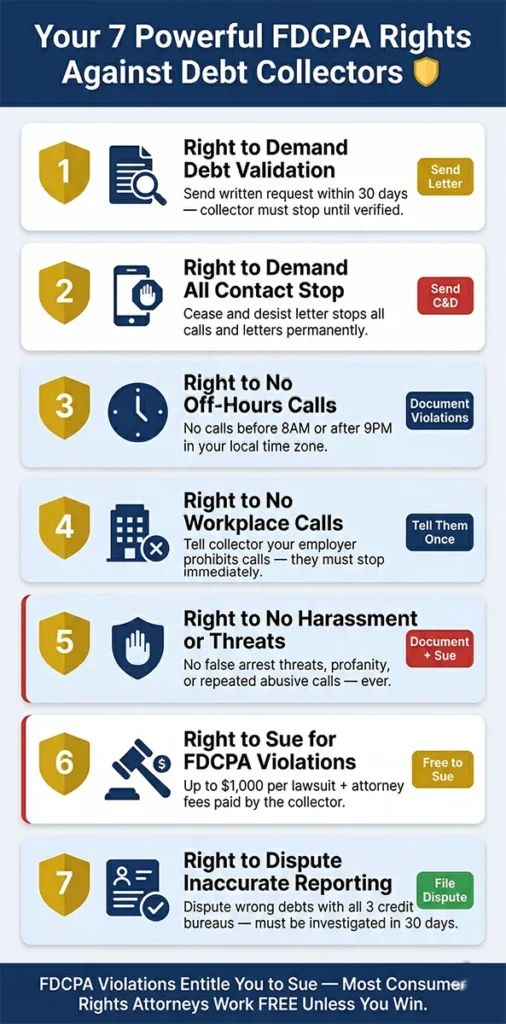
| # | Your FDCPA Right | How to Exercise It | What Happens If Violated |
| 1 | Demand debt validation | Send written validation request within 30 days | Collector must stop collection until verified |
| 2 | Stop all contact (cease and desist) | Send written cease and desist letter | Any further contact = FDCPA violation + $1,000 fine |
| 3 | No calls outside 8AM–9PM | Tell collector in writing about prohibited times | FDCPA violation — sue for damages |
| 4 | No calls at work | Tell collector employer prohibits calls | Must stop immediately — FDCPA violation if continues |
| 5 | No harassment or abuse | Document all violations with date and time | Statutory damages up to $1,000 + actual damages |
| 6 | Sue for FDCPA violations | Consult consumer rights attorney — free consult | Collector pays your attorney fees + damages |
| 7 | Dispute inaccurate credit reporting | File dispute with all 3 credit bureaus | Bureau must investigate and remove unverified items |
3. What Debt Collectors Can Legally Do to You
Understanding what debt collectors can and cannot legally do is essential to responding correctly when you ignore a debt collector. Many people overestimate the collector’s legal power — which leads to unnecessary fear — and also underestimate the real consequences, which leads to ignoring things that require action.
What Debt Collectors CAN Legally Do:
- Contact you by phone, text, email, and mail — within FDCPA time and frequency restrictions
- Report your debt to the three major credit bureaus — Experian, Equifax, and TransUnion
- File a civil lawsuit against you in state court to obtain a judgment for the debt
- After obtaining a court judgment, pursue wage garnishment, bank account levies, and property liens
- Contact third parties to locate you — but only to obtain your address, phone number, or workplace, and only once per third party
- Add interest and fees to the debt if permitted by the original contract or state law
- Sell your debt to another collection agency — which starts the collection cycle over with a new collector
- Access your credit report to verify your contact information and financial status
4. What Debt Collectors Are Absolutely Prohibited From Doing
The FDCPA’s list of prohibited debt collection practices is extensive. When a debt collector violates any of these prohibitions, you have an actionable federal lawsuit against them — often worth more than the original debt:
| Prohibited Debt Collector Action | Relevant FDCPA Section |
| Threatening arrest or criminal prosecution for a civil debt | §1692e — Debt collectors cannot threaten actions they cannot take. Debt is civil, not criminal — you cannot be arrested for owing money. |
| Using false, deceptive, or misleading representations | §1692e — Includes misrepresenting the amount owed, claiming to be an attorney when they are not, or threatening legal action they do not intend to take. |
| Using obscene, profane, or abusive language | §1692d — Any abusive or harassing language is a per se FDCPA violation, no matter how small the debt. |
| Calling more than 7 times per week per debt | CFPB 2021 Rule — Calling more than 7 times within 7 days is a violation. Must wait 7 days after reaching you before calling again. |
| Contacting you after a written cease and desist | §1692c — Once they receive your written cease communication, they can only contact you once more to confirm stopping or to notify of a specific action. |
| Contacting you before 8AM or after 9PM local time | §1692c(a)(1) — Time-restricted calling is one of the most commonly violated FDCPA provisions. Keep call logs with timestamps. |
| Revealing your debt to unauthorized third parties | §1692c(b) — Discussing your debt with anyone other than you, your attorney, a credit bureau, or the original creditor is a violation. |
| Collecting more than legally owed | §1692f — Collecting unauthorized fees, interest, or charges not permitted by original contract or state law is a federal violation. |
💡 Document Everything:
If you suspect a debt collector is violating the FDCPA, document every contact immediately — the date, time, phone number, name of the person calling, and exactly what was said. Screenshot any text messages and emails. Save all voicemails. This contemporaneous documentation is the foundation of any FDCPA lawsuit. A single documented violation entitles you to statutory damages up to $1,000 plus your attorney fees — which your attorney will collect from the debt collector, not from you.
5. The Statute of Limitations — When Ignoring Debt Becomes Safer
One of the most important concepts in understanding what happens if you ignore a debt collector is the statute of limitations on debt. Every type of debt has a legal time limit — called the statute of limitations — beyond which a debt collector cannot sue you to collect the debt in court.
Once the statute of limitations on a debt has expired, the debt is considered ‘time-barred.’ A debt collector can still contact you about a time-barred debt and it can still affect your credit (until the 7-year reporting limit expires), but they cannot legally obtain a court judgment against you. If they sue on a time-barred debt and you respond to the lawsuit asserting the statute of limitations as a defense, the case is typically dismissed.
| Debt Type | Typical SOL Range | Key Notes |
| Credit card debt | 3–6 years | Varies by state — based on open account or written contract rules |
| Medical debt | 3–6 years | California is 4 years; Texas is 4 years; New York is 3 years |
| Personal loans | 3–6 years | Written contract SOL applies — typically 4–6 years |
| Auto loan deficiency | 2–6 years | After repossession — SOL for the remaining balance after car sale |
| Federal student loans | No SOL | Federal student loan debt has no statute of limitations — government can collect indefinitely |
| State tax debt | Varies widely | Most state tax debts have long or unlimited collection periods |
| Court judgment debt | 10–20 years (renewable) | Once a judgment is entered, the collection period resets and can be renewed for decades |
⚠️ Zombie Debt Warning — Do NOT Make This Mistake:
A ‘zombie debt’ is a time-barred debt that has been reactivated. Making any payment — even $1 — or making a written acknowledgment of a time-barred debt can restart the statute of limitations clock in many states, giving the debt collector a brand new window to sue you. Before making any payment on an old debt, verify the statute of limitations in your state and whether any payment would re-activate the debt.
6. The Debt Validation Letter — Your Most Powerful First Move
If you are going to take any proactive action when a debt collector contacts you, sending a debt validation letter within 30 days of first contact is the single most powerful and legally protective first step available to you.
A debt validation letter is a written request demanding the debt collector provide verification that: the debt is actually yours, the amount claimed is accurate, the collector has the legal right to collect this specific debt, and documentation of the original creditor exists. Under the FDCPA, they must stop all collection activity until they fulfill this request.
What to Include in Your Debt Validation Letter:
- Your full name and address
- A statement that you are requesting validation of the debt per your rights under the FDCPA, 15 U.S.C. §1692g
- Request for the name and address of the original creditor
- Request for the complete account history showing how the amount claimed was calculated
- Request for proof that the collection agency is licensed to collect debts in your state
- A statement that you do not acknowledge the debt until it is verified
- Request that all further contact be in writing only
Send the debt validation letter by certified mail with return receipt requested. This creates a documented record that the letter was received and the date of receipt — which starts the clock on the debt collector’s obligation to verify or cease. Keep a copy of the letter for your records.
Approximately 40%–60% of collection accounts cannot be fully verified by third-party debt collectors because original documentation was not transferred when the debt was sold. When a debt collector cannot verify a debt, they must cease collection activity — and any continued collection without verification is an FDCPA violation you can sue them for.
7. When Ignoring a Debt Collector Is and Is Not a Good Strategy
Given everything covered in this guide, here is a practical framework for deciding when ignoring a debt collector is a reasonable choice and when it creates serious risk:
| Ignoring May Be Reasonable When: | Ignoring Is Dangerous When: |
| The debt is beyond the statute of limitations in your state — they cannot sue | The debt is within the statute of limitations and the amount is significant (over $1,000) |
| The debt is not yours — mistaken identity or identity theft | You have been served with a lawsuit and have not responded within the required window |
| The 7-year credit reporting period has expired and the debt is off your credit report | You own real property, have regular income, or have bank accounts that could be garnished |
| You have sent a valid cease and desist letter and the collector continues harassing you anyway | The collector is threatening specific legal actions that are credible given the debt size |
| The collector cannot verify the debt when you send a validation letter | You need good credit in the next 1–2 years (mortgage, car loan, job application) |
| You have no income or assets that could be legally collected (‘judgment proof’) | The debt involves federal student loans, tax debt, or child support — no SOL applies |
The concept of being ‘judgment proof’ is important here. If you have no wages to garnish (no employment), no bank accounts with funds, no real property, and no significant assets — a court judgment against you is effectively uncollectable. Many people in genuine financial distress are judgment proof, which changes the risk calculation of ignoring a debt collector significantly.
However, being judgment proof today does not mean you will be judgment proof in 5 years when you have found stable employment. Court judgments in most states are valid for 10–20 years and can be renewed. A judgment entered against you today can follow you into financial recovery — which is why bankruptcy may be a better strategy than simple avoidance for people with significant unsecured debt.
8. Frequently Asked Questions
Q: Can a debt collector sue you for ignoring them?
A: Yes — if the debt is valid, the amount is significant, and the statute of limitations has not expired, a debt collector or original creditor can file a civil lawsuit against you. The critical step is to respond to any lawsuit within the required time period (typically 20–30 days after being served). Ignoring a lawsuit results in a default judgment, which gives collectors legal authority to garnish wages and freeze bank accounts.
Q: Can a debt collector have you arrested for not paying?
A: No. In the United States, you cannot be arrested or criminally prosecuted for failing to pay a civil debt such as credit cards, medical bills, or personal loans. Any debt collector who threatens you with arrest, criminal charges, or jail time is committing a clear FDCPA violation. Document the threat and consult a consumer rights attorney — you may be able to sue the collector for up to $1,000 in statutory damages plus attorney fees.
Q: How long can a debt collector try to collect a debt?
A: Debt collectors can attempt to contact you about a debt indefinitely — there is no time limit on collection attempts themselves. However, the statute of limitations limits how long they have to sue you in court to collect the debt, which ranges from 3–10 years depending on the debt type and state. After the statute of limitations expires, you have a complete defense to any lawsuit. The credit reporting limit is separate — most debts can only be reported on your credit report for 7 years from the date of first delinquency.
Q: What should I do if a debt collector calls about a debt that is not mine?
A: If a debt collector contacts you about a debt you do not recognize or believe is not yours, send a written debt validation letter immediately requesting full verification of the debt. Also file a dispute with all three credit bureaus if the debt appears on your credit report. If the collector continues collection activity after you dispute the debt and they cannot verify it, they are violating both the FDCPA and the Fair Credit Reporting Act — contact a consumer rights attorney.
Q: Does ignoring a debt make it go away after 7 years?
A: The 7-year rule only applies to credit reporting — after 7 years from the date of first delinquency, a debt must be removed from your credit report. This does not eliminate the underlying debt. The debt still legally exists and can still be collected unless the statute of limitations (3–6 years in most states) has also expired. If a collector obtains a court judgment before the statute of limitations expires, that judgment has its own 10–20 year enforcement period regardless of the 7-year reporting rule.
Q: Can I sue a debt collector for violating my rights?
A: Yes. If a debt collector violates the FDCPA — including through harassment, false statements, calling outside permitted hours, contacting you at work after being told not to, or continuing contact after a cease and desist letter — you can sue them in federal or state court within 1 year of the violation. Damages include actual damages, up to $1,000 in statutory damages per lawsuit, and your attorney fees paid by the collector. Most consumer rights attorneys take FDCPA cases on contingency — you pay nothing if you lose.
The Bottom Line
What happens if you ignore a debt collector depends almost entirely on two factors: whether the debt is valid and within the statute of limitations, and whether the collector decides to file a lawsuit. Ignoring early collection calls is low-risk for time-barred debts or debts you do not recognize. Ignoring a lawsuit is catastrophic — a default judgment turns a manageable debt situation into court-authorized wage garnishment and bank account seizure.
The most powerful thing you can do when a debt collector contacts you is not to ignore them passively — it is to exercise your FDCPA rights aggressively. Send a debt validation letter within 30 days. Document every FDCPA violation. Know that collectors cannot arrest you, cannot call your employer after you tell them not to, and cannot contact you outside permitted hours. These are federal law violations for which you can and should sue.
If you are dealing with significant debt and are unsure whether to respond, negotiate, or consider bankruptcy, consult a consumer rights attorney or a nonprofit credit counselor. Many consumer rights attorneys offer free consultations and take FDCPA violation cases at no cost to you. Knowledge of your rights is the most valuable tool you have in any debt collection situation.
⚖️ Legal Disclaimer: This article provides general legal information about debt collection rights for educational purposes only. State laws, statutes of limitations, and FDCPA regulations change. Always consult a licensed consumer rights attorney or credit counselor for advice specific to your debt situation.