⚡ Quick Answer: If your workers comp claim was denied in California, you have the right to appeal. You must file a Declaration of Readiness to Proceed (DOR) with the Workers’ Compensation Appeals Board (WCAB). Over 60% of denied California workers comp claims that go to a formal hearing are overturned or settled in the worker’s favor — especially with legal representation.
Getting a workers comp denial notice in California feels like the floor has been pulled out from under you. You were injured doing your job. You followed the steps. You filed the claim. And then the insurance company sent back a letter saying: denied.
Here is what you need to know right now: a workers comp denial is not the end. In California, denied workers comp claims can be appealed — and thousands of injured workers successfully overturn denials every year. California has one of the strongest workers compensation systems in the country, with a dedicated Workers’ Compensation Appeals Board (WCAB) that exists precisely to protect injured workers from bad-faith denials.
This guide gives you the 7 concrete steps to fight a workers comp denial in California, explains the most common reasons claims are denied and how to counter each one, and tells you exactly when you need an attorney to maximize your chances of winning.
📑 What You Will Learn in This Guide
- Why California Workers Comp Claims Are Denied — The 7 Most Common Reasons
- Your Rights After a Workers Comp Denial in California
- The 7 Steps to Fight a Denied Workers Comp Claim in California
- Key Deadlines You Cannot Miss
- The Role of the QME and AME in Disputed Claims
- Do You Need a Workers Comp Attorney in California?
- Frequently Asked Questions
1. Why California Workers Comp Claims Are Denied — The 7 Most Common Reasons
Understanding exactly why your workers comp claim was denied in California is the first step to fighting back. Every denial notice must include a specific reason by law. Here are the 7 most common denial reasons — and the core argument used to fight each one:
| # | Denial Reason | What the Insurer Claims | How Workers Fight Back |
| 1 | Injury not work-related | Your injury occurred outside of employment scope | Medical records + witness statements linking injury to job duties |
| 2 | Late reporting | You didn’t report within 30 days of injury | Show good cause for delay — many exceptions exist under Labor Code §5400 |
| 3 | Pre-existing condition | Your condition existed before employment | In CA, employers must cover work-aggravated pre-existing conditions under apportionment rules |
| 4 | No medical evidence | Insufficient documentation of injury | Obtain independent medical evaluation — request a QME immediately |
| 5 | Willful misconduct | Injury caused by your own reckless behavior | Burden of proof is on employer — must show specific intent, not mere carelessness |
| 6 | Independent contractor status | You are not an employee covered by workers comp | CA has strong ABC test for worker classification — many ‘contractors’ are legally employees |
| 7 | Claim filed after termination | Suspicion of fraudulent claim post-firing | Termination date is irrelevant if injury occurred during employment — document everything |
⚠️ Critical Point:
California Labor Code §3600 establishes a very broad definition of workplace injuries — far broader than most employees realize. If your injury occurred during any activity that benefited your employer, including travel for work, company events, and even some off-site activities, it may be compensable. Do not accept the insurer’s characterization of your injury without a challenge.
2. Your Rights After a Workers Comp Denial in California
When your California workers comp claim is denied, you have specific legal rights guaranteed by the California Labor Code. Knowing these rights is essential before you take any action:
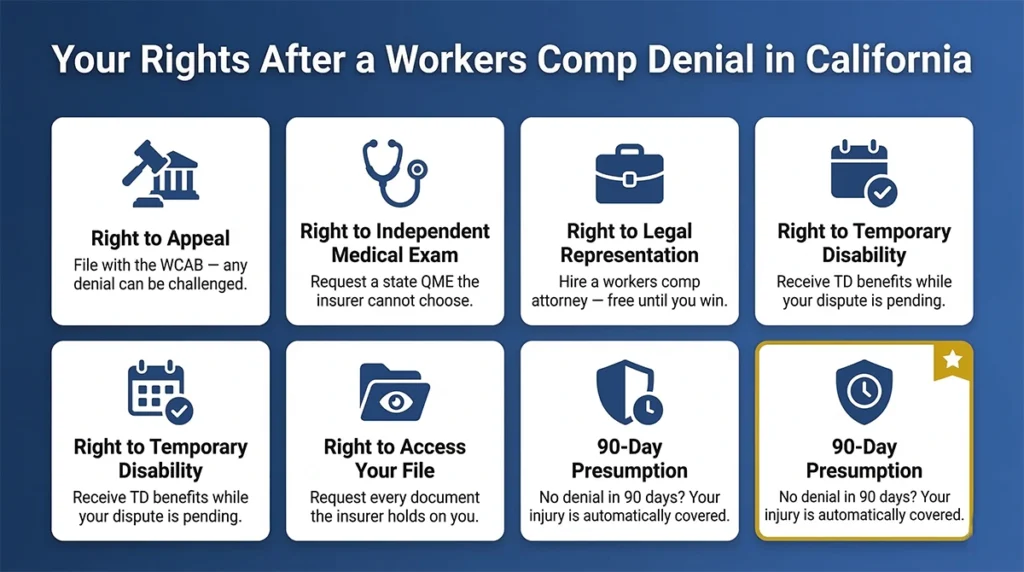
- Right to Appeal: Every denied workers comp claim in California can be appealed before the Workers’ Compensation Appeals Board (WCAB) — an independent tribunal that operates separately from the insurance company.
- Right to Independent Medical Examination: If the insurer’s doctor says you are not injured, you have the right to request a Qualified Medical Evaluator (QME) through the state’s Medical Unit — a doctor the insurance company cannot select or influence.
- Right to Legal Representation: You have the right to hire a workers comp attorney at any stage — and California workers comp attorneys work on contingency, meaning you pay nothing upfront.
- Right to Temporary Disability Benefits: Even during a dispute, if you are unable to work, you may be entitled to temporary disability (TD) benefits while your claim is being adjudicated.
- Right to Access Your File: You have the right to obtain a copy of your complete workers comp claim file from the insurance company, including all internal notes, medical reviews, and denial rationale.
- Right to Timely Decisions: California law requires the insurer to accept or deny your claim within 90 days of the claim form being filed. If they do not respond within 90 days, the injury is presumed compensable by law — this is called the ’90-day presumption.’
💡 The 90-Day Presumption — Powerful Protection:
Under California Labor Code §5402, if the insurance company does not deny your workers comp claim within 90 days of filing, the injury is presumed to have occurred at work and is automatically covered. Check your claim filing date carefully. If 90 days have passed without a written denial, your workers comp claim may be valid by operation of law alone.
3. The 7 Steps to Fight a Denied Workers Comp Claim in California
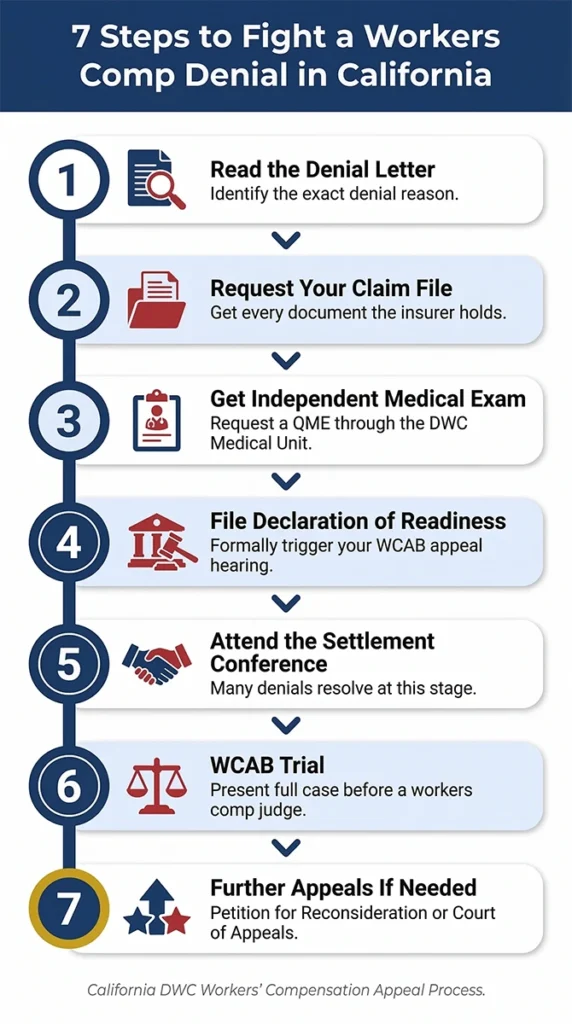
Fighting a workers comp denial in California requires following a specific sequence. These 7 steps give you the strongest possible path to getting your denied workers comp claim overturned:
Step 1 — Read the Denial Letter Carefully and Identify the Exact Reason
Your first action after a workers comp denial is to read the denial letter in full and identify the precise legal reason for the denial. California insurers are required to state the specific grounds for denial. Write down the reason word for word — this becomes the foundation of your appeal strategy.
Look for the claims administrator’s name, contact information, and the specific California Labor Code section cited. This information determines which arguments you need to build in your workers comp appeal.
Step 2 — Request Your Complete Claim File
Contact the claims administrator and request a complete copy of your workers comp claim file. You are legally entitled to this under California Code of Regulations §10102. The file will contain the insurer’s medical review, surveillance notes (if any), investigation reports, and all internal communications. Review it carefully for errors, missing medical records, and inconsistencies you can challenge.
Step 3 — See Your Own Doctor and Get Independent Medical Evidence
The insurer’s medical reviewer has a financial interest in denying your claim. California law gives you the right to an independent medical evaluation. If you are in a Medical Provider Network (MPN), you can request a QME — a Qualified Medical Evaluator selected through a random panel process that prevents insurer bias.
A QME report supporting your injury is one of the most powerful tools in overturning a workers comp denial in California. The QME process is state-regulated, and QME findings carry significant weight with the WCAB.
Step 4 — File a Declaration of Readiness to Proceed (DOR) with the WCAB
This is the formal step that initiates your workers comp appeal in California. You file a Declaration of Readiness to Proceed (DOR) with the Workers’ Compensation Appeals Board (WCAB) in your district. The WCAB will then schedule a hearing — either a Mandatory Settlement Conference (MSC) or an Expedited Hearing depending on your situation.
The DOR form (DWC form 10250.1) is available on the California Department of Industrial Relations website. Filing this form puts the insurance company on notice that you are pursuing your workers comp denial appeal formally and triggers a court date.
Step 5 — Attend the Mandatory Settlement Conference (MSC)
At the Mandatory Settlement Conference, a workers comp judge will attempt to facilitate a settlement between you and the insurance company. Many denied workers comp claims in California are resolved at this stage — often because the insurer realizes the denial will not hold up at trial.
Come prepared with all your medical records, the denial letter, your claim file, employment records, and documentation of your lost wages. If you have a workers comp attorney, they will handle most of this communication.
Step 6 — Proceed to a WCAB Trial if No Settlement Is Reached
If no settlement is reached at the MSC, your workers comp appeal proceeds to a formal trial (also called a ‘hearing’) before a workers comp judge at the WCAB. Both sides present medical evidence, witness testimony, and legal arguments. The judge issues a written decision.
At a WCAB trial, having a workers comp attorney gives you a significant advantage. The insurer will have legal counsel. Self-represented injured workers face major procedural disadvantages in presenting medical evidence and cross-examining the insurer’s experts.
Step 7 — Appeal Further to the WCAB Appeals Board or Court of Appeals
If the WCAB judge rules against you, you can file a Petition for Reconsideration with the WCAB panel within 20 days. If that fails, you can appeal to the California Court of Appeals. While these higher-level workers comp appeals are less common, they are available and have succeeded in cases involving significant legal errors.
| # | Step | Key Action | Typical Timeline |
| 1 | Read denial letter | Identify exact denial reason + cite Labor Code section | Immediately |
| 2 | Request claim file | Written request to claims administrator | Within 1 week |
| 3 | Get independent medical exam | Request QME panel through DWC Medical Unit | 2–6 weeks |
| 4 | File Declaration of Readiness | File DOR with WCAB — triggers hearing date | After QME report |
| 5 | Attend MSC | Present evidence — many denials settled here | 1–3 months after DOR |
| 6 | WCAB Trial | Present full case before workers comp judge | 3–12 months after MSC |
| 7 | Further appeals | Petition for Reconsideration → Court of Appeals | If needed |
4. Key Deadlines You Cannot Miss
Workers comp appeals in California are governed by strict deadlines. Missing any of these dates can permanently bar you from receiving workers comp benefits — even if your denial was completely unjustified. Know these dates and mark your calendar immediately.
| Deadline | Timeframe | Consequence of Missing |
| Report injury to employer | Within 30 days of injury | Insurer can deny based on late reporting |
| File initial workers comp claim (DWC-1) | As soon as possible — no strict deadline but delays hurt | Delays create credibility issues at WCAB hearing |
| File Application for Adjudication (start WCAB case) | Within 1 year of injury OR last benefit payment | Claim may be barred by statute of limitations |
| Request DMV hearing for license suspension (if applicable) | Within 10 days of arrest (if DUI-related) | Automatic suspension |
| File Petition for Reconsideration after WCAB ruling | Within 20 days of judge’s decision | Lose right to appeal WCAB decision |
| Statute of Limitations — overall workers comp claim | 5 years from date of injury (for some benefits) | Permanent bar from further workers comp benefits |
🔴 Most Critical Deadline:
The 1-year statute of limitations for filing an Application for Adjudication with the WCAB is the most important deadline in California workers comp. If your claim has been denied and you do not file this application within 1 year of your injury (or last benefit payment), your right to contest the workers comp denial may be permanently lost.
5. The Role of the QME and AME in Disputed California Workers Comp Claims
In most contested workers comp cases in California, the medical dispute comes down to two key evaluators — the QME and the AME. Understanding both is essential to building a strong workers comp appeal.
Qualified Medical Evaluator (QME)
A Qualified Medical Evaluator is a physician certified by the California DWC Medical Unit to perform independent medical-legal evaluations in disputed workers comp cases. QMEs are randomly selected from a state panel — neither you nor the insurance company can choose a specific QME. This independence is the key protection for injured workers.
The QME evaluates your injury, reviews your medical history, and prepares a medical-legal report that addresses: whether your injury is work-related, the nature and extent of your permanent disability, your future medical care needs, and your work restrictions. A QME report supporting your workers comp claim is extremely powerful evidence in a WCAB hearing.
Agreed Medical Evaluator (AME)
If you are represented by a workers comp attorney in California, both your attorney and the insurance company can agree on a specific physician to serve as the Agreed Medical Evaluator (AME) — a single evaluator trusted by both sides. AME reports tend to resolve disputes faster than the full QME panel process because both parties agreed to the evaluator in advance.
An experienced California workers comp attorney will know which AMEs in your specialty area tend to write favorable reports for injured workers — and will negotiate accordingly. This is another major reason why legal representation matters in denied workers comp cases.
6. Do You Need a Workers Comp Attorney in California?
For a denied workers comp claim, the honest answer is: almost always yes. Here is why the numbers strongly favor hiring a California workers comp attorney when your claim has been denied:
| With a Workers Comp Attorney | Without a Workers Comp Attorney |
| Average settlement 3–4× higher than self-represented workers | Significantly lower settlements — insurers make lowball offers |
| Attorney negotiates AME — strategic doctor selection | Assigned random QME — no strategic input |
| Knows WCAB procedural rules and evidence requirements | Procedural errors can sink your case at trial |
| Contingency fee — you pay nothing upfront or out of pocket | No fee advantage — but lower outcome likely |
| Handles all DOR filings, hearing prep, insurer negotiations | All paperwork and deadlines are your responsibility |
| Can identify and pursue bad faith insurer conduct | Bad faith rarely identified without legal expertise |
California workers comp attorneys charge a contingency fee — typically 9%–15% of your permanent disability award or settlement, approved by the WCAB. Under California law (Labor Code §4906), the WCAB must approve all attorney fees to ensure they are reasonable. You pay nothing unless you win.
Given that denied workers comp claims with attorney representation in California resolve at significantly higher values than self-represented claims, the contingency fee is almost always economically worth paying. Most California workers comp attorneys offer a completely free initial consultation.
7. Frequently Asked Questions
Q: How long do I have to appeal a workers comp denial in California?
A: You have 1 year from the date of your injury — or 1 year from the date of your last workers comp benefit payment — to file an Application for Adjudication with the WCAB and formally appeal a workers comp denial in California. Do not wait. File as soon as possible after receiving a denial notice.
Q: What happens at a WCAB workers comp hearing in California?
A: At a WCAB hearing (also called a trial), both you and the insurance company present your evidence before a workers comp judge. Evidence typically includes medical reports (QME or AME), your employment records, wage statements, and witness testimony. The judge issues a written decision, typically within 30–90 days of the hearing.
Q: Can I get temporary disability benefits while my workers comp claim is being appealed?
A: Possibly. If your treating physician certifies that you are temporarily unable to work due to your injury, you may petition the WCAB for an Expedited Hearing specifically to obtain temporary disability (TD) benefits while the broader dispute is resolved. An Expedited Hearing is typically set within 30 days of the request.
Q: What is a workers comp settlement in California after a denial?
A: Even after a workers comp denial in California, the case often resolves through a settlement rather than a full WCAB trial. The two main settlement types are: Stipulation with Request for Award (future medical care stays open) and Compromise and Release (C&R — full and final settlement of all benefits in exchange for a lump sum payment).
Q: What does it mean when workers comp is denied for ‘pre-existing condition’ in California?
A: In California, a pre-existing condition does not automatically disqualify a workers comp claim. Under California’s apportionment laws (Labor Code §4663), if your work duties aggravated, accelerated, or ‘lit up’ a pre-existing condition, your employer is still responsible for the work-related portion. A QME or AME will apportion the disability between work-related and non-work-related causes.
Q: Is hiring a workers comp attorney worth it for a denied claim in California?
A: Yes, in almost every denied workers comp case in California. Workers comp attorneys take cases on contingency — you pay nothing unless you win. The fee (9%–15% of your award) is approved by the WCAB. Studies consistently show that represented workers receive significantly higher settlements. For a denied claim specifically, an attorney knows how to build the medical and legal evidence needed to overcome the insurer’s objections.
The Bottom Line
A workers comp denial in California is not the end of your case — it is the beginning of your appeal. California law gives injured workers strong rights and a clear path to challenge every denial, from the QME independent medical evaluation all the way to a formal WCAB hearing.
The most important actions to take immediately after a workers comp denial in California are: read the denial letter and identify the exact reason, calculate your appeal deadlines, consult with a California workers comp attorney, and request your full claim file. Most California workers comp attorneys offer free initial consultations and charge nothing unless you win.
Over 60% of contested California workers comp denials resolve in the worker’s favor — either through settlement or a WCAB ruling — when properly appealed. You have rights. Use them.
⚖️ Legal Disclaimer: This article provides general legal information about California workers compensation law for educational purposes only. It does not constitute legal advice and does not create an attorney-client relationship. Laws and procedures change. Always consult a licensed California workers compensation attorney for advice specific to your situation.